
Is that thick layer of moss on your shingles just a cosmetic nuisance, or is it silently rotting your home from the inside out? In the Pacific Northwest, moisture saturation is the ultimate decider between a patch and a project. You shouldn't have to guess if your family is safe or if you're being pressured into an unnecessary expense. We know the stress of facing high roofing costs and the fear of being upsold. This roof repair vs replacement guide helps you navigate the confusion between simple moss damage and actual structural failure, especially with the 150 plus days of rain we face every year.
You deserve a clear, honest look at your options. We're here to show you exactly when a repair makes sense and when a full replacement is the only way to safeguard your property. We'll explore the "30 percent rule," the impact of strict regional ventilation codes, and how long a professional repair will actually last in our damp climate. If a new roof is the right call, we'll also explain how our accessible roofing financing keeps your project affordable. It's time to get the facts you need for total peace of mind.
Key Takeaways
- Identify whether your home needs a targeted fix or a full system reset to stop moisture from compromising your structure.
- Learn how the Pacific Northwest "Moss Trap" accelerates rot and why roofs in Everett and Renton often require attention after the 20-year mark.
- Follow our roof repair vs replacement guide to determine if you're stuck in a costly repair cycle or if a permanent solution is more financially sound.
- Explore how a new roof installation boosts your home's appraisal value and how to use roofing financing to make the project affordable.
- Find out why a no-nonsense diagnostic that includes a full attic check is the only way to truly verify your roof's health.
The Roof Repair vs. Replacement Dilemma: A 2026 Overview
Deciding between a quick patch and a total overhaul is a major financial crossroads for any homeowner. This roof repair vs replacement guide helps you navigate that choice with total confidence. A roof repair is a targeted solution designed for localized issues. It focuses on specific problems like a single leak or a few blown-off shingles. It is about maintenance and extending the life of your current system. In contrast, a roof replacement is a total system reset. We strip everything down to the wood, inspect the decking for rot, and install fresh underlayment and shingles for long-term security.
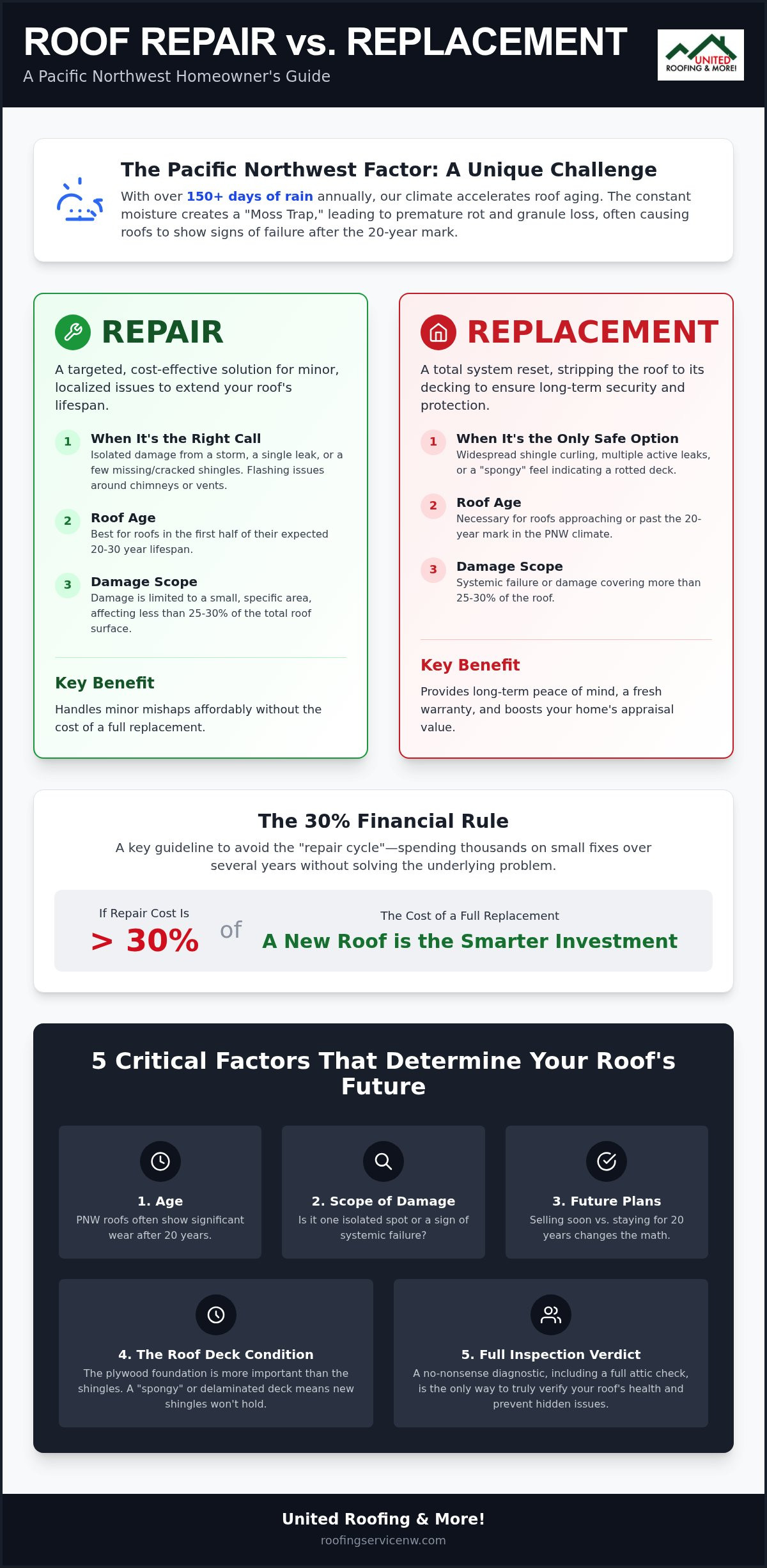
Professionals often use the "25% Rule" to help homeowners decide. If damage or wear covers more than a quarter of your total roof surface, a repair is usually just a temporary bandage. At that point, the labor costs for multiple repairs often approach the cost of a full installation. Roof integrity is the system's ability to shed water effectively without allowing any moisture to intrude into your attic space. Whether your home features asphalt, metal, or other commercially available roofing materials, the goal remains the same: keeping your interior bone-dry during a PNW winter.
When a Quick Repair is the Right Call
A repair is the most cost-effective way to handle minor mishaps. It is the right choice when the damage is isolated to one small area. Perhaps a single fallen branch cracked a few shingles, or a wind gust pulled up a corner piece. If your roof is in the first half of its expected 20 to 30 year lifespan, a repair is a smart investment. We often find that flashing issues around chimneys or vents can be fixed quickly. As long as the water hasn't compromised the wooden deck underneath, a targeted fix will keep you protected for years to come.
When Replacement is the Only Safe Option
Sometimes, a repair is just throwing good money after bad. Replacement becomes the only safe option when you see widespread shingle curling or "clawing." This indicates the material has reached its limit. If you find multiple active leaks in different zones of your home, the system has failed. A "spongy" feel when walking on the roof is another major red flag. This usually means the underlying decking is rotted and can no longer hold nails or support weight. We offer flexible roofing financing for every project size to take the sting out of these big decisions and ensure your home stays safe.
Five Critical Factors That Determine Your Roof's Future
Choosing between a patch and a full installation requires looking at five specific data points. This roof repair vs replacement guide breaks down the math so you aren't left guessing about your home's safety. Age is your first indicator. In the Pacific Northwest, most asphalt shingle systems start to fail after the 20-year mark. The constant rain and freeze-thaw cycles simply wear down the granules faster than in drier climates. If your roof is approaching two decades, a repair is often just a temporary fix.
Look at the scope of the damage next. Is the problem isolated to a single slope or a specific valley? If the rest of the structure is healthy, a repair is viable. If you see signs of failure across multiple sections, you're looking at a systemic issue. Your future plans matter just as much as the shingles. If you're selling your home next year, a professional repair might be enough to satisfy a buyer's inspection. If you plan to stay for twenty years, a full replacement provides long-term peace of mind and avoids recurring costs.
Use the 30% rule for a clear financial verdict. If the cost of a repair exceeds 30% of what a full replacement would cost, it's rarely a good investment. You're better off putting that money toward a new system that comes with a fresh warranty. This prevents the "repair cycle" where you spend thousands on small fixes over several years without ever solving the underlying problem.
Evaluating the Condition of the Roof Deck
The plywood decking is the literal foundation of your roof. It's actually more important than the shingles themselves. We often see "delamination," where the layers of plywood separate because of trapped attic moisture. This happens when heat and dampness can't escape the house. Nailing new shingles into rotted or soft wood is a wasted investment. The nails won't hold, and the system will fail during the next big storm. A solid deck is the only way to ensure your roof lasts its full intended lifespan.
Local Building Codes and Safety Standards
Washington state building codes have strict rules about "re-roofing" versus a full "tear-off." In many cases, you cannot simply add a second layer of shingles if the weight exceeds structural limits. Adhering to master roofing standards is essential for maintaining your home's resale value. Additionally, 2026 energy codes mandate specific attic ventilation ratios. Proper airflow prevents the very rot that forces early replacements. If you're unsure where your home stands, our team can provide a transparent roof assessment to guide your next steps.
The Pacific Northwest Factor: Why Our Climate Shortens the Clock
Living in the PNW means your roof faces unique environmental stress. This roof repair vs replacement guide wouldn't be complete without discussing our 150 plus days of annual rain. With over 35 inches of precipitation falling every year, the constant cycle of saturation accelerates shingle erosion significantly. It isn't just the volume of water; it's the total lack of drying time. In cities like Everett and Renton, minor leaks don't stay minor for long. They quickly evolve into structural rot because the moisture never truly evaporates between storms.
Coastal Washington winds add another layer of complexity to your home's defense. These gusts put immense pressure on your roof drip edges, which serve as the final guard against water intrusion. If your drip edge is compromised, water will find its way behind your gutters and into your fascia boards. This is why we emphasize local expertise. A roof built for a dry climate won't survive a single season in our backyard. We focus on building systems that handle the heavy lifting of our local weather.
Moss Growth and Shingle Degradation
Moss is the silent killer of roofs in our region. It creates a "moss trap" by soaking up water like a heavy sponge and holding it directly against your shingles. As the moss grows, it physically lifts the edges of the shingles. This allows water to travel "uphill" through capillary action, bypassing the protective overlap of the shingle layers. Cleaning a very old roof can actually be dangerous for your home's integrity. The moss roots often penetrate deep into the asphalt matting. Removing the moss can rip away the remaining granules, causing more leaks than it solves. We always recommend preventative maintenance, but if the roots have already compromised the asphalt, a reactive replacement is usually the only way to restore your safety.
The Impact of Poor Attic Ventilation in the PNW
Ventilation is just as important as the shingles themselves. Without proper airflow, trapped heat "cooks" your shingles from the inside out, even during our milder summers. This makes them brittle and prone to cracking. There is a direct relationship between calculating roof pitch and designing a ventilation system that actually works. Steeper roofs often require different vent placements to move air effectively. Many homeowners also mistake attic condensation for a roof leak. If your attic isn't breathing, warm air from your home will hit the cold underside of the roof and turn into water droplets. This "phantom leak" is a ventilation problem, not a shingle problem. We help you identify the real cause so you don't spend money on unnecessary repairs.
The Financial Math: Comparing Short-Term Fixes vs. Long-Term Value
Stop throwing good money after bad. This roof repair vs replacement guide helps you see the long-term financial picture beyond today's price tag. Many homeowners fall into the "Repair Cycle" trap. They spend $1,000 every autumn to patch a new leak. After four years, they've spent $4,000 on a failing system. That money could have been a significant down payment on a permanent solution. In the competitive Seattle market, a new roof installation significantly boosts your home's appraisal value. it removes the largest "red flag" for potential buyers and provides a much faster path to closing.
Insurance coverage is another critical variable. If a windstorm or fallen branch damages your home, insurance may cover the cost of a professional repair. However, they rarely pay for age-related wear or moss damage. If your shingles are simply timed out, the bill is on you. We hear it all the time: "I just can't afford a new roof right now." We understand that stress. That's why we prioritize financial transparency and offer solutions that fit your actual budget. You shouldn't have to choose between your savings account and a dry living room.
Roofing Financing: Making Quality Affordable
We offer flexible roofing financing for Marysville homeowners. This changes the math entirely. A major repair can be a huge hit to a monthly budget if paid in one lump sum. In contrast, a full replacement with low monthly payments is often more manageable. You get a brand-new system, a fresh warranty, and total peace of mind. No more staring at the ceiling every time the wind picks up. That emotional ROI is worth every penny for busy PNW families.
Energy Savings and Tax Credits
A full roof replacement is an investment in your home's thermal efficiency. In 2026, new tax credits and incentives make high-efficiency materials more attractive than ever. Homeowners in Sammamish and Bellevue are seeing lower summer cooling costs by switching to "cool roof" technology that reflects solar heat. You also benefit from massive warranty upgrades. A repair might only have a one-year labor warranty. A full installation often carries 50-year material coverage. If you are ready to stop the leaks for good, explore our flexible payment plans and secure your home today.
Getting the Verdict: United Roofing & More! Inspection Process
Finding the right answer for your home shouldn't feel like a guessing game. We provide a no-nonsense diagnostic that puts the power back in your hands. This roof repair vs replacement guide works best when paired with a professional, local eye. We don't just glance at your shingles from the driveway and hand you a bill. Our team provides a detailed, written report filled with photo evidence of every issue we find. You see exactly what we see. If a targeted repair can safely extend your roof's life, we will tell you. We are your neighbors, and we value long-term community trust over a high-pressure sales pitch.
Our commitment to transparency means you get the full story. We lead with our professional credentials and a "no-nonsense" approach. We believe in keeping you informed throughout the entire service process. You deserve to know the state of your investment without the stress of being upsold. If it can be fixed, we fix it. If it needs a reset, we show you why. This clarity is our core promise to every homeowner we serve in the Pacific Northwest.
Step 1: The Comprehensive Exterior and Interior Audit
We start with a total system audit that goes beyond the surface. Most companies stop at the roofline. We go into the attic to see the truth. We look for "shiners," which are nails that missed the rafters and now act as conduits for frost and moisture. These tiny points often lead to major rot if they aren't caught early. Our experts check the flashing around your chimney and every penetration point for signs of water entry. We pay close attention to the valleys where water flow is heaviest. We even measure moisture levels in your insulation. If your insulation is damp, your roof's ability to shed water has already failed. This interior check is the only way to truly verify your home's safety.
Step 2: Custom Solution and Financing Review
After the audit, we review your options together. We never push a full roof installation if a repair is the better financial choice for your situation. We present custom solutions based on your home's unique needs and your future plans. This includes a full review of our flexible roofing financing options. We make sure the numbers work for your monthly budget. Whether you need a minor leak fix or a complete system replacement, we offer payment plans that keep your savings intact. We then schedule the work to beat the next big storm. Protecting your family is our top priority. We stay in constant communication so you always know the status of your project. Let's get your home ready for the next rainy season together.
Secure Your Home's Future Before the Next Storm
Your home is your most significant investment. This roof repair vs replacement guide has shown that waiting for a visible leak often costs more than acting today. We've explored how the Pacific Northwest climate accelerates wear through moss growth and constant saturation. You now have the tools to understand the "30 percent rule" and the importance of a healthy roof deck. Don't let the fear of high costs or high-pressure sales keep you from protecting your family. We specialize in expert roof repairs and full replacements throughout Marysville, Seattle, and the entire PNW.
Our team is here to provide the clarity and transparency you deserve. We offer flexible roofing financing options to ensure a safe home is accessible for every budget. Whether you need a simple patch or a complete system reset, we lead with honesty and professional proficiency. Take the first step toward total peace of mind and stop the repair cycle for good. Get Your No-Nonsense Roof Inspection & Financing Quote Today! We're ready to help you safeguard your home for years to come.
Frequently Asked Questions
How long does a typical roof repair last compared to a replacement?
A professional repair typically buys you one to five years of additional life. It depends entirely on the condition of the surrounding shingles and the severity of the initial damage. A full roof replacement is a long-term protection investment that lasts 20 to 50 years. We help you use this roof repair vs replacement guide to decide if a patch is a smart move or a wasted expense for your specific home.
Does a single leak always mean I need a full roof replacement?
No, a single leak does not automatically require a new roof. If the leak comes from a localized issue like a cracked vent pipe or a missing shingle, a repair is usually sufficient. We recommend a full replacement only when the damage is systemic or the roof has reached the end of its functional life. Our goal is to provide a no-nonsense diagnostic that saves you money while keeping your family dry.
Is it cheaper to just shingle over my existing roof?
Shingling over an old roof might save money today, but it often costs more in the long run. Adding a second layer traps heat and can shorten the life of the new shingles. It also prevents us from inspecting the decking for rot or structural failure. Washington building codes have specific weight limits for multiple layers. A full tear-off is almost always the better investment for your home's long-term integrity.
How much does moss growth actually affect the need for replacement?
Moss is a major factor in roof failure throughout the Pacific Northwest. It acts like a sponge, holding moisture against the shingles and allowing water to travel uphill. If moss roots have penetrated the asphalt matting, cleaning the roof can cause even more damage. In these cases, a full replacement is often the only way to ensure your home remains safe. Regular maintenance is the best way to avoid this costly scenario.
Can I get financing for a major roof repair, or only for a full replacement?
We offer flexible roofing financing for projects of all sizes. You don't have to wait for a full replacement to access affordable payment plans. If a major repair is necessary to maintain your home's integrity, we can help you find a monthly payment that fits your budget. Our commitment to financial accessibility ensures you never have to delay essential maintenance because of a lump-sum price tag.
What is the average lifespan of an asphalt shingle roof in the Seattle area?
In the Seattle area, most asphalt roofs last between 20 and 25 years. While manufacturers might advertise longer lifespans, our constant moisture and moss growth shorten the actual clock. Regular maintenance can extend this timeframe, but homeowners should start planning for a replacement once their roof hits the two-decade mark. Our local climate is simply tougher on materials than other regions across the country.
Will my homeowners insurance cover a roof replacement due to age?
Standard homeowners insurance policies do not cover roof replacement due to age or general wear and tear. Insurance is designed to cover sudden, accidental damage from events like windstorms or fallen trees. If your roof is simply old and failing, the cost of replacement is typically the homeowner's responsibility. We can help you navigate the process and provide the documentation you need if storm damage is actually present.
How do I know if my roof decking is rotted without tearing off shingles?
You can often spot rotted decking by looking for specific red flags. A "spongy" feel when walking on the roof is a clear indicator that the wood underneath has softened. You can also check your attic for dark water stains, mold growth, or sagging between the rafters. If you notice these signs, it is critical to get a professional inspection. Catching rot early can save you thousands in structural repairs later on.

