
What if your biggest home investment is actually a ticking time bomb because of a few missed nails? In our damp Pacific Northwest climate, the difference between a roof that lasts thirty years and one that leaks in five comes down to strict roofing workmanship standards. It's natural to feel anxious about hiring the right contractor, especially when you're facing the significant costs of a roof replacement. You want a system that stands up to atmospheric rivers and heavy moss, not a "fly-by-night" job that fails when the rain hits. We believe quality should always be accessible, which is why we focus on clear communication and flexible roofing financing.
We know that technical jargon and conflicting advice can feel overwhelming. You need a partner who prioritizes your peace of mind through transparency and professional expertise. This guide teaches you how to spot expert craftsmanship and ensure your home meets the latest 2026 industry requirements. You'll get a clear inspection checklist to use on-site, a better understanding of how workmanship affects your warranty, and the confidence that your investment is fully protected.
Key Takeaways
- Learn the technical details of precision nailing and starter shingles that prevent wind uplift during severe PNW storms.
- Discover the "hidden" requirements for underlayment and ventilation that act as a vital second skin for your home.
- Ensure your project complies with the latest 2026 Washington State Building Code updates for Snohomish and King Counties.
- Master the roofing workmanship standards needed to verify that your contractor is delivering a durable, high-quality installation.
- Understand the vital difference between material and workmanship warranties to safeguard your long-term investment.
Defining Modern Roofing Workmanship Standards in 2026
Workmanship standards are the technical blueprints for your home's protection. They aren't just suggestions or "good ideas" from a contractor. Instead, they represent the specific methods, tolerances, and installation sequences required to keep your interior dry. In 2026, roofing workmanship standards have become more rigorous than ever. This is especially true in the Pacific Northwest, where atmospheric rivers and constant moisture test every single shingle. If these standards aren't met, your roof is essentially a collection of expensive parts rather than a functional shield. Precision is the only way to ensure your investment survives the next decade of storms.
The Three Pillars of Roofing Quality
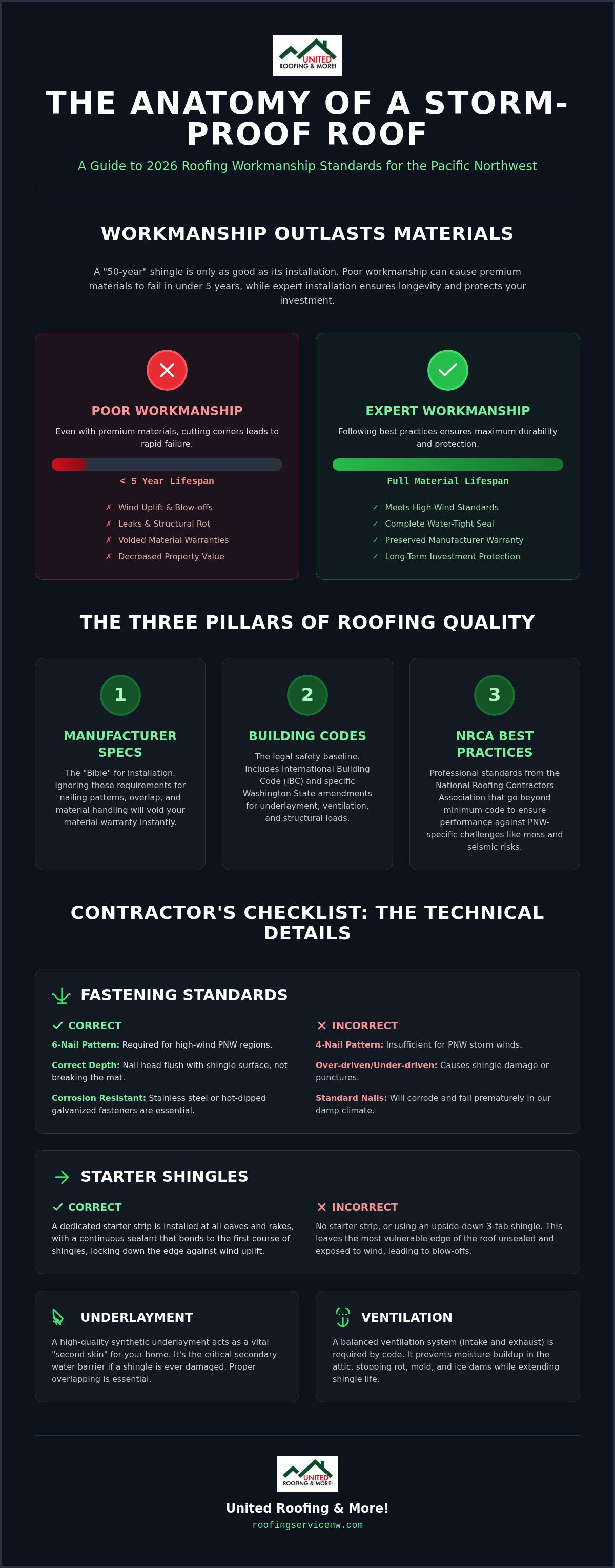
True quality relies on three distinct layers of oversight. First, manufacturer specifications act as the "Bible" for any project. Every shingle or metal panel brand has exact requirements for nailing patterns and overlapping. If a contractor ignores these, the manufacturer will likely void your material warranty. Second, the International Building Code (IBC) and Washington State amendments provide a legal safety baseline. As of 2026, we're operating under updated codes that mandate specific underlayment and ventilation practices. Finally, the National Roofing Contractors Association (NRCA) provides professional standards for domestic roof construction that go far beyond the bare legal minimum. These best practices ensure your roof can handle the unique pressures of Snohomish and King Counties. Minimum building codes are designed for general safety, but they don't always account for the relentless dampness of the PNW. High-quality standards mean accounting for moss growth and seismic risks specific to our region.
Why Workmanship Outlasts Materials
A "50-year" shingle is only a 50-year shingle if it's installed correctly. We've seen premium materials fail in less than five years because a "fly-by-night" crew cut corners on flashing or used the wrong nail depth. Poor installation leads to leaks, structural rot, and expensive rework. Cutting corners might save a few dollars today, but it destroys your property value over time. At United Roofing & More!, we don't just meet the minimum code. We exceed it. We prioritize transparency and open dialogue throughout the entire roof installation process. Every roof replacement or roof installation we perform is built to last. We also offer dedicated roofing financing to ensure these high standards are affordable for every local family. You deserve a roof that lasts, and that starts with a commitment to excellence. We keep you informed at every step, ensuring you have total peace of mind.
The Technical Anatomy of High-Quality Roof Installation
A roof is only as strong as its smallest components. While shingles are the most visible part of your home, the technical execution of the installation determines if the system actually works. High-quality roofing workmanship standards focus on the "anatomy" of the roof, ensuring every nail and piece of flashing is placed with surgical precision. This is not just about aesthetics. It is about creating a structural barrier that survives the punishing rains of the Pacific Northwest. When these technical details are ignored, even the most expensive materials will fail long before their time.
Fastening Standards: More Than Just Nails
Nail placement is the most common area where contractors cut corners. In high-wind regions like Snohomish County, a standard 4-nail approach is often insufficient. Professional standards frequently require a 6-nail pattern to prevent shingles from blowing off during a winter storm. The angle and depth of these fasteners are equally critical. Over-driven nails can cut through the shingle mat, while under-driven nails create "high nails" that eventually puncture the layer above them. Because we live in the Seattle area, salt air and constant moisture make stainless steel or hot-dipped galvanized fasteners non-negotiable to prevent premature corrosion. These requirements are grounded in national model building codes that set the baseline for safety and performance.
Starter shingles are another vital component often overlooked by "fly-by-night" crews. These are the first line of defense at the eaves and rakes. Without a properly installed starter strip, wind can easily get under the first course of shingles and peel the entire roof back. We ensure every edge is secured to withstand PNW wind uplift, protecting your home and your long-term budget. It is a simple step that makes a massive difference in durability.
Flashing and Waterproofing Penetrations
Waterproofing the junctions where the roof meets a wall, chimney, or vent is the true test of a roofer's skill. We use step flashing for sloped walls, which involves overlapping individual pieces of metal with each shingle course. This ensures water is directed away from the wall and back onto the roof surface. Continuous flashing is reserved for horizontal transitions. In valleys, where water volume is highest, we choose between "closed" or "open" standards based on your specific roof pitch. Open valleys, often lined with metal, provide superior drainage for heavy debris and rainfall. Dead valleys, where water tends to pool, require specialized membranes to prevent structural rot. If you are worried about past leaks, our team can provide a thorough roof installation assessment to ensure these transitions are bulletproof. We prioritize transparency, showing you exactly how we seal every penetration to keep your attic dry and your manufacturer warranty valid.
Critical Hidden Standards: Underlayment and Ventilation
Your roof's survival depends on what you cannot see. While shingles provide the primary defense, the underlayment and ventilation systems act as the silent protectors of your home's structure. In 2026, roofing workmanship standards require a sophisticated, multi-layered approach to moisture management. If these hidden components are installed poorly, your new roof will fail. This often leads to structural rot and mold long before the shingles themselves wear out. We prioritize these "hidden" details to ensure your home remains a dry, safe sanctuary.
Advanced Underlayment Requirements
Standards have shifted away from traditional felt paper. Synthetic underlayment is now the preferred choice because it doesn't tear or absorb moisture. For many projects, especially those with lower slopes, specific overlap patterns are mandatory. According to Washington state public works law, the scope of professional roofing includes the precise application of these protective membranes. We also prioritize self-adhering polymer-modified bitumen (ASTM D1970) in critical areas like valleys and eaves to prevent ice damming. This "ice and water shield" is non-negotiable for high-quality PNW installations. Proper integration with the drip edge is also essential to keep water away from your fascia. You can learn more about The Essential Guard for Marysville Homes and how it fits into a complete system.
Mastering Attic Airflow
Proper ventilation is the lungs of your home. Without it, heat and moisture trap in your attic, effectively "baking" your shingles from the inside out. This heat damage causes premature granule loss and will void most manufacturer warranties. We follow the strict 1/300 rule. This means you need one square foot of net free vent area (NFVA) for every 300 square feet of attic floor space. It's a delicate balance between intake at the soffits and exhaust at the ridge. While box vents are common, ridge vents often provide more consistent airflow in our climate. United Roofing & More! provides a full diagnostic of your current airflow to ensure your investment stays protected. We offer flexible roofing financing to make sure these critical upgrades don't strain your budget. Our goal is transparency. We want you to understand exactly how your roof breathes.
Local Compliance: Washington State Codes & PNW Standards
Building codes are not just red tape. In Washington, they are a vital safeguard against our unique environmental challenges. As of August 2026, the Washington State Building Code Council is finalizing the adoption of the latest 2024 codes. This means roofing workmanship standards must now account for stricter moisture barriers and structural fastening than ever before. If your contractor isn't talking about the latest WAC updates, they aren't prepared to protect your home. Local compliance is the only way to ensure your roof replacement passes a city inspection and stands up to the next atmospheric river.
Wind load requirements are particularly strict in coastal and elevated areas of Snohomish and King Counties. A roof installed in Everett or Kirkland must withstand different pressure than one in a sheltered valley. We also prioritize materials with high algae resistance. In our damp climate, moss isn't just an eyesore; it's a structural threat that can lift shingles and trap water. Proper permitting is also non-negotiable. Most full replacements require a permit, which typically costs between $150 and $600 depending on your city. This fee pays for an official inspection, which is your final guarantee that the work meets legal safety benchmarks.
Seattle and Marysville Specific Requirements
Navigating codes in Renton, Everett, or Kirkland requires local experience. For older PNW homes, seismic strapping and structural reinforcements are often necessary to bring the roof up to modern standards. We also carefully monitor installation windows. Trapping moisture under new shingles during a rainy week can lead to mold and rot. We wait for the right weather to ensure a dry, secure seal. This attention to detail prevents "baked" roofs and structural damage.
The Importance of Certified Local Contractors
Out-of-state "storm chasers" rarely understand the nuances of Washington's building environment. They often fail local workmanship audits because they use generic techniques that don't apply to our rain-heavy region. You can learn more about how we Master Roofing Standards in Marysville & Seattle to provide superior protection. Always verify a contractor’s standing with the Washington Department of Labor & Industries (L&I) before signing a contract. This ensures they are licensed, bonded, and insured. If you are ready for a compliant, high-quality installation, request a professional roof replacement quote from our local team today. We prioritize transparency and keep you informed throughout the entire process.
Securing Quality: How to Hire and Finance Standard-Setting Work
Hiring a contractor shouldn't feel like a gamble. You can spot red flags before a single nail is driven into your deck. If a roofing estimate is vague or only lists a total price, it's a warning sign. A professional quote must detail the specific installation methods the crew will use. It should mention the starter shingles, the underlayment overlap, and the flashing types we discussed in previous sections. High roofing workmanship standards require a detailed plan. If the price seems too good to be true, the contractor is likely cutting corners on labor or safety. We believe in total transparency from the first handshake to the final inspection.
Understanding your protection is equally critical. Don't confuse a material warranty with a workmanship warranty. A material warranty covers the shingles if they are defective from the factory. However, a workmanship warranty covers the actual installation. Since most roof failures in the Pacific Northwest are caused by poor labor rather than bad materials, the workmanship guarantee is your most important shield. Adhering to premium roofing workmanship standards is a long-term financial win. It protects your property value and prevents the high cost of structural rot repairs down the road.
Vetting Your Contractor for Standards
Ask for a written "Scope of Work" before the project begins. This document should list every material and specific installation technique. We also recommend a pre-installation meeting. Use this time to discuss how the crew will handle complex junctions like chimneys and valleys. It's the best way to ensure everyone is on the same page regarding ventilation and moisture barriers. For more help navigating the process, read The Complete Local Guide to Roof Replacement. It provides a roadmap for homeowners who value quality over shortcuts.
Making Superior Workmanship Affordable
Quality work has a higher upfront cost because it requires skilled labor and premium components. We understand this can cause anxiety. You don't have to choose between a "cheap" roof and a "correct" one. We offer flexible payment plans designed for high-durability roofing systems. Our Roofing Financing options protect your savings while securing your home. These plans bridge the gap, making standard-compliant work accessible for every budget. United Roofing & More! is your partner for honest, expert service. We lead with our professional credentials and a commitment to keeping you informed. Let's ensure your investment is protected for decades to come.
Protect Your PNW Home with Standard-Compliant Quality
Your roof is your home's first line of defense against relentless Pacific Northwest weather. We've explored how technical precision in nailing and flashing creates a durable system. You now know that hidden details like ventilation and underlayment are just as vital as the shingles themselves. Most importantly, you understand that roofing workmanship standards are the key to maintaining your warranty and protecting your property value. Don't settle for "minimum code" when your home deserves superior protection.
United Roofing & More! is here to help you navigate these complex requirements. We specialize in expert roof repairs that restore structural integrity and full replacements built to last. We proudly serve Seattle, Marysville, and the Greater PNW with a commitment to transparency. Our team offers accessible roofing financing options to make sure high-quality work fits your budget. Ready to secure your investment? Get a Professional Roof Inspection and Standard-Compliant Quote today. We look forward to partnering with you for a safer, drier home.
Frequently Asked Questions
What is the most important workmanship standard for a new roof?
Proper moisture management is the most critical standard for any installation. This includes the precise application of underlayment and metal flashing at every roof junction. In the Pacific Northwest, water is the primary threat to your home's structural integrity. A roof that sheds water effectively will always outlast one with premium materials but poor sealing. We prioritize these details to ensure your home remains dry during intense atmospheric rivers.
How can I tell if my roofer is following manufacturer standards?
You can verify compliance by requesting the specific brand's installation guide before work begins. Check that the crew uses the exact nailing pattern and underlayment overlap required by that manufacturer. Most brands provide these technical guides online for public view. Following these roofing workmanship standards is the only way to keep your material warranty valid and your investment protected.
Does the Washington State building code require a drip edge?
Yes, the current Washington State Building Code requires a drip edge at both eaves and gables. This metal flashing is vital because it directs water into the gutters and protects the underlying fascia from rot. It is a mandatory safety baseline for all new roof installations in Snohomish and King Counties. We never skip this step because it's essential for long-term durability in our damp climate.
Will poor workmanship void my shingle warranty?
Yes, poor installation is the fastest way to void a manufacturer's shingle warranty. Manufacturers only guarantee their products if they are installed according to their exact technical specifications. If a leak occurs because of a missed nail or improper flashing, the manufacturer will likely deny your claim. This is why hiring a reliable, hardworking local expert is so important for your peace of mind.
How many nails should be in each roofing shingle?
Standard shingles usually require four nails, but high-wind zones in the PNW often mandate a six-nail pattern. The nails must be driven straight and at the correct depth to be effective. Over-driven nails can slice through the shingle mat, while under-driven nails cause punctures from the layer above. We always use the specific pattern that best protects your home from local wind uplift.
What is the "standard" warranty for roofing workmanship in 2026?
A standard workmanship warranty in 2026 typically ranges from two to ten years depending on the contractor. This is separate from the shingle manufacturer's warranty, which covers product defects. Premium contractors often provide longer terms to prove their confidence in their crew's proficiency. Always ensure your workmanship guarantee is provided in writing before the first shingle is laid.
How does attic ventilation affect roofing standards?
Attic ventilation is a foundational roofing standard because it regulates temperature and moisture levels. Without the proper 1/300 intake-to-exhaust ratio, shingles can overheat and fail prematurely. Poor ventilation causes "baked" shingles and structural rot, which are common reasons for warranty denials. We provide a full diagnostic of your attic's airflow during every professional inspection to ensure your system breathes correctly.
Can I get financing for a roof that exceeds minimum quality standards?
Yes, you can absolutely get roofing financing for high-quality installations that go beyond the bare legal minimum. We offer flexible payment plans that make it easy to afford premium materials and superior labor. This allows you to invest in a roof that exceeds current building codes without draining your savings. Our goal is to make professional roofing workmanship standards accessible to every family in our community.

