

What if the most dangerous threat to your home isn't the shingle you see on the grass, but the moisture you can't see at all? In the Pacific Northwest, storm damage is often a slow burn. Our heavy rains and damp seasons mean a tiny leak can quickly lead to rotted decking or mold before you even notice a drip. Learning how to spot storm damage on your roof is the first step in protecting your home and your budget. You shouldn't have to guess about the safety of your structure or feel overwhelmed by the technical jargon of insurance claims.
We know that roof issues bring up fears of high costs and safety concerns. You don't need to climb a ladder to get the clarity you deserve. This guide will walk you through the specific signs of damage to look for from the safety of the ground. You'll learn how to tell the difference between a simple repair and a necessary roof replacement. We also show you how to find a local partner who offers transparent estimates and flexible roofing financing. Let's take the stress out of the process and ensure your home stays dry and secure through 2026 and beyond.
Key Takeaways
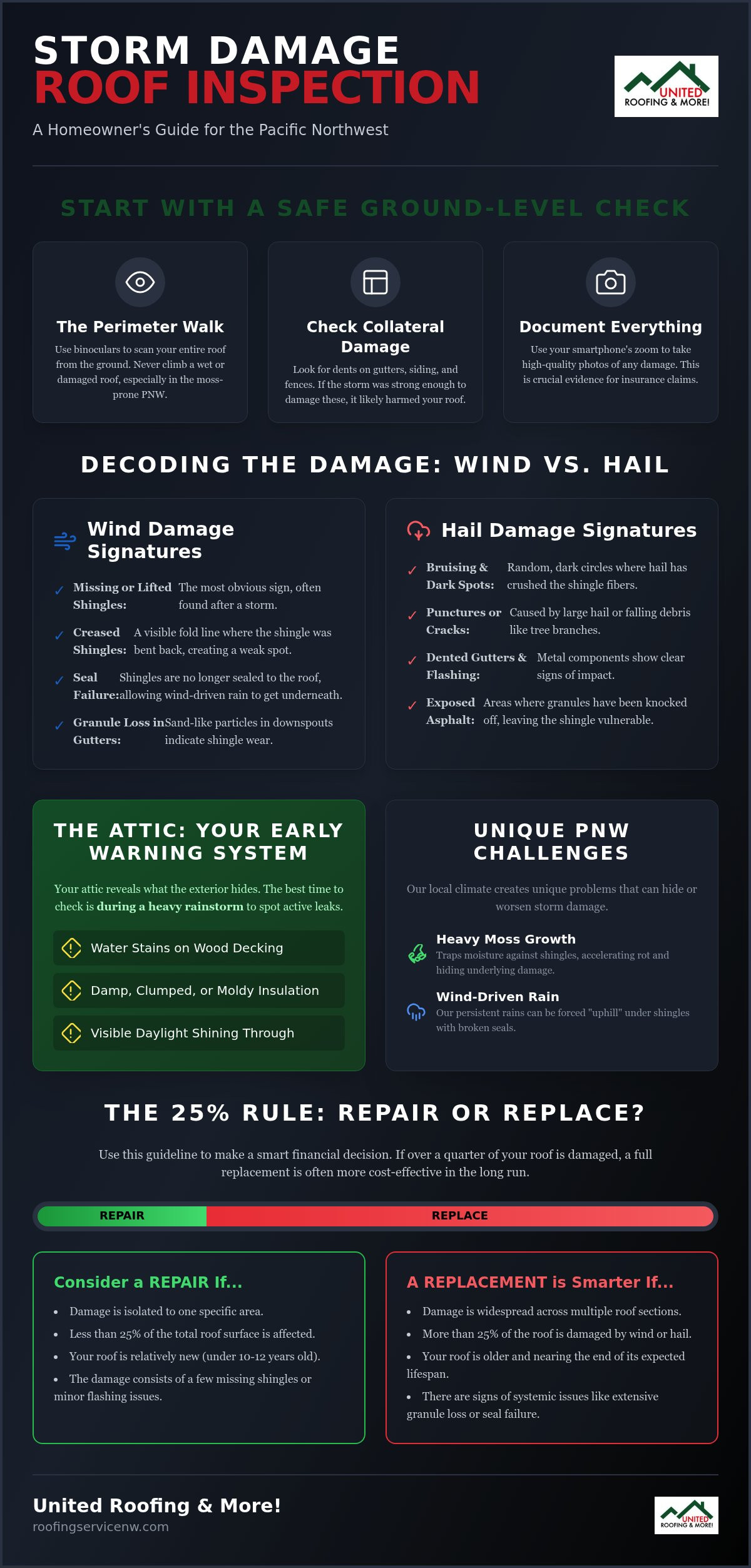
- Perform a safe "perimeter walk" with binoculars to identify exterior issues without ever leaving the ground or using a ladder.
- Learn exactly how to spot storm damage on your roof by identifying the unique signatures of wind-blown shingles versus hail impacts.
- Discover why your attic is the ultimate early warning system and how to catch active leaks during a heavy Pacific Northwest rainstorm.
- Understand how local challenges like moss and wind-driven rain can hide structural damage or push moisture deep into your roof's layers.
- Master the "25% Rule" to determine if a simple roof repair is enough or if a full roof replacement is the smarter long-term financial choice.
Immediate Post-Storm Safety and Ground-Level Inspection
Safety must be your first priority after a storm hits the Seattle or Marysville area. Never walk on a wet or potentially damaged roof. PNW roofs often harbor moss and algae, which become incredibly slick when damp. A single slip could lead to a serious injury. Instead of risking a fall, keep your feet firmly on the ground. You can still perform a thorough check to understand how to spot storm damage on your roof without ever touching a ladder.
Start by grabbing a pair of binoculars and performing a slow "perimeter walk" around your entire property. Look beyond the shingles themselves. Check for "collateral damage" on your siding, fences, and even your mailbox. If a storm was strong enough to dent your metal gutters or crack a vinyl fence, it likely caused structural issues on your roof as well. Document every sign of impact with high-quality photos. These images serve as vital evidence for insurance claims and help your roofing contractor provide a more accurate estimate. Clear documentation makes the entire restoration process smoother and less stressful.
The 360-Degree Ground Walk
As you circle your home, pay close attention to your drainage system. Look for shingle "crumbs" or granules piling up in your downspouts. These small, sand-like particles are the protective layer of your shingles. When they wash away, your roof loses its ability to resist UV rays and water. Identify any dented or hanging gutters that suggest heavy debris or hail impact. You should also scan the roofline for metal flashing that has pulled away from chimneys or dormers. Exposed gaps in these areas are common entry points for the heavy PNW rain. Small gaps today lead to big leaks tomorrow.
Using Technology for Safety
Your smartphone is a powerful tool for a safe inspection. Use the zoom lens to get a close-up view of high-altitude shingle cracks or "bruising." Bruising looks like dark, round spots where hail has crushed the shingle fibers. You should also watch for "lifting" shingles. These are shingles that haven't blown off completely but are no longer sealed to the roof. High winds can break the adhesive bond, allowing water to be pushed "uphill" during the next rainstorm. Identifying these subtle signs early helps you decide if you need simple roof repairs or a full roof replacement. Our team at United Roofing & More! is ready to help you navigate these findings with transparent dialogue and accessible roofing financing options to keep your home protected.
Identifying Common Storm Damage Signatures: Wind vs. Hail
Understanding how to spot storm damage on your roof requires a keen eye for detail. Wind and hail leave very different fingerprints on your property. While wind often tears or lifts materials, hail acts like a hammer, bruising the shingle surface and weakening its structural integrity. You need to know which one you're dealing with to handle insurance claims effectively and ensure your home remains watertight. Our PNW weather often delivers both during a single event, making a thorough inspection essential.
Falling debris is another major factor in our region. Look for deep scratches, punctures, or cracked shingles caused by falling branches. A single puncture from a heavy limb can lead to a significant leak during a typical Seattle downpour. Even if you don't see a hole, a heavy impact can crack the underlying shingle matting, creating a hidden path for water to enter your home. Documenting these specific impact points is the first step in a successful restoration process.
Spotting High-Wind Red Flags
High winds in the Seattle corridor often target the most vulnerable parts of your roof. Start your inspection at the peaks and edges where wind pressure is most intense. Look for "crease lines." These occur when a shingle tab is folded back by a gust, snapping the internal fiberglass matting. Even if the shingle looks flat now, that crease is a permanent failure point. You should also examine the roof drip edge for any signs of uplift or bending. If the wind has pulled the metal away, your fascia and decking are now exposed to moisture and rot.
Sometimes, wind damage is invisible to the untrained eye. This is known as "seal failure." The shingle is still present, but the adhesive strip has broken. If shingles feel loose or appear to "flutter" in a light breeze, the seal is gone. Once the bond is broken, your roof is defenseless against wind-driven rain.
The Subtle Signs of Hail Impact
Hail damage creates random patterns of "pockmarks" or circular indentations across your roof. These impacts knock off the protective granules, exposing the black asphalt underneath. In some cases, you might see "shiny" spots on the shingles. This happens when the hail strike is so fresh that the underlying bitumen is exposed but hasn't yet weathered. Check your soft metal components first. Vents, valleys, and chimney caps show dents much more clearly than shingles. If your vents look like they've been hit by a ball-peen hammer, your shingles are likely damaged too.
Don't confuse hail hits with "blistering." Blisters are small, popped bubbles caused by poor attic ventilation and age. Hail hits are usually accompanied by a loss of granules and a distinct bruise in the shingle matting. If you notice these signs, it's time to consult a local roofing expert who can provide a clear restoration plan. We focus on transparent dialogue and offer roofing financing to ensure your repairs don't wait until the next storm hits.
Interior Red Flags: Spotting Hidden Leaks in Your Attic
While the exterior signs discussed earlier are critical, the most accurate way to understand the health of your home is from the inside. Your attic serves as a vital early warning system for your entire property. Many homeowners wait for a massive ceiling stain to appear before they take action. By then, the structural damage is already extensive and expensive. Knowing how to spot storm damage on your roof involves checking the underside of your decking long before a puddle forms in your living room. A proactive internal check can save you thousands in avoided mold remediation and structural repairs.
The best time to perform this check is during a classic Pacific Northwest downpour. If it's safe to do so, head into the attic while the rain is still falling. This allows you to catch active drips that might dry up or evaporate before a contractor arrives. Bring a high-powered flashlight and scan the rafters. You should also turn off all attic lights to look for "daylight" peeking through the roof boards. If light can penetrate the barrier, water definitely can too. Pay close attention to your senses. Musty, earthy odors often precede visible water stains. These smells indicate that moisture is trapped in your insulation or wood, creating a breeding ground for mold.
The Ceiling and Wall Diagnostic
Start your internal inspection in the living areas directly below the attic. Identify "water rings" or bubbling paint, especially in the corners of rooms or along the top of the walls. These are classic signs of a leak that has traveled from the roof, down a rafter, and into your wall cavity. You should also check for dampness or discoloration around light fixtures and ceiling fans. Water often follows electrical wiring, which creates a significant fire hazard. Trace every stain back to its highest point to find the true source of the failure. Remember that the leak on your ceiling is rarely directly below the hole in your roof.
Attic Insulation and Rafter Health
Your attic insulation should be dry and fluffy to remain effective. Feel for matted, flat, or damp sections. Wet insulation loses its R-value quickly, which immediately drives up your heating and cooling costs. Next, look for dark streaks or "mold blooms" on the plywood decking. These are clear indicators of long-term moisture exposure from a storm-damaged seal. Inspect the areas around the chimney, skylights, and vent pipes. These roof penetrations are the most common spots for failure after a high-wind event. If you find these red flags, United Roofing & More! can provide a professional assessment. We focus on transparent dialogue and offer flexible roofing financing to help you manage roof repairs or a necessary roof replacement with total peace of mind.
The Pacific Northwest Factor: Moss, Ice Dams, and Heavy Rain
PNW homeowners face challenges that national roofing blogs simply don't understand. Our damp winters and long rainy seasons create a specific environment where minor issues become structural failures overnight. If you're wondering how to spot storm damage on your roof in Western Washington, you must look past the shingles. You have to consider our local climate factors. Moss, persistent drizzle, and the unique wind patterns of the Puget Sound Convergence Zone all play a role in how your roof ages and fails. We see these regional issues every day in cities like Seattle, Everett, and Marysville.
Moss is a primary culprit in our region. It acts like a giant sponge, holding moisture against your shingles long after the rain stops. During a high-wind event, those heavy, water-logged moss chunks can be ripped away by the wind. When they go, they often take the protective shingle granules with them. This leaves the underlying asphalt exposed and vulnerable to the next storm. Heavy saturation from our "Big Dark" months can also lead to visible sagging in older roof structures. The sheer weight of constant moisture puts immense pressure on your rafters and decking.
Why Moss Makes Storm Damage Worse
Hidden rot is a major concern for homes with significant growth. Thick moss blankets can hide cracked or missing shingles, making a ground-level inspection difficult. Even worse, moss physically expands during our winter freeze cycles. This expansion lifts the shingle edges, breaking the adhesive seal and allowing wind-driven rain to push water "uphill" under the tabs. Once water gets under the shingle, it has a direct path to your roof deck.
Regional Weather Patterns
The weather in the Seattle-Everett corridor is notoriously unpredictable. The Puget Sound Convergence Zone can dump heavy rain and localized wind in one neighborhood while leaving another dry. Constant drizzle might seem harmless, but it keeps your roof in a state of permanent saturation. Sudden downpours then exploit these weaknesses. In Everett and Marysville, we also see ice dams where melting snow refreezes at the eaves. This causes water to back up into the soffits and wall cavities, leading to mold and rot.
Don't wait for a major leak to address these regional issues. If you suspect your roof has been compromised by recent weather, we are here to help. We provide expert roof repairs and full replacements with transparent dialogue every step of the way. Schedule your professional inspection today to ensure your home is ready for the next cycle of storms. We offer accessible roofing financing to help lower the barrier to essential home protection.
From Detection to Restoration: Repair vs. Replacement
Once you've learned how to spot storm damage on your roof, you face a critical decision. Should you patch the problem or invest in a full restoration? We use the "25% Rule" as a professional guide for homeowners in the Seattle-Everett corridor. If storm-related failures cover more than a quarter of your roof surface, localized repairs are rarely cost-effective. Patching an extensively damaged system often leads to a "whack-a-mole" situation where new leaks appear after every heavy PNW rain. A comprehensive approach ensures your home remains protected for the long haul.
Your roof's age plays a major role in this decision. Asphalt shingles have a finite lifespan. If your roof is already 15 or 20 years old, a storm can actually be a hidden opportunity. Rather than pouring money into a failing structure, you can leverage insurance coverage to upgrade your home. A modern master roofing installation provides superior wind resistance and moisture protection compared to older standards. This transition turns a stressful weather event into a long-term increase in your home's value and safety.
The Repair vs. Replace Framework
We believe in transparent dialogue to help you choose the right path. Minor issues are often perfect candidates for simple roof repairs. These include:
- Replacing a few missing shingle tabs in a single area.
- Fixing minor flashing leaks around a chimney or vent.
- Resealing small sections where the adhesive bond has lifted.
However, a full roof replacement is necessary when we identify widespread granule loss, multiple active leaks, or structural sagging. Widespread damage suggests the entire system has reached its breaking point. In these cases, roof installation is the only way to guarantee your peace of mind during the next "Big Dark" season.
Next Steps with United Roofing & More!
Taking the first step toward restoration shouldn't be stressful. We invite you to schedule a no-obligation professional storm damage assessment with our local experts. Our team helps you document every sign of impact to support your insurance claim with clear, photographic evidence. We act as your supportive partner throughout the entire process. To make the project even more accessible, we offer flexible roofing financing options. These plans are designed to fit your specific budget and timeline, ensuring you don't have to compromise on quality. Let's work together to restore your home's integrity with a "no-nonsense" approach that puts your family first.
Secure Your Home Against the Next PNW Storm
Your roof is the primary shield against the relentless weather of the Seattle-Everett corridor. You now have a professional framework for how to spot storm damage on your roof without ever leaving the ground. From identifying subtle hail bruises to catching active attic leaks during a downpour, these steps provide the clarity you need to move forward. Don't let moss or wind-driven rain compromise your home's structural integrity. Our locally owned and operated expert team is ready to help you navigate the restoration process with ease and total transparency.
We serve homeowners throughout Marysville, Seattle, and all of Snohomish County. Our goal is to lower the barrier to essential home protection through clear dialogue and supportive service. We offer flexible roofing financing to ensure your roof replacement or repair fits your budget perfectly. Take the guesswork out of your home's safety and secure your peace of mind today. Book Your Free Storm Damage Diagnostic with United Roofing & More! and ensure your home stays dry through every season.
Frequently Asked Questions
How long do I have to file a roof storm damage claim in Washington?
You typically have as little as one year from the date the loss occurred to file a lawsuit regarding a disputed claim in Washington. While many insurance policies require you to report damage within a "reasonable timeframe," state law allows policies to set a strict 12 month deadline for legal action. It is critical to document issues and contact your provider immediately after a storm to ensure you don't miss these narrow windows for coverage.
Can I spot hail damage on my roof from the ground?
Yes, you can often identify clear signs of hail impact from the safety of the ground by using binoculars or a high-quality smartphone zoom lens. Look for dark, circular pockmarks or "bruised" spots where the protective granules have been knocked away from the asphalt. Learning how to spot storm damage on your roof from a distance allows you to gather evidence for a claim without the safety risks of climbing a ladder.
My roof isn't leaking yet; do I still need an inspection after a storm?
Yes, because storm damage in the Pacific Northwest is frequently a "slow burn" that doesn't result in immediate dripping. High winds can break the adhesive seals on your shingles or crack the underlying matting without creating an obvious hole. A professional inspection identifies these hidden failures before the next rainy season turns them into expensive structural rot or mold growth inside your attic space.
Will my insurance company pay for a full roof replacement?
Insurance coverage for a full roof replacement depends on the severity of the damage and the specific language in your policy. Generally, if the damage is widespread or affects the structural integrity of the home, the company may cover a total replacement. We work closely with homeowners to provide detailed documentation and transparent dialogue, ensuring your insurance adjuster has all the facts needed to make a fair decision.
What happens if I ignore minor storm damage on my roof?
Ignoring minor issues like a few missing shingles or broken adhesive seals leads to rapid deterioration in our damp PNW climate. Small gaps allow moisture to seep into the wooden decking, which quickly triggers wood rot and mold. What starts as a simple repair can easily escalate into a mandatory, high-cost replacement if moisture is allowed to sit against the structure through a long winter.
How much does a typical roof repair cost after a storm in Seattle?
The cost for repairs in the Seattle-Everett corridor varies based on the severity of the storm impact and the specific materials required. Minor fixes like replacing shingle tabs are generally more affordable than moderate repairs involving underlayment or flashing. We provide clear, no-nonsense estimates for every project and offer flexible roofing financing options to help lower the barrier to entry for essential home restoration services.
Is it safe to use a drone to check my roof for damage?
Using a consumer drone is a safe and effective way to get a bird's-eye view of your property without any fall risks. However, standard drone cameras often miss subtle signs like shingle bruising or seal failures that a professional eye would catch during a hands-on diagnostic. A drone is an excellent tool for initial documentation, but it should be followed by a professional assessment to ensure total accuracy.
What is the difference between a roof leak and attic condensation?
A roof leak usually creates localized water stains or active drips that appear or worsen specifically during heavy rain events. Attic condensation is typically a widespread issue caused by poor ventilation trapping warm, moist air inside the home. If you notice damp insulation or mold blooms across the entire underside of your roof deck rather than in one specific spot, you likely have a ventilation problem rather than storm damage.


