
What if the most expensive part of your roof replacement isn't the shingles you choose, but the angle they sit at? It's a common realization for homeowners who face a sudden jump in their project estimates. Understanding how roof pitch affects roof replacement cost is the first step toward avoiding sticker shock and navigating your quote with clarity. You might feel confused by technical terms or worried about extra safety fees, but these costs are tied to the physical reality of your home's structure.
At United Roofing & More!, we believe in total transparency and open dialogue. We know that a steeper slope means more than just a different look; it changes the entire math of the job. In this article, you'll discover how your roof's steepness dictates material needs, labor safety requirements, and your total replacement budget. We provide a clear breakdown of the pitch-to-cost ratio and explain how to budget for a steep roof replacement without the stress. You'll gain the knowledge needed to choose a local expert who prioritizes both safety and your financial peace of mind.
Key Takeaways
- Learn how the "X/12" ratio measures steepness and why this technical detail is the foundation of your roofing estimate.
- Understand the "Multiplier Effect" where a steep pitch can require significantly more materials than a flat roof with the same footprint.
- Discover how roof pitch affects roof replacement cost through labor surcharges, specialized safety gear, and slower installation speeds on non-walkable slopes.
- Identify which pitch category your home falls into to anticipate whether you will face standard rates or a steep premium for complex geometry.
- Learn how United Roofing & More! uses flexible financing to make high-quality, safety-first roof replacement accessible for any home design.
Understanding Roof Pitch: The Rise and Run Basics
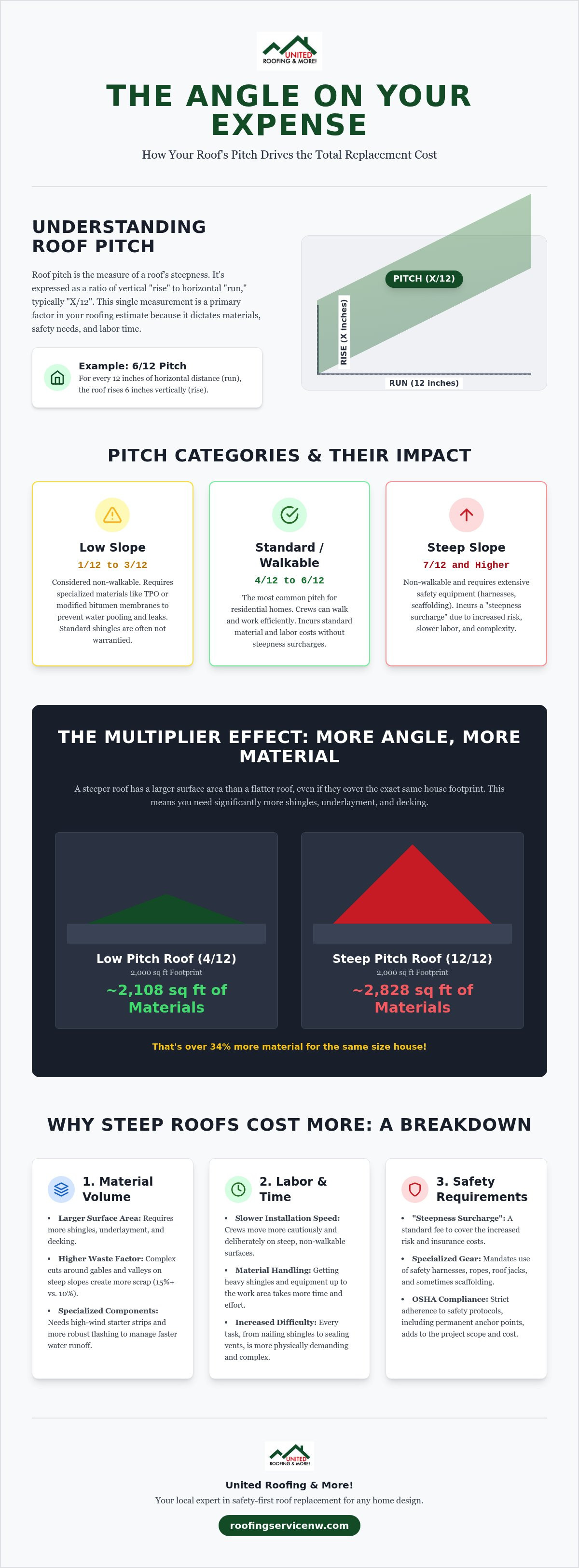
Roof pitch isn't just a design choice. It's a mathematical ratio that defines your home's profile and structural needs. Marysville roofing contractors use the "X/12" notation to describe this steepness. For every 12 horizontal inches, how many inches does the roof rise? A 6/12 pitch rises 6 inches for every foot of run. Understanding Roof Pitch helps you visualize how water moves off your home. In our rainy Pacific Northwest climate, a steeper pitch is a natural defense against leaks. It sheds water fast. Low-slope roofs, often found on modern additions or commercial buildings, need specialized membranes to stay dry. This technical detail is a primary reason how roof pitch affects roof replacement cost.
How to Determine Roof Pitch on Your Home
Your home's architectural style offers the first clue to its pitch. Ranch homes usually feature gentle slopes between 4/12 and 6/12. Victorian or Tudor homes often have steep, aggressive angles that can exceed 10/12. You can measure this yourself with a level and a tape measure in your attic. Press a 12-inch level horizontally against a rafter. Measure the vertical gap from the end of the level to the wood. This gives you your rise. While DIY methods are helpful for planning, they aren't perfect. Professional measurements are much more accurate for building a project budget. At United Roofing & More!, we use precision technology to ensure your estimate reflects the true geometry of your home.
Why Pitch is a Primary Factor in Your Quote
Pitch determines what materials we can actually install on your home. Asphalt shingles typically need a minimum slope to shed water effectively and maintain their warranty. If your pitch is too low, we must use specialized underlayment or different roofing systems like TPO or EPDM. Steeper roofs involve a "steepness surcharge" due to the increased difficulty of the work. Safety is our top priority. Steep projects require more equipment, such as harnesses and scaffolding, and specialized training for the crew. You can learn more in our guide on how to calculate roof pitch. Understanding these basics ensures you aren't surprised by how roof pitch affects roof replacement cost when you receive your professional quote.
Surface Area vs. Footprint: The Geometry of Material Costs
Most homeowners start by looking at their home's footprint. If you have a 2,000 square foot ranch, you might assume you need exactly 2,000 square feet of shingles. This is a mistake. The footprint is just the floor. The roof is the "lid" of your home, and as that lid gets steeper, the surface area expands. A 12/12 pitch adds roughly 40% more surface area compared to a flat roof covering the same space. This mathematical reality is a core reason how roof pitch affects roof replacement cost. You aren't just paying for the slope; you are paying for the physical materials required to cover that extra space.
The "Multiplier Effect" is a simple geometric truth that impacts every layer of your roof. As the angle increases, the rafters must be longer to reach the peak. This creates more surface area for every square foot of the home's interior. We use a pitch multiplier to calculate the actual number of roofing "squares" needed. A "square" in roofing terms is a 10-by-10-foot area. On a steep roof, your home might require 30 squares of shingles even if a flat roof would only need 20. This jump in material volume is often the biggest surprise on a quote.
Steep roofs also create a higher "Waste Factor." When we cut shingles to fit complex valleys, gables, and dormers on a steep slope, there is more scrap. We typically account for 10% to 15% waste on standard roofs, but steep, complex designs can push that higher. Understanding these geometric shifts is vital for seeing how roof pitch affects roof replacement cost. Because a steeper slope covers more physical area, it naturally requires a higher volume of OSB plywood and protective underlayment to fully deck the roof.
Materials Impact: Beyond Just Shingles
Steep slopes face higher wind loads. To protect your home, we use specialized high-wind starter strips and robust roof drip edges. These components are essential for Marysville homes. In addition to standard materials, steep pitches require extra flashing in valleys where water flows with more force. Following OSHA safety requirements, we also install more permanent anchoring points, which adds to the material list. These anchors ensure our team stays safe while delivering a high-quality installation.
The Hidden Cost of Ridge Caps and Hip Shingles
Steep roofs often feature more "linear" lines, such as hips and ridges. These areas require specialized ridge cap shingles. These aren't your standard shingles; they are thicker and designed to bend over the peak. Because steep roofs have more vertical distance, the length of these ridges often increases. This drives up the total material bill significantly. If you are unsure how your home's geometry impacts your budget, our team at United Roofing & More! can provide a detailed breakdown of these material multipliers. Pitch also changes how we install ventilation hardware, often requiring more specialized caps to prevent wind-driven rain from entering the attic.
Labor and Safety: How Slope Impacts Installation Speed
Pitch isn't just a number on a blueprint; it's a measure of gravity. In the roofing world, we categorize homes as "walkable" or "non-walkable." Typically, any slope at or above a 7/12 pitch is considered non-walkable. This means our crews cannot stand or move freely on the surface without specialized support. This threshold is a major driver in how roof pitch affects roof replacement cost. When a roof is too steep to walk, the "Slow-Down Factor" kicks in. Installation speed drops significantly. Every movement requires careful positioning and safety checks. Instead of laying shingles in a steady rhythm, installers must navigate ropes and harnesses, which reduces the total shingles laid per hour.
Staging a steep roof requires more than just a ladder. We use scaffolding, roof brackets, and "walk boards" to create stable work platforms. This extra equipment takes time to set up and move as the project progresses. Safety is non-negotiable for certified roofers who follow strict industry standards to protect both the crew and your property.
OSHA and Fall Protection Requirements
Washington state L&I and federal OSHA rules require specific fall protection for steep-slope work. We install temporary roof anchors and use high-grade safety harnesses for every team member. These systems must be moved constantly as we work across the deck. Because of these risks, "steep pay" is a standard industry practice. Specialized labor for high-pitch projects costs more because the work is physically demanding. It requires advanced training. Additionally, steep roofs carry higher insurance premiums for contractors. This is another hidden factor in how roof pitch affects roof replacement cost that homeowners should understand when reviewing quotes.
Material Handling and Logistics
Getting materials onto a steep roof is a major logistical challenge. While a conveyor truck can reach many roofs, a steep pitch makes "roof loading" dangerous. Bundles can slide off a 10/12 pitch if they aren't secured immediately. Often, our team must hand-carry heavy shingle bundles up the slope, which adds hours of manual labor. The tear-off process is equally difficult. Removing old shingles on a steep slope takes twice as long. We must control the debris to prevent it from sliding uncontrollably and damaging your landscaping. In the Pacific Northwest, we often deal with slick surfaces due to rain or moss. These local conditions make our safety protocols even more critical for a successful installation.
Breaking Down Cost Multipliers by Pitch Category
Pitch categories act as a roadmap for your project's budget. It's helpful to view these in three distinct brackets. First, low-pitch roofs (2/12 to 4/12) often present a paradox. While they are easier to walk on, they frequently cost more per square than standard slopes. This is because shingles aren't designed for standing water. At these low angles, water can back up under the shingles through capillary action. We must use specialized membranes like TPO or EPDM rubber to ensure a watertight seal. These systems require different tools and expert heat-welding techniques. Understanding how roof pitch affects roof replacement cost means looking beyond the shingles to the underlying waterproofing technology required for your specific slope.
Standard Pitch: The Baseline for Quotes
The 4/12 to 6/12 range is the industry "sweet spot." It offers the best balance of drainage and labor efficiency. Most ranch-style and modern homes in Marysville fall into this category. Crews can work at full speed without constant harness adjustments or specialized staging. Material waste remains low because cuts are standard and predictable. In our local climate, this pitch provides excellent drainage for heavy seasonal rainfall. It prevents the moss buildup common on flatter roofs while remaining accessible for routine maintenance. This is the baseline most contractors use when they provide a preliminary estimate.
Steep and Extreme: The Cost Curve
The "Steep Premium" typically starts at the 9/12 mark. At this angle, gravity becomes a primary adversary for the installation team. Labor costs begin to outpace material costs because the work pace slows by nearly half. Extreme pitches, those at 12/12 or above, are common on historic Victorian or Tudor styles. These projects require a specialist. Many general contractors won't touch a 14/12 pitch because the risk and equipment needs are too high. Seeing how roof pitch affects roof replacement cost at this level is vital for planning your budget accurately.
At United Roofing & More!, we have the expertise and safety gear to handle these "non-walkable" slopes safely. High-pitch roofs also catch more wind during Seattle's winter storms. We use specific high-wind installation techniques and reinforced nailing patterns to ensure your investment lasts for decades. If your home has a complex or steep profile, request a professional roof replacement estimate to get a clear, transparent breakdown of your project's specific multipliers.
Budgeting for Your Replacement with Flexible Financing
A steep roof is one of the most significant investments you'll make in your home's protection. While it offers superior drainage and aesthetic appeal, the financial reality of steep-slope premiums can be daunting. Understanding how roof pitch affects roof replacement cost is essential, but knowing how to pay for that quality is just as important. We believe that every homeowner deserves a safe, durable roof regardless of their home's geometry. United Roofing & More! is committed to financial accessibility. We provide transparent, detailed estimates that break down every cost multiplier. This clarity ensures you aren't paying for "mystery fees." You're paying for specialized skill, safety, and materials that keep your family dry.
Navigating High-Cost Projects with Payment Plans
You shouldn't have to choose between your budget and your home's structural integrity. Steep roofs that are already showing signs of wear need immediate attention. Waiting to replace a leaking, steep-slope roof is always more expensive in the long run. Water damage can quickly spread to your rafters, insulation, and drywall. To help you manage these essential projects, we offer dedicated roofing financing options. These flexible monthly payments bridge the gap for steep-pitch premiums. By choosing a contractor who handles both the expert installation and the financing, you streamline the entire process. It's a supportive partnership designed to lower the barrier to entry for high-quality roofing.
Get a Professional Pitch Assessment Today
Don't let the math of your roof's rise and run cause unnecessary stress. We invite you to experience our complimentary diagnostic service. Our team provides a "no-nonsense" assessment of your home's geometry. We explain exactly how roof pitch affects roof replacement cost for your specific property. There are no high-pressure tactics here. We value long-term trust and open dialogue above all else. Our local Marysville experts are ready to provide the clarity you need to move forward with confidence. Contact United Roofing & More! today to secure your detailed quote. Let's protect your home with an installation that meets the highest professional standards.
Secure Your Home's Future with Expert Roofing
Your roof's steepness is more than an architectural detail. It's a critical factor in your home's longevity and your replacement budget. You now understand that a steeper slope requires more materials and specialized safety protocols. These factors directly influence how roof pitch affects roof replacement cost, but they shouldn't stand in the way of a dry home. Whether you have a standard ranch or a complex Victorian, the right team makes all the difference.
United Roofing & More! is your supportive partner for every project size. Our expert steep-slope installation team handles the toughest angles with a safety-first approach. We serve Marysville, Seattle, and the Greater PNW with transparency and local expertise. Don't let the complexity of your roof's geometry cause stress. We offer flexible roofing financing to ensure your project fits your financial needs.
Get Your Transparent Roof Replacement Quote & Financing Options Today!
Your peace of mind is our priority. We look forward to helping you protect your home with clarity and professional care.
Frequently Asked Questions
Does a steeper roof last longer than a flat roof?
Generally, yes. Steeper slopes shed water, debris, and snow much faster than low-pitch or flat roofs. This prevents water from pooling and minimizes the risk of leaks or moss growth, which are common issues in the Pacific Northwest. While the materials themselves have set lifespans, the superior drainage of a steep slope often protects the underlying structure from moisture damage for a longer period than a flat surface would.
What is considered a 'steep' roof in the roofing industry?
In the roofing trade, any slope above a 6/12 pitch is typically considered steep. Once a roof reaches a 7/12 pitch, it is often categorized as "non-walkable." This means installers cannot stand on the surface without safety equipment like harnesses or roof brackets. These technical thresholds are important because they determine the safety gear required and directly influence how roof pitch affects roof replacement cost for your project.
How much more does a 12/12 pitch cost compared to a 4/12 pitch?
A 12/12 pitch can cost significantly more than a 4/12 pitch due to a 40% increase in surface area and much higher labor demands. While a 4/12 roof is walkable and efficient to install, a 12/12 slope requires specialized staging and safety anchors. The labor pace slows down by nearly half on extreme slopes. United Roofing & More! provides detailed estimates to show exactly how these geometric multipliers apply to your specific home.
Can I change the pitch of my roof during a replacement to save money?
Changing your roof pitch is possible but rarely saves money during a standard replacement. Altering the slope requires structural changes to your home's rafters, trusses, and interior ceilings. The cost of these major framing modifications usually far outweighs any potential savings on shingles or labor. It's almost always more cost-effective to replace the roof at its current pitch while using flexible financing to manage any steep-slope premiums associated with the project.
Why do roofers charge more for steep roofs?
Roofers charge more because steep slopes increase material volume, labor hours, and safety risks. A steeper angle means more physical surface area to cover with shingles and underlayment. Additionally, the work is physically exhausting and requires constant use of fall-protection gear, which slows down installation. These factors are the primary reasons how roof pitch affects roof replacement cost. We prioritize safety and quality to ensure a lasting result on difficult, high-angle slopes.
Is a steep roof safer for snow and rain in the Pacific Northwest?
Yes, steep roofs are ideal for the heavy rainfall and occasional snow seen in Marysville and Seattle. High-pitch designs allow gravity to pull moisture away from the shingles instantly. This prevents the "ice damming" often found on shallower slopes during cold snaps. It also reduces the buildup of pine needles and organic debris, which can trap moisture and lead to premature rot on low-pitch roofing systems that lack aggressive drainage.
Does my homeowners insurance cover the extra cost of a steep roof replacement?
Most standard homeowners insurance policies cover the replacement of your roof based on its current configuration, including its pitch. If your roof is damaged by a covered peril like a windstorm, the payout should reflect the actual cost of replacing that specific structure. This includes the extra labor and safety equipment required for steep slopes. Always review your policy details or consult with your agent to confirm your specific coverage limits before starting work.
What are the best roofing materials for a very steep pitch?
Asphalt shingles are excellent for steep pitches because they are easy to secure with reinforced nailing patterns. Metal roofing is another popular choice for high slopes due to its lightweight nature and exceptional shedding capabilities. For historic homes with extreme pitches, high-quality architectural shingles provide the best balance of durability and aesthetic appeal. United Roofing & More! can help you select the right material that fits your home's specific geometry and your budget.


