
That "lifetime warranty" sticker on your shingles doesn't mean your roof is covered for the next 50 years regardless of what happens. In fact, if your installer missed a single vent or used the wrong nails, your protection might already be worthless. Understanding roofing warranties is the only way to ensure you aren't left paying out of pocket when a leak appears. It’s natural to feel anxious about hidden costs or confused by the gap between marketing slogans and reality. You want a roof that lasts, and you want the peace of mind that comes with knowing the fine print actually has your back.
We're here to clear up the confusion and put you back in control. This guide will show you exactly how to navigate complex terms so you can protect your investment for the long haul. We will break down the critical differences between material and labor coverage, explain why manufacturer certifications matter, and provide a simple plan to keep your warranty valid for 20 years or more. You'll gain the confidence to choose the right protection tier and ensure your home stays dry through every storm. From manufacturing defects to workmanship guarantees, you'll find everything you need to secure your home's future.
Key Takeaways
- Identify the critical differences between manufacturer material defects and contractor workmanship errors to ensure you are never left with an unprotected roof.
- Master the art of understanding roofing warranties to see past "lifetime" marketing and realize how prorated coverage affects your long-term financial protection.
- Learn how specific installation details, such as proper attic ventilation and nailing techniques, are mandatory for keeping your warranty valid.
- Discover how the unique Pacific Northwest climate makes high-quality installation a requirement for securing the best warranty tiers available in 2026.
- Explore how professional roofing financing can help you afford a complete roofing system that qualifies for extended, non-prorated manufacturer protection.
The Basics of Roofing Warranties: Why Protection Matters in 2026
A roof is more than just shingles. It's a complex system designed to keep your family safe and dry. In the Pacific Northwest, from Seattle to Marysville, the weather is relentless. Constant rain, high humidity, and sudden windstorms mean your roof works harder than those in drier climates. This makes understanding roofing warranties a non-negotiable part of homeownership. It isn't just about feeling good; it's about having a binding legal agreement that protects your bank account when things go wrong. High stakes in our local climate require more than just a handshake. You need a multi-layered protection plan that stands up to the elements.
At its core, The Basics of Warranties involve a promise from a manufacturer or service provider to stand behind their product. If the material fails or the installation was botched, the warranty dictates who pays for the fix. Without this protection, a small leak could turn into a massive financial burden. A strong warranty also adds significant value to your home appraisal. It tells future buyers and lenders that the structure is secure and backed by professional accountability.
What Exactly is a Roofing Warranty?
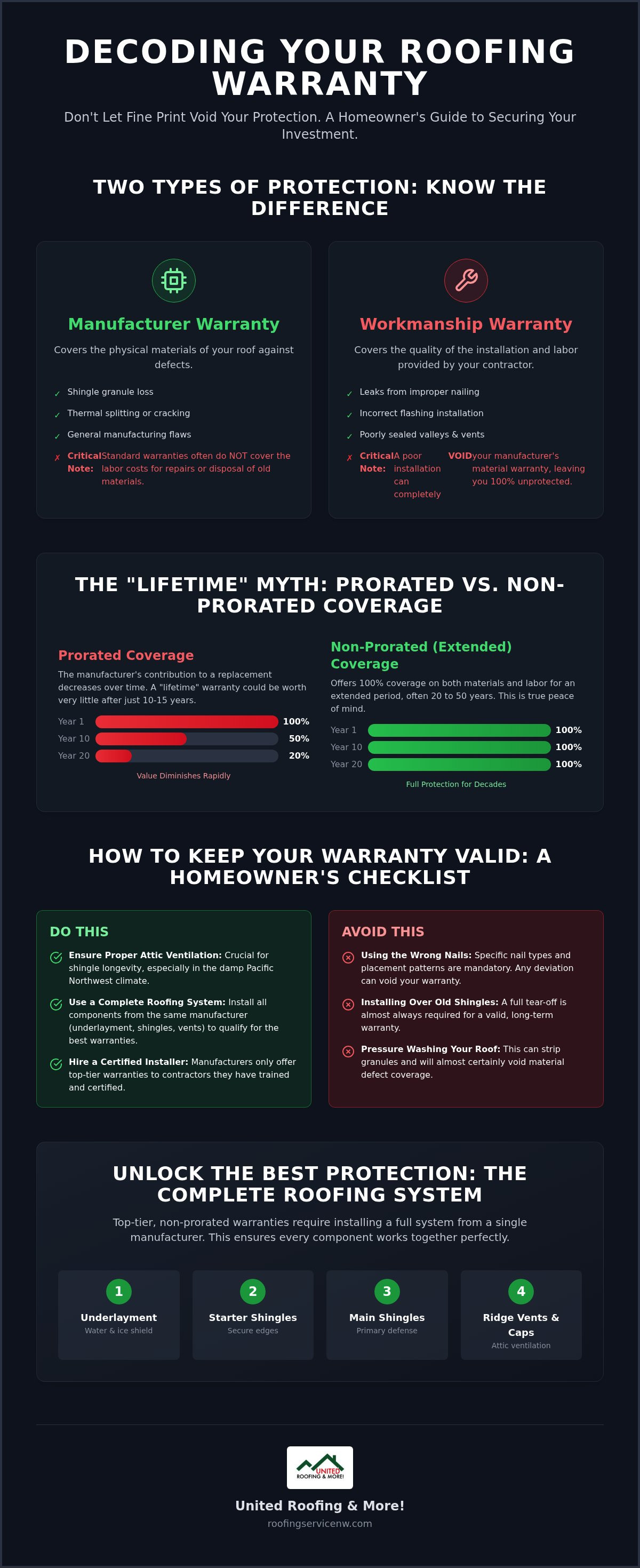
Think of your warranty as a three-legged stool. The first leg is the manufacturer warranty, which covers defects in the shingles or materials. The second is the workmanship warranty. This covers the labor and the quality of the installation itself. The third is often an extended system warranty that ties everything together. Most "standard" coverage plans are too thin for long-term protection. They might cover the shingles but leave you to pay for labor, shipping, and disposal. Investing in a roof replacement requires a plan that covers every layer of the system. Mastering the art of understanding roofing warranties allows you to see the true value of your investment before the project begins.
The Financial Impact of Warranty Protection
A cheap roof often comes with a weak warranty. You might save money upfront, but you're taking on all the risk. Manufacturing defects are rare, but they are incredibly expensive to fix. If a batch of shingles fails prematurely, you don't want to be the one paying for the teardown and haul-away. A robust warranty ensures the manufacturer picks up the tab. If you're worried about the initial cost of a premium system, roofing financing can bridge the gap. Choosing a higher-tier warranty through financing is often smarter than paying cash for a budget roof that lacks protection. It prevents unexpected out-of-pocket expenses and ensures your home stays dry for decades. We prioritize transparency so you know exactly what your financial safety net looks like.
Manufacturer vs. Workmanship Warranties: Knowing the Difference
A roofing warranty isn't a single document. It's a partnership between the people who made the shingles and the experts who nailed them down. If you don't grasp the line between the two, you could end up footing the bill for a five-figure repair. In 2026, with material prices climbing by 4% to 8%, a failed warranty claim is a financial disaster you can't afford. Understanding roofing warranties requires looking at the two distinct buckets of coverage: materials and labor. These two must work in tandem. If the installation is botched, the material coverage often becomes void, leaving you completely unprotected.
The Manufacturer’s Material Warranty
This covers the physical products. If your shingles suffer from premature granule loss, thermal splitting, or manufacturing defects, the manufacturer is responsible. However, standard coverage is often limited. It might provide replacement shingles but ignore the massive cost of labor or disposal. To get full protection, you should look into system-based warranties. These cover every component from the underlayment to the ridge vents. For example, CertainTeed roofing warranties offer different tiers of protection that can include non-prorated periods of up to 50 years. This ensures the manufacturer stands behind the product's performance, not just its existence. We emphasize these high-tier options because they provide the most robust financial safety net for your home.
The Contractor’s Workmanship Warranty
Most roof failures aren't caused by bad shingles. They're caused by bad installation. A workmanship warranty is your contractor's promise that they did the job right. This covers errors like improper flashing, poor ventilation, or incorrect nailing patterns. These are common mistakes that can void your material coverage entirely. Following master roofing standards ensures your installation meets the strict requirements needed to keep your manufacturer warranty valid. Local experts in Seattle and Marysville understand our specific wind and rain loads better than out-of-state storm chasers. If a problem arises five years from now, you want a local partner who will still be in business to honor the claim. If you're concerned about your current installation, our team can provide a professional roof inspection to identify potential risks before they become leaks.
Deciphering the Fine Print: Lifetime, Prorated, and Extended Coverage
The word "lifetime" is the most misunderstood term in the roofing industry. Many homeowners assume it means the roof is covered for 50 or 100 years regardless of who lives in the house. In reality, a lifetime warranty usually lasts only as long as you own the home. If you sell the property, that protection can vanish instantly. Understanding roofing warranties requires you to look past the bold headers and read the transferability clauses. In the 2026 real estate market, a transferable warranty is a massive selling point. It provides the next buyer with immediate peace of mind and can even increase your home's appraisal value. Don't let your investment lose its edge just because you decided to move.
Prorated vs. Non-Prorated Coverage
Coverage value changes over time. A prorated warranty is like a new car; it loses value the moment you drive it off the lot. For many standard "lifetime" plans, the non-prorated period only lasts for the first 10 years. After that, the manufacturer's payout for a claim drops every single year. If your roof fails in year 15, you might only receive a small fraction of the replacement cost. This is the "coverage cliff" that catches many homeowners off guard. Paying more upfront for a non-prorated period of 20 or 50 years is a smart financial move. It ensures the manufacturer covers the full cost of materials for the long haul. We always recommend checking the non-prorated duration before signing any contract.
Extended Warranties and Manufacturer Certifications
The best protection isn't available to everyone. Manufacturers reserve their "Enhanced" or "System Plus" tiers for certified contractors who have proven their proficiency. Hiring a certified expert is the only way to unlock 50-year, non-prorated material warranties and long-term workmanship coverage backed by the manufacturer. These extended plans often cover things that standard warranties ignore, such as:
- Full replacement labor costs
- Tear-off and disposal fees
- Coverage for the entire roofing system, including underlayment and vents
How to Keep Your Roofing Warranty Valid: A Homeowner’s Checklist
Your responsibility doesn't end when the installation crew leaves your driveway. To keep your protection alive, you must follow the manufacturer's strict rules for maintenance. In the Pacific Northwest, moisture is the constant enemy of your home's exterior. Improper attic ventilation is the leading cause of "heat-voided" warranties. Without balanced airflow, heat and moisture trap under the roof deck. This effectively cooks the shingles from the inside out. It leads to premature curling and cracking that manufacturers will not cover. Understanding roofing warranties means knowing that your ventilation must meet specific building codes in Marysville and Seattle to keep your claim rights active.
Nailing techniques also play a massive role in warranty validity. Some premium protection plans require specific nailing patterns or depths. Over-driven nails from high-pressure air guns can slice through the shingle. Under-driven nails cause the shingle above to sit unevenly. Both errors give manufacturers a valid reason to deny a claim. We also warn homeowners against using pressure washers for roof cleaning. High-pressure water strips away the protective granules. Manufacturers classify this as physical abuse. Regular roof repairs and professional cleaning are the only way to show you've exercised "reasonable care" for your system. This includes ensuring your roof drip edge is clear and functioning to divert water away from your home's structure.
Common Actions that Void Your Warranty
Don't take shortcuts that compromise your coverage. "Overlaying," or installing new shingles over old ones, is a major mistake. It traps excessive heat and adds weight the structure wasn't designed to hold. Be careful with third-party additions like solar panels or satellite dishes. If an installer drills into your shingles without professional sealing, your warranty is likely gone. Even the slope of your home matters. You must calculate roof pitch accurately to ensure you're using materials rated for that specific incline. Using the wrong product for your pitch is a guaranteed way to lose your protection. Understanding roofing warranties helps you avoid these expensive pitfalls before they happen.
The Importance of Professional Documentation
Keep a dedicated "Roofing File." This should include your original contract, all invoices, and photos of the project. Never lose your original Certificate of Warranty. It’s the legal proof of your protection tier. Annual inspections provide a vital paper trail. They prove you've maintained the roof as required by the fine print. If a defect appears in ten years, this documentation is your best weapon. We offer complimentary diagnostic services to help you build this record and keep your investment secure. Don't leave your protection to chance! Schedule your professional roof inspection today to ensure your warranty stays rock solid.
Securing Your Investment with United Roofing & More!
We believe in total transparency. Our "no-nonsense" approach means you never have to guess about your coverage. Understanding roofing warranties is about more than just reading a document. It's about knowing your contractor stands behind every nail and shingle. We lead with our professional credentials and decades of tenure in the Pacific Northwest. Our team acts as your advocate. If a manufacturing defect ever occurs, we don't leave you to handle the manufacturer alone. We help you navigate the complex claims process to ensure you get the protection you paid for. Our goal is to provide a supportive partnership that prioritizes your peace of mind.
Local expertise matters. We are the experts who understand the specific rain and wind loads of Marysville and Seattle. This geographic proficiency ensures your roof is built to last. Our promise is simple: quality materials meet expert labor. By consistently delivering high-value workmanship, we ensure your manufacturer warranty remains rock solid for decades. We value long-term trust over high-pressure tactics. You can count on us for clear dialogue and reliable service throughout the life of your roof.
Our Commitment to Quality Installation
Quality materials require expert labor. Our certified team follows manufacturer-specific guidelines to the letter. This precision is vital for keeping your warranty valid. Every roof installation we perform is built to withstand PNW weather standards. We prioritize open dialogue from the first diagnostic service to the final inspection. You stay informed throughout the entire process. This commitment to clarity ensures that your "Manufacturer" warranty is never voided by poor workmanship. We take pride in our highly organized, customer-centric process that leaves nothing to chance.
Financing Your New Protected Roof
You shouldn't have to settle for a budget roof with weak protection. We offer dedicated roofing financing options to help you manage project costs. These flexible payment plans allow you to afford a premium, high-warranty system today. Using financing is a strategic tool for securing better long-term protection for your investment. Applying for financing for your Marysville or Everett roofing project is simple and fast. We aim to lower the barrier to entry with supportive financial solutions. You can protect your home without breaking your monthly budget. Trust United Roofing & More! to provide the proficiency, quality, and financial flexibility you deserve. Reach out to us now for a clear dialogue about your next project and secure your home's future.
Secure Your Home's Future Today
Your roof is a major investment. Mastery of the fine print is your best defense against unexpected costs. You now know the vital difference between material defects and workmanship errors. You also understand why proper maintenance is mandatory for keeping your 50-year protection valid. Understanding roofing warranties puts the power back in your hands. It ensures you aren't just buying shingles; you're buying decades of security for your family.
United Roofing & More! is ready to be your local partner. We are locally owned and operated right here in the Pacific Northwest. Our hardworking team delivers expert roof replacement and installation that exceeds manufacturer requirements. We even offer flexible roofing financing to make high-tier protection accessible for every budget. Get a Free Estimate and Warranty Consultation from United Roofing & More! today. Don't leave your home's safety to chance. We look forward to helping you protect what matters most. Your new, worry-free roof is just a click away.
Frequently Asked Questions
Does a roofing warranty cover storm or hail damage?
No, a standard roofing warranty typically does not cover storm, wind, or hail damage. These events are classified as "Acts of God" and fall under your homeowner's insurance policy rather than the manufacturer's protection. While your warranty covers defects in the shingles or installation errors, it won't pay for shingles ripped off by a hurricane or dented by large hail. Always review your insurance policy alongside your warranty to ensure full coverage against PNW weather.
What is the difference between a 30-year shingle and a 30-year warranty?
A 30-year shingle refers to the expected lifespan of the material under ideal conditions. A 30-year warranty is a legal contract that defines how long the manufacturer will cover specific defects. Understanding roofing warranties helps you realize that the warranty often has a non-prorated period that is much shorter than 30 years. After that initial period, the value of the protection drops significantly even if the shingle is still on your roof.
Can I transfer my roofing warranty if I sell my home?
Most premium warranties are transferable to the next homeowner, but there are often strict conditions. You usually must notify the manufacturer in writing within 30 to 60 days of the home sale. Some companies only allow a one-time transfer and may charge a small administrative fee. Having a transferable warranty is a major asset when selling your home in Marysville or Seattle. It provides the new buyer with immediate confidence in the structure.
Will my warranty be voided if I install solar panels?
Installing solar panels won't automatically void your entire warranty, but it can void the coverage for the specific areas where the panels are attached. If the solar installers drill holes that cause leaks, the roofing manufacturer and your original contractor aren't responsible for those repairs. We recommend having your roofing contractor present during the solar installation. They can ensure all penetrations are sealed according to professional standards to keep your protection intact.
How much does an extended roofing warranty cost?
The cost of an extended warranty varies based on the size of your roof and the level of protection you choose. It is usually a small percentage of the total project cost. While there is an upfront fee, it covers expensive items like labor and disposal that standard warranties ignore. Many homeowners use our roofing financing options to cover this cost. This ensures they have the highest tier of protection without a large out-of-pocket expense.
Does my warranty cover the cost of removing and disposing of old shingles?
Standard manufacturer warranties usually only cover the cost of the replacement shingles themselves. They often exclude the labor required to remove the old roof and the fees for hauling it to a landfill. However, premium "system" warranties often include these costs during the non-prorated period. Understanding roofing warranties at this level is crucial. It helps you avoid a massive surprise bill for tear-off and disposal if a manufacturing defect ever occurs.
Why do I need a workmanship warranty if the shingles have a lifetime guarantee?
Shingle guarantees only cover physical defects in the product. They don't protect you if a leak is caused by a nail driven too deep or a piece of flashing installed backward. Most roofing issues in the Pacific Northwest stem from installation mistakes rather than material failure. A workmanship warranty from a local expert ensures the labor is covered. This dual protection is the only way to truly secure your home against our heavy rainfall.
What should I do if I suspect a manufacturing defect in my shingles?
Contact your original roofing contractor immediately to perform a professional inspection. They can determine if the issue is a material defect or an installation problem. If it is a defect, your contractor will help you gather the necessary documentation, such as photos and shingle samples, to file a claim with the manufacturer. We pride ourselves on open dialogue and will guide you through every step of this process to ensure a fair and timely resolution.


