
A single open seam can silently funnel gallons of rainwater straight into your ceiling insulation long before you spot the first yellow drip. With Tacoma averaging up to 41 inches of rain each year, winter downpours and standing puddles quickly exploit any weak modified bitumen joint. When water starts pooling, arranging dependable torch down roofing repair Tacoma property owners can trust becomes an immediate priority. We understand how stressful it is to balance water damage worries against open-flame fire risks and sudden home maintenance expenses.
You shouldn't have to guess whether your low-slope system requires a targeted patch or a complete reroof. In this guide, you'll learn how to identify early membrane blisters, understand the proper multi-ply patching procedure, and determine the true condition of your roof deck. We'll also break down how to partner with a licensed, transparent contractor who provides clear communication and accessible financing solutions to keep your property protected.
Key Takeaways
- Spot subtle signs of low-slope membrane breakdown early, from pooling water blisters to cap sheet granulate loss caused by damp winter weather.
- Follow proven multi-ply patch steps to ensure your torch down roofing repair Tacoma project creates a secure, watertight thermal weld.
- Evaluate core damage thresholds to determine whether targeted patch repairs or a full roof replacement makes the most sense for your home.
- Protect your property by confirming essential hot-work liability insurance coverage and verified state credentials before hiring any crew.
- Discover dependable roof repairs paired with flexible roofing financing options designed to keep your repair project simple and manageable.
Diagnosing Torch Down Roofing Damage on Tacoma Flat Roofs
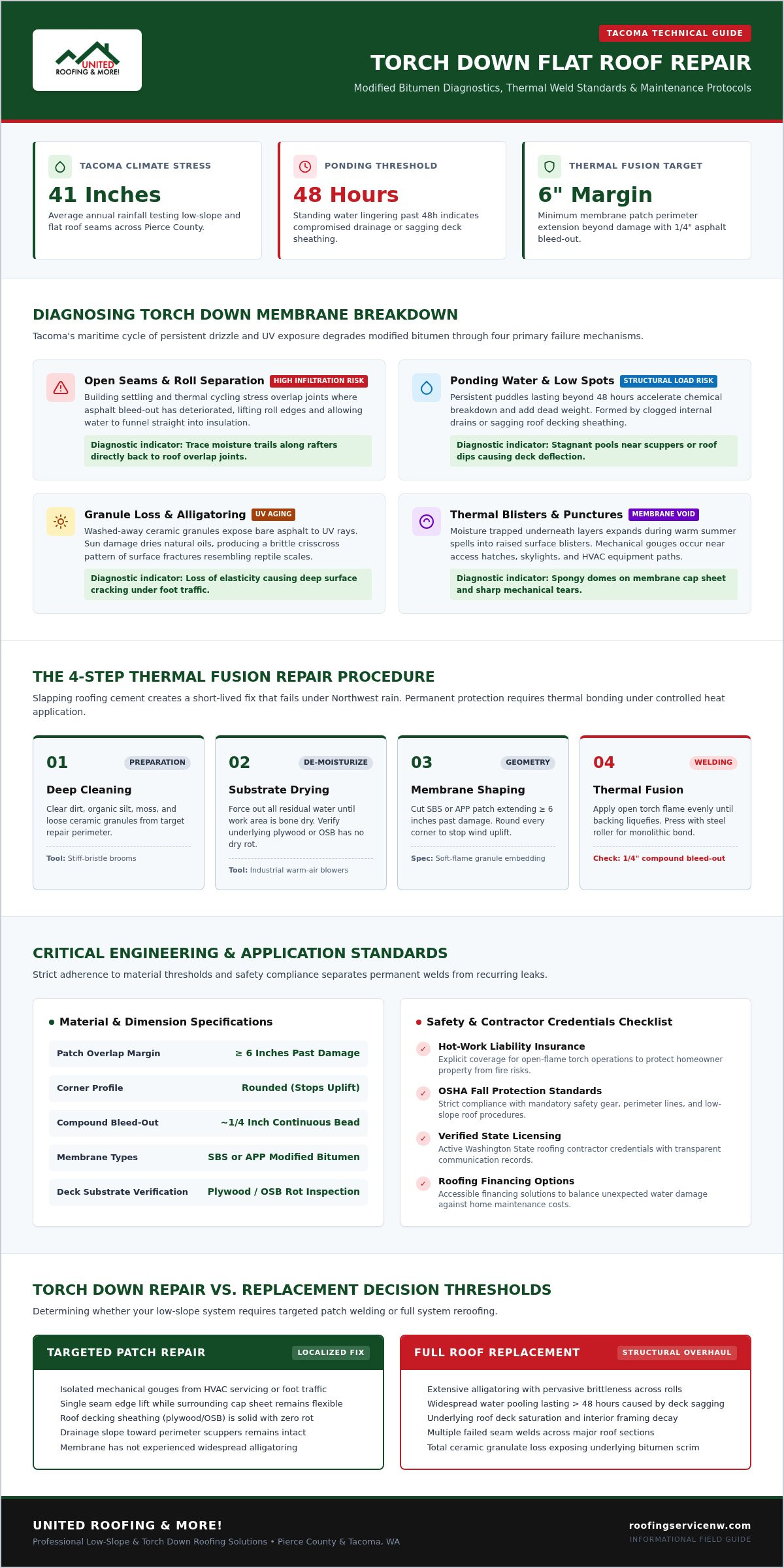
Tacoma's maritime climate creates a punishing environment for modified bitumen. Months of persistent drizzle saturate exterior surfaces, testing the watertight integrity of flat and low-slope roofing systems across Pierce County. When protective ceramic granules wash away, bare asphalt faces direct ultraviolet exposure. This sun damage dries out essential oils, leaving the membrane brittle and vulnerable. During warm summer spells, moisture trapped underneath the layers expands rapidly into raised surface blisters. Add fluctuating seasonal temperatures, and continuous thermal expansion pulls adjacent seams apart. Catching these structural shifts early prevents costly interior framing destruction.
Identifying Open Seams, Punctures, and Membrane Tears
Most flat roof failures begin along the overlap joints where rolls were heat-welded together during initial installation. Over time, building settling and thermal cycling stress these seams, causing them to lift and create entry pathways for moisture. Routine foot traffic around rooftop skylights or HVAC units also introduces sharp punctures, gouges, and tears into the cap sheet. To diagnose the damage accurately, map damp spots on interior ceilings directly against exterior trouble zones. Pinpointing these entry points helps establish whether targeted torch down roofing repair Tacoma services will secure the building envelope or if broader measures are needed.
- Separated roll overlaps: Look for edges lifting where asphalt bleed-out has deteriorated.
- Mechanical punctures: Check for tears near service equipment, access hatches, and walking paths.
- Interior water mapping: Trace moisture trails along rafters back to the roof membrane above.
Assessing Ponding Water and Surface Alligatoring
Ponding water presents an ongoing threat to low-slope structures. If puddles linger longer than forty-eight hours after a storm, your roof has drainage complications. These standing pools accelerate chemical breakdown and add dead weight to your structure. Aging asphalt membranes also display alligatoring, a crisscross pattern of surface fractures that looks like reptile scales. This cracking pattern signals that the bitumen has lost its natural elasticity. When low spots form due to sagging roof decking or clogged internal drains, immediate torch down roofing repair Tacoma interventions keep water from penetrating the deck sheathing below.
Step-by-Step Torch Down Roof Repair Procedure for Lasting Protection
Executing a durable torch down roofing repair Tacoma project requires controlled heat application and strict material preparation. Slapping roofing cement over torn modified bitumen creates a short-lived fix that fails under Pacific Northwest rain. A permanent thermal bond demands a step-by-step approach. Technicians strictly observe OSHA fall protection regulations for low-slope roofs while executing these repair stages:
- Step 1: Deep cleaning. Clear dirt, organic silt, moss, and loose ceramic granules from the target area using stiff-bristle brooms.
- Step 2: Substrate drying. Force out all residual water using industrial warm-air blowers until the work area is bone dry.
- Step 3: Membrane shaping. Cut an SBS or APP patch extending at least six inches past the damage, rounding every corner to stop wind uplift.
- Step 4: Thermal fusion. Apply the torch flame evenly across the underside until the asphalt backing liquefies into a monolithic bond.
Surface Preparation and Substrate Drying Standards
Mineral granules prevent fresh bitumen from fusing properly. Before laying a patch, warm the surrounding granulated cap sheet with a soft flame and embed the granules flat using a rounded trowel. Always verify that underlying plywood or oriented strand board sheathing shows no sign of dry rot or water saturation before heating new membrane layers. Preserving correct deck slope toward perimeter scuppers or gutters guarantees rainwater flows freely away from the patch area.
Torching and Sealing the Modified Bitumen Patch
Controlled open-flame heating is the core of torch application. Pass the torch steadily across the rolled patch backing to melt the compound without burning the polyester or fiberglass scrim. Press the hot material firmly into position with a heavy steel roller to squeeze out trapped air bubbles. Look for an even bead of melted compound flowing roughly one-quarter inch beyond all patch seams, signaling an impenetrable joint.
Addressing Parapet Walls, Vents, and Edge Flashings
Flashing joints around vertical elements fail faster than open field membrane. When patching wall upstands, tuck the new modified bitumen underneath rigid counter-flashing metal along Tacoma parapet walls. Property owners should review how a properly installed roof drip edge protects vulnerable low-slope perimeters against water creeping back beneath the deck. Seal penetrations like plumbing stacks using compatible asphalt mastic reinforced with woven glass mesh. If you want experienced technicians to handle these high-heat procedures, you can explore local roofing solutions that keep the entire process worry-free.
Torch Down Roof Repair vs. Replacement: Making the Right Decision
Deciding between a localized fix and a full tear-off protects both your building structure and your wallet. Isolated repairs work wonders for younger roofs facing minor puncture wounds, accidental punctures, or isolated seam splits. If over a quarter of the surface shows deep alligatoring or the underlying wood sheathing feels spongy, patching becomes a temporary band-aid. Washington State building codes also mandate that residential roofs can have no more than two membrane layers. If your roof already carries two layers, applying an overlay is prohibited by law, making a full tear-off necessary. Review our detailed roof replacement guide to explore full system options when repeated issues outgrow standard maintenance.
Evaluating Membrane Lifespan, Saturation, and Roof Geometry
Most two-ply modified bitumen assemblies last between fifteen and twenty years under Northwest weather patterns. Technicians use core sampling and thermal scans to detect whether trapped moisture has soaked the rigid insulation board below. Trapped moisture degrades thermal efficiency and rots underlying roof timbers from within. Evaluating your deck slope is equally critical. You can learn how to calculate roof pitch to see if your low-slope structure meets necessary drainage standards. If persistent dips consistently retain water, restructuring the sub-deck during a complete reroof solves ponding issues that spot repairs cannot fix.
- System age: Roofs under ten years old usually benefit from targeted seam patching.
- Core saturation: Wet insulation boards demand immediate membrane stripping and replacement.
- Surface coverage: Damage exceeding 25% of the membrane surface calls for full system installation.
Long-Term Cost Comparisons and Structural Security
Scheduling frequent emergency patches quickly becomes an unnecessary financial strain. While an isolated torch down roofing repair Tacoma service call solves sudden leaks, aging single-ply layers eventually lose structural strength across every seam. Investing in a modern multi-ply modified bitumen installation gives you fresh materials, seamless seams, and renewed manufacturer coverage. Upgrading sub-decking and adding slope crickets eliminates chronic water retention above your living areas once and for all. When facing larger projects, working with a contractor that offers flexible roofing financing solutions helps you protect your home without financial disruption.
Selecting a Certified Torch Down Roofing Contractor in Tacoma
Working with open-flame propane torches demands unmatched precision and comprehensive insurance protection. Operating a torch generating heat up to 2,000 degrees Fahrenheit carries structural fire hazards that unqualified service providers cannot safely manage. Responsible roofing crews follow rigid post-application fire watch procedures, monitoring roof decks and wall perimeters with thermal imaging tools to catch smoldering materials. When you need torch down roofing repair Tacoma specialists, verifying proven regional experience and rigorous safety protocols keeps your home protected throughout the entire project.
Mandatory Safety Credentials, Insurance, and CERTA Certification
Never permit a crew on your low-slope roof without inspecting their official credentials. Start by confirming active registration through the Washington State Department of Labor and Industries at secure.lni.wa.gov/verify. Ensure your roofer carries the updated statutory surety bond of $30,000 for general contractors or $15,000 for specialty contractors. Most importantly, demand written proof of an open-torch liability rider on their general liability policy. Standard contractor insurance policies routinely exclude open flame operations. You should also verify that lead technicians hold Certified Roofing Torch Applicator credentials from the National Roofing Contractors Association.
- Active L&I registration: Confirms updated state bonding and workers' compensation coverage.
- Dedicated hot-work insurance: Specifically covers open-flame torch applications on residential structures.
- CERTA qualification: Proves technicians have completed formal fire prevention and torch safety training.
Local Tacoma Permitting and Quality Craftsmanship Standards
Navigating municipal codes in Pierce County requires hands-on local knowledge. In the City of Tacoma, replacing an existing residential roof covering with identical materials without modifying structural sheathing is permit-exempt for single-family homes. Adding an overlay layer, replacing structural plywood decking, or executing commercial reroofs requires formal permits submitted through Tacoma's digital permitting portal. Review the industry benchmarks outlined in our guide to master roofing standards to understand how verified installation methods prevent premature seam failure. Always ask prospective contractors for local references across Pierce County to inspect past flat roof restorations firsthand. Ready to get started? Schedule a free roof inspection to secure an honest assessment backed by clear communication and flexible roofing financing options.
Professional Flat Roof Solutions with United Roofing & More!
Dealing with sudden low-slope leaks shouldn't leave you stressed or guessing about your options. United Roofing & More! delivers dependable roof repairs, installations, and roof replacement services throughout Pierce and King counties. Our experienced crew understands how Pacific Northwest weather wears down modified bitumen over time. By applying proven torching methods and precision thermal welds, our technicians stop active leaks at the source. We believe in total transparency, giving you clear explanations, steady updates, and attentive service from your initial roof evaluation through final cleanup.
Tailored Repair and Replacement Programs for Tacoma Properties
Every low-slope structure has distinct drainage patterns and stress zones. We begin by examining your roof system thoroughly, documenting puncture points, degraded flashings, and sub-deck integrity with detailed photographic reports. You receive honest recommendations tailored to your building, whether an isolated torch down roofing repair Tacoma project solves the leak or underlying saturation requires a new roof installation. We work strictly with premium, weather-tested materials manufactured to withstand Tacoma's heavy rainfall, freezing mornings, and summer sun cycles.
- Comprehensive photographic assessments: See high-resolution images of damaged seams and decking before work begins.
- Customized repair scopes: Target specific water intrusion areas without paying for unnecessary labor.
- Durable roofing systems: Install heavy-duty modified bitumen membranes engineered for long-term weather protection.
Stress-Free Roof Financing and Direct Scheduling
Unexpected roofing issues can strain any household budget. We alleviate that financial pressure by offering dedicated roofing financing options with adaptable payment solutions. Discover practical payment structures in our guide to roof financing near me to find an arrangement that aligns with your family's needs. You'll receive straightforward, itemized estimates without hidden line items, sales pressure, or confusing jargon. Protect your home and eliminate interior water damage before the next rainy week arrives. Contact United Roofing & More! today to speak with our local team and schedule your thorough Tacoma flat roof evaluation.
Protect Your Tacoma Property with Dependable Flat Roof Solutions
Staying ahead of seam splits and ponding water is the simplest way to prevent interior structural damage during wet winter months. Knowing how to spot membrane fatigue and understanding the differences between targeted multi-ply patching and full reroofing helps you make confident, informed investments for your home. When moisture threatens your low-slope system, executing a precise torch down roofing repair Tacoma project restores total weather defense.
As a locally owned and operated Pacific Northwest roofing contractor, United Roofing & More! brings specialized expertise in low-slope and flat roof membrane systems to every neighborhood across Pierce and King counties. You don't have to navigate sudden roofing repairs alone or worry about surprise expenses. With accessible roofing financing plans designed to fit your project budget, restoring your roof remains smooth and stress-free. Schedule your professional Tacoma flat roof inspection with United Roofing & More! today and keep your building secure through every rainy forecast.
Frequently Asked Questions
How long does a professional torch down roof repair last in Tacoma?
A properly executed torch down patch lasts between five and ten years when installed over a dry, sound deck. The overall lifespan depends directly on the age of your surrounding membrane, seasonal temperature swings, and how quickly rainwater drains toward perimeter scuppers. Routine annual inspections help catch edge wear early so your patched seams stay completely watertight through harsh Pacific Northwest winters.
Can you repair a torch down flat roof while it is wet or raining?
No, you cannot execute open-flame torch repairs on damp or rain-soaked membranes. Trapping moisture beneath a heated modified bitumen sheet turns water into pressurized steam, which causes immediate blistering and prevents asphalt from fusing to the substrate. Professional crews apply emergency temporary tarping or specialized wet-seal mastics during active rainfall, returning to complete the permanent thermal weld once weather clears.
What causes blisters and wrinkles to form on torch down roofs?
Blisters form when moisture or air pockets become trapped between membrane layers during installation or through microscopic punctures. As direct sunlight warms the dark roof surface, this trapped vapor expands, forcing the bitumen cap sheet upward into hollow bubbles. Stepping on these raised blisters breaks the brittle material, creating direct entry points that necessitate prompt torch down roofing repair Tacoma interventions.
Is an open-flame torch required to fix every modified bitumen leak?
An open flame is not mandatory for every repair situation. While heat-welding remains standard for fusing heavy APP modified bitumen, many crews use cold-applied adhesives, self-adhering SBS membranes, or high-grade elastomeric flashing compounds. These cold-process alternatives provide durable watertight seals around sensitive timber overhangs, plastic skylight curbs, and restricted areas where open torches pose severe fire risks.
What is the difference between APP and SBS modified bitumen membranes?
APP membranes feature plasticized asphalt that melts smoothly under an open flame, creating a rigid, highly durable waterproof surface. SBS membranes incorporate synthetic rubber modifiers, providing superior flexibility and elongation during cold freezing snaps. In the maritime Northwest climate, rubberized SBS systems expand and contract easily across changing seasons without cracking along structural joints or parapet transitions.
How do I know if my flat roof needs a repair or a complete replacement?
Your low-slope roof likely needs complete replacement if widespread blistering, pervasive seam splits, or saturated insulation boards cover more than 25% of the overall deck. Minor punctures, localized flashing gaps, and isolated edge tears on membranes under ten years old can be repaired effectively. If your roof already carries two separate membrane layers, state building codes mandate a full tear-off.
Do I need a city building permit for flat roof repairs in Tacoma?
Isolated patch repairs and minor maintenance do not require a building permit from the City of Tacoma. Single-family residential replacements using identical materials without structural deck changes remain permit-exempt under local guidelines. However, adding an overlay layer, replacing rotted plywood sheathing, altering rooflines, or completing commercial reroofs requires submitting plans through the city's online permitting portal before commencing work.


