
Is your roof actually protecting your home, or are you just one heavy Marysville rainstorm away from a structural disaster? In the Pacific Northwest, our homes don't just age. They fight a constant battle against relentless moisture, moss, and hidden rot. You shouldn't have to wait for a puddle on your living room floor to realize there's a problem. Identifying the early signs you need a roof replacement is the only way to prevent catastrophic structural damage. It's about more than just shingles. It's about your peace of mind and your family's safety.
We know that the high cost of unplanned home improvements is a major stress for local families. You deserve a home that stays dry and a contractor you can trust. This guide will teach you how to identify critical roof damage early to protect your property from our unique climate. We also explore affordable ways to fund your project with flexible roofing financing. You'll get a clear checklist of damage signs and a better understanding of the financial options available to you. Let's ensure your home remains a safe, dry sanctuary for years to come.
Key Takeaways
- Learn how the unique Pacific Northwest climate, characterized by constant moisture and moss, accelerates the deterioration of standard roofing materials.
- Master the seven visual signs you need a roof replacement that are easily identifiable from the safety of your yard or a ladder.
- Discover how to perform a simple attic inspection to spot hidden structural rot and moisture issues before they damage your living space.
- Apply the "Rule of 50" to decide whether a quick repair is sufficient or if a full roof replacement is the most cost-effective long-term solution.
- Explore how dedicated roofing financing can turn an urgent home improvement project into a manageable and predictable monthly investment.
Understanding Your Roof’s Lifespan in the Pacific Northwest
Living in the Pacific Northwest means your home faces unique environmental challenges. While a standard roof might last decades in a sun-drenched desert, our local moisture levels change the math entirely. Constant dampness and limited sunlight create a breeding ground for moss and algae. These organisms trap water against your shingles, leading to rapid deterioration. Roof failure is officially reached at the point where your shingles or primary materials are no longer capable of protecting the underlying waterproof underlayment from the elements. Proactive monitoring helps you spot the early signs you need a roof replacement before a minor leak turns into a massive structural repair bill.
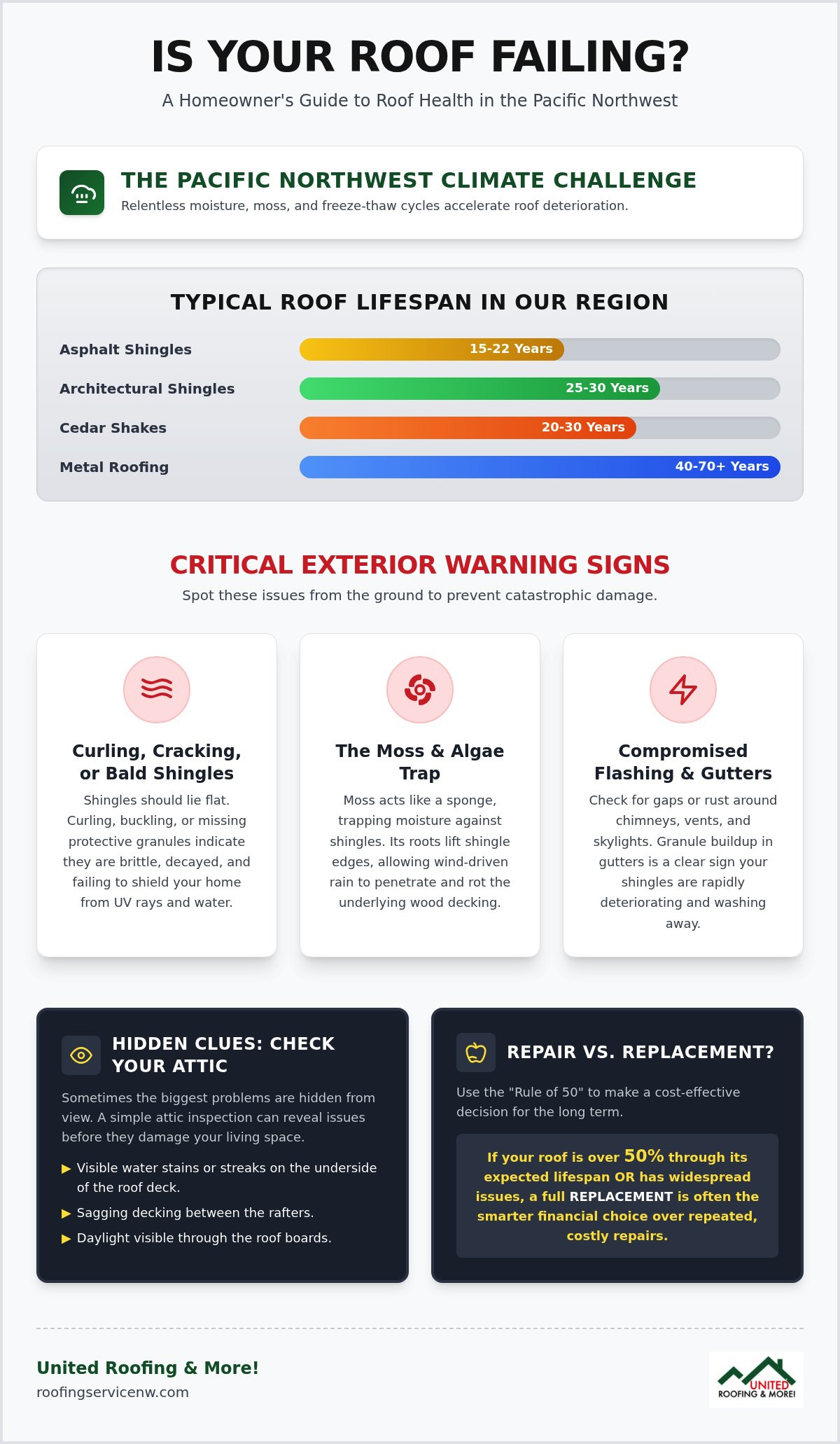
Different materials handle our climate with varying degrees of success. Here is what you can typically expect in our region:
- Asphalt Shingles: Usually 15 to 22 years, depending on ventilation and moss growth.
- Architectural Shingles: Often 25 to 30 years due to their thicker, more durable construction.
- Metal Roofing: Can last 40 to 70 years, though fasteners may need maintenance sooner.
- Cedar Shakes: Roughly 20 to 30 years, provided they receive regular specialized treatments.
The Age Factor: When Does a Roof Become "Old"?
Most manufacturers suggest a 20-year lifespan for basic shingles. However, a 15-year-old roof in Marysville is often "older" than a 25-year-old roof in a drier state. Our high humidity and frequent freeze-thaw cycles fatigue the materials faster. Waiting until the very end of a roof's life is a risky gamble. If your roof is approaching the two-decade mark, it's time to look for specific signs you need a roof replacement to avoid sudden failure during a heavy winter storm. Early detection saves money and protects your home's interior from mold and rot.
Environmental Stressors Specific to Seattle and Marysville
Persistent rain is our baseline. This constant water flow puts immense pressure on roof drip edges, which are vital for directing water away from your fascia. In the PNW, wind-driven rain often finds even the smallest gaps in aging flashing. Nearby evergreens add to the problem by dropping needles and debris that hold moisture against the roof surface. This creates a "sponge effect" that rots organic material and weakens the roof's integrity. Keeping your home structurally sound requires understanding how our local weather accelerates wear and tear. We see these issues daily, and we know exactly where the moisture hides.
7 Critical Exterior Signs You Need a Roof Replacement
You don't always need to climb a ladder to know your home is in trouble. Many of the most obvious signs you need a roof replacement are visible right from your driveway or sidewalk. We recommend a "ground-level diagnostic" after every major Pacific Northwest wind storm. Look for inconsistencies in the roof's texture or color. If you notice just one of these issues, a repair might suffice. However, seeing multiple signs appearing at once usually indicates a systemic failure of the entire roofing system. This is a no-nonsense situation where your home's structural integrity is at risk.
Shingle Deformities: Curling, Buckling, and Cracking
Shingles should lay flat and uniform. When they begin to "cup" or "claw," they are losing the volatiles that keep them flexible. This curling makes them brittle and easily broken by high winds. You might also notice "bald spots" where the protective granules have washed away. These granules act as a shield against UV rays. Once they are gone, the underlying asphalt decays rapidly. Missing shingles are an immediate invitation for leaks. If your roof looks like a patchwork quilt of damage, it's time to consider a professional roof replacement to secure your home.
The Moss and Algae Trap
In Marysville and Seattle, moss is more than just a cosmetic nuisance. It's a structural threat. Moss acts like a sponge, holding moisture directly against your shingles for weeks at a time. As the moss grows, its roots lift the edges of the shingles. This allows wind-driven rain to bypass your primary barrier and rot the wood decking underneath. Never use a high-pressure washer to "fix" an old, mossy roof. The intense pressure will strip away the remaining granules and accelerate the need for a total tear-off. If the moss has taken over, the damage is likely already deep.
Compromised Flashing and Gutter Debris
Check the high-risk zones around your chimney, vents, and skylights. Flashing is your last line of defense in these areas. If it's rusted, cracked, or pulling away, water will find its way in. We often find that poor initial craftsmanship leads to premature failure. This is why following master roofing standards during installation is so critical. Finally, look in your gutters. If they are full of "sand" or heavy shingle granules, your roof is literally washing away. This debris is one of the clearest signs you need a roof replacement before the next rainy season begins.
Hidden Interior Clues: What Your Attic Is Telling You
Your attic serves as the ultimate early warning system for your home. While exterior damage is often easy to spot from the driveway, the attic reveals the "slow kill" issues that lead to significant structural rot. We recommend a safe, seasonal inspection with a high-powered flashlight to catch problems before they become disasters. By identifying these hidden signs you need a roof replacement early, you protect your home's air quality and avoid the stress of unplanned home improvements. Don't wait for a yellow watermark to appear on your living room ceiling. The real story of your roof's health is written on your rafters and insulation.
Light and Moisture: The Attic Daylight Test
One of the most effective ways to check your roof's integrity is the daylight test. Head into the attic on a bright day and turn off all artificial lights. If you see pinpricks of light peeking through the roof boards, your barrier is compromised. It's a simple rule: where light can enter, water will eventually follow. Next, inspect the wood surfaces immediately after a typical Seattle drizzle. Look for dark spots, damp streaks, or standing moisture along the rafters. These are clear indicators of active leaks that might not have reached your drywall yet. If you notice the roof decking feels soft to the touch or looks like it is sagging, the structural wood is likely waterlogged. This level of damage requires immediate action to ensure your home remains structurally sound.
Mildew, Mold, and Poor Ventilation
In our damp climate, moisture is a constant threat to your home's interior. If your attic has a persistent musty smell, it's a red flag that moisture is trapped. A failing roof often allows small amounts of water to seep into your insulation, creating a perfect environment for mold growth. This isn't just a structural concern; it's a matter of home air quality. Mold spores can easily migrate into your living areas, affecting your family's health. Proper ventilation is a non-negotiable part of a modern roof installation. It ensures that damp air is cycled out before it can settle and cause rot. If you see black staining or white "fuzzy" growth on the underside of your roof sheathing, your current system is failing. These are definitive signs you need a roof replacement to keep your sanctuary dry and healthy.
Repair vs. Replacement: Making the Right Financial Decision
Deciding between a quick patch and a full tear-off is a major financial crossroads for any homeowner. You want to protect your investment without overspending on unnecessary work. We use a transparent, no-nonsense framework to help you make this choice with confidence. The most reliable tool in the industry is the "Rule of 50." If a repair estimate exceeds 50% of the price of a total replacement, or if your roof has reached 50% of its expected lifespan while showing systemic wear, replacement is the smarter financial move. While a patch might stop a leak today, it doesn't reset the clock on your roof's aging process. A full replacement provides a comprehensive warranty and the peace of mind that your home is structurally sound for the next two decades. This is particularly important if you are already seeing multiple signs you need a roof replacement across different areas of your home.
When a Professional Roof Repair is Sufficient
Sometimes, a full replacement isn't necessary yet. If your roofing system is only 8 or 10 years old and suffers from isolated damage, a targeted repair is often the right call. Perhaps a single tree limb fell during a recent wind storm or a small section of flashing around a vent came loose. In these specific cases, expert roof repairs can effectively bridge the gap and keep your home dry. Regular maintenance and minor fixes play a huge role in extending the life of a sound structure. We always lead with an honest assessment. If your shingles are still flexible and the underlayment is dry, we won't push for a replacement you don't need.
The Cost of Delay: Why Waiting Can Double Your Bill
Ignoring a minor leak is the fastest way to double or triple your home improvement budget. A small $500 shingle issue can quickly evolve into $5,000 worth of structural rot repair if water reaches the rafters or ceiling joists. In our damp climate, moisture moves through wood fast. Beyond the wood itself, water damage destroys the effectiveness of your home insulation. Wet insulation loses its R-value, which causes your monthly energy bills to spike as your heating system works harder to compensate. Addressing damage promptly also makes the insurance process much smoother. Claims are easier to justify when damage is handled as soon as it occurs. If you wait until the damage is widespread, insurance adjusters may argue the issue was caused by long-term neglect rather than a specific storm event. If you are currently noticing the signs you need a roof replacement, taking action today is the most affordable choice you can make. Ready for a clear, honest assessment? Get a professional roofing diagnostic from our local experts.
Taking Action: Professional Inspections and Financing Solutions
Once you've spotted the signs you need a roof replacement, the next step is moving from observation to action. You don't have to face this transition alone. We act as your supportive partner throughout the entire process. United Roofing & More! is locally owned and operated right here in the PNW. We understand the stress that comes with major home improvements. Our team focuses on alleviating that pressure by providing clear dialogue and expert guidance. We don't use high-pressure sales tactics. We lead with professional credentials and a commitment to keeping you informed from the first diagnostic to the final shingle installation.
What to Expect During a Professional Roof Inspection
A professional roofing diagnostic is a comprehensive health check for your home. We take a no-nonsense approach to every assessment we perform. Our experts get on the roof to examine shingle integrity and granule loss. We check every junction. We inspect valleys and chimney flashing for hidden gaps. We also perform a thorough attic inspection to verify that your ventilation system is functional. This ensures your new roof won't trap moisture and fail prematurely. You will receive a clear, written estimate that outlines exactly what your home needs. This document is a vital tool for your personal budgeting or for coordinating with your insurance provider. It's essential to work with a local contractor who understands Marysville and Seattle building codes. We ensure your installation meets every regional requirement for wind resistance and moisture protection.
Removing the Barrier: Roofing Financing Options
The high cost of home improvements shouldn't keep you in a leaky house. We believe every family deserves a dry sanctuary. That's why we offer dedicated roofing financing to make your project manageable. These flexible payment plans allow you to address the signs you need a roof replacement immediately. You don't have to wait for your savings to catch up with a growing leak. Financing also gives you the freedom to choose high-quality, durable materials rather than settling for the cheapest option. Investing in premium shingles now means better protection against our local climate and a higher resale value for your home later. We are here to help you secure your property with a payment structure that fits your life. Let's get your home back to its best condition together.
Secure Your Home Against the Pacific Northwest Elements
Your roof is the first line of defense against our region's relentless moisture. By identifying the critical signs you need a roof replacement, you've taken a vital step toward protecting your home's structural integrity. Whether you found curling shingles or hidden dampness in your attic, acting now prevents minor leaks from becoming expensive disasters. We are here to simplify the process and remove the stress of major home improvements.
As locally owned PNW experts, we prioritize open dialogue and total transparency. We help you evaluate your options with a no-nonsense approach to ensure you get the best value for your investment. Our flexible roofing financing makes it easy to choose high-quality materials without straining your budget. Don't wait for the next major storm to test your home's defenses. We are ready to provide the professional diagnostic and reliable workmanship your family deserves. Your safe, dry home is just one step away.
Get a Professional Roof Inspection and Explore Our Financing Options Today!
Frequently Asked Questions
How much does a new roof cost in the Seattle area?
The total cost of a new roof in the Seattle area depends on your home's square footage, the materials you select, and the complexity of your roof's pitch. High-quality architectural shingles or metal roofing will influence the final estimate. We provide transparent, written estimates that account for local labor and disposal fees. To help manage these investment costs, we offer dedicated roofing financing with flexible payment plans that fit your family's budget.
Can I just shingle over my existing roof to save money?
While "overlaying" shingles might seem like a shortcut, we generally advise against it in our damp climate. Adding a second layer traps heat and moisture between the shingles, which significantly shortens the lifespan of the new materials. It also adds immense weight to your home's structure. A full tear-off allows us to inspect the wood decking for rot, ensuring your new roof installation is built on a solid, dry foundation.
Is moss on my roof a sign that it needs to be replaced?
Moss isn't always a definitive reason for replacement, but it is one of the most serious signs you need a roof replacement if left untreated. In the PNW, moss acts like a sponge that holds water against your shingles, leading to rot and shingle lifting. If the moss has already caused the underlying wood to soften or the shingles to buckle, a full replacement is often the only way to restore your home's safety.
How long does a typical roof replacement take to complete?
Most residential roof replacements in areas like Marysville or Everett take between one and three days to complete. The exact timeline depends on the size of your home and the weather conditions during the project. Our team works efficiently to minimize disruption to your daily routine. We handle everything from the initial tear-off to a thorough site cleanup, ensuring your property is left in pristine condition once the new system is installed.
What is the best time of year to replace a roof in the PNW?
Late summer and early fall are traditionally the best times for roofing projects in the Pacific Northwest because the weather is consistently dry. However, our experienced crews perform roof installations year-round. We monitor local forecasts closely to find dry windows during the winter months. Taking action when you first notice damage is more important than waiting for summer, as a winter leak can cause rapid structural damage.
Does homeowners insurance cover roof replacement?
Homeowners insurance typically covers roof replacement if the damage is caused by a sudden, accidental event like a wind storm or a fallen tree limb. It generally does not cover replacements needed due to old age or lack of maintenance. We recommend reviewing your specific policy details with your agent. Our team provides professional diagnostics and detailed documentation to help you present a clear case to your insurance adjuster after a storm.
What happens if I ignore a small leak in my roof?
Ignoring a small leak is a recipe for expensive structural failure. In our humid climate, even a tiny drip can lead to widespread mold growth and wood rot within your attic and walls. This moisture also destroys the effectiveness of your insulation, which leads to higher energy bills. Addressing the signs you need a roof replacement early is the most cost-effective way to protect your home's value and your family's health.
What are the most common roofing materials used in Marysville?
Asphalt architectural shingles are the most popular choice for Marysville homeowners because they offer a great balance of durability and affordability. Metal roofing is also gaining popularity due to its long lifespan and superior resistance to moss and heavy rain. We also see cedar shakes on many local homes, though they require more maintenance in our damp environment. Our experts help you choose the material that best fits your home's style and your long-term goals.


