

What if a commercial roof assessment report points to repairs, not replacement? For Seattle property owners, roof-condition terms and severity ratings can be hard to interpret, especially when persistent rain puts drainage, seams, and flashing under pressure. A concerning finding deserves attention, but it isn’t automatically a reason to replace the entire roof.
You need clear evidence, not guesswork. A useful report explains what was observed, where the concern is, how serious it appears, and what the assessment couldn’t confirm. That context helps you weigh the findings without overreacting or letting repair needs go unaddressed.
This guide explains what to look for in a commercial roof assessment report, how to understand its findings and limitations, and how to prioritize repairs, maintenance, and future capital planning. You’ll also learn how documented conditions can inform practical next steps for a Puget Sound property, including when roof repair or replacement planning may make sense. The goal is a clear, proportionate plan, not an automatic replacement pitch.
Key Takeaways
- A commercial roof assessment report records observed conditions and suggested next steps, helping guide maintenance and capital planning.
- Look for property details, inspection date, accessible areas, clear observations, and supporting images to understand what the assessment covers.
- Separate urgent water-entry concerns from planned repairs and routine maintenance; a documented issue doesn’t automatically call for full replacement.
- Gather roof plans, repair records, leak reports, and previous assessments to help prepare for a Seattle-area roof assessment.
- Use the report to review evidence, clarify priorities, compare repair or replacement options, and document a practical plan.
What a Commercial Roof Assessment Report Reveals About Your Puget Sound Building
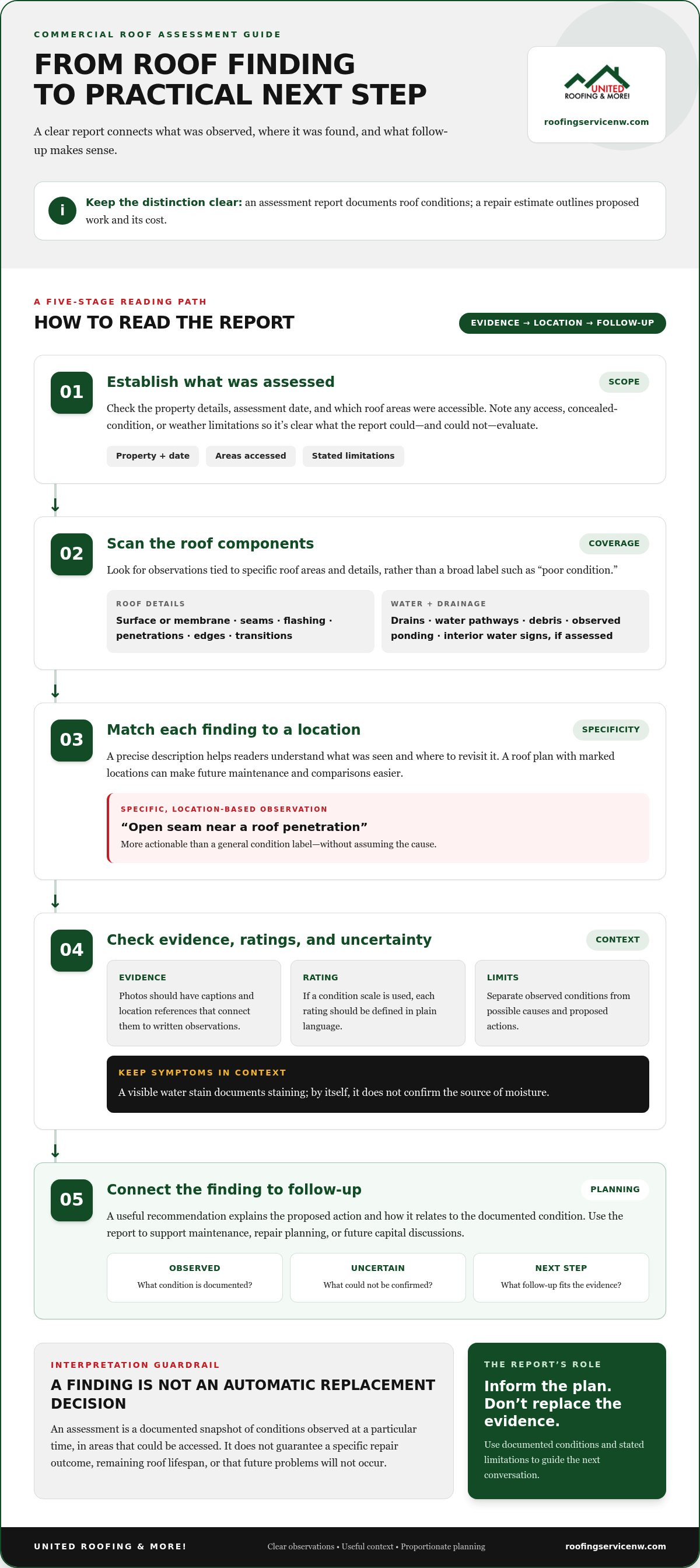
A commercial roof assessment report is a record of observed roof conditions, documented concerns, and recommended next steps. It helps building owners understand what was seen and how those findings may inform maintenance, repair planning, or future capital budgets. It isn’t the same as a repair estimate: An assessment report documents roof conditions; a repair estimate outlines proposed work and its cost.
That distinction matters in the Puget Sound region, where recurring rain can expose weaknesses in drainage, seams, flashing, or other roof details. A note about standing water, for example, records a condition worth understanding, but it doesn’t by itself establish the cause or dictate a specific repair. Clear documentation gives decision-makers a practical basis for follow-up. For general context on common commercial roof forms, see Flat Roofs on Commercial Buildings.
Who uses a commercial roof assessment report?
Owners, facility managers, property managers, and other building representatives can use a report to coordinate maintenance, track repairs, and explain roof-related needs to stakeholders. Dated observations tied to clear locations make future comparisons more useful: a team can see whether a previously documented concern appears unchanged, has developed, or needs further attention. That record can also help connect current work with longer-term capital planning.
For example, a facility manager may use a documented drainage concern to plan follow-up, while an owner reviews the findings alongside other property needs before setting a budget. The report supports an informed discussion. It doesn’t make the budget decision on its own.
What an assessment can, and cannot, tell you
An assessment describes conditions observed at a particular time, in areas that could be accessed. It can record visible symptoms, such as damaged flashing or signs of moisture, but a symptom isn’t always a confirmed cause. Further investigation may be needed to understand what’s happening beneath the roof surface or how an issue developed.
Use the report as a documented snapshot, not a promise that no future problems will occur. Weather, changing conditions, and areas that weren’t accessible can affect what an assessment reveals. Findings also don’t guarantee a specific repair outcome or remaining roof lifespan. Instead, they help focus the next conversation: what evidence is documented, what remains uncertain, and whether repair, maintenance, or replacement planning fits the observed conditions.
What a Complete Commercial Roof Assessment Report Should Include
A useful report makes it easy to connect each concern to a specific part of the roof. It should identify the property and assessment date, describe which areas were accessible, record observed conditions, and include supporting photos or roof-plan references when available. These details help readers understand what was reviewed and where to focus follow-up.
Look for clear descriptions of the roofing surface or membrane, seams, flashing, penetrations, edges, and transitions between roof sections. Drainage notes matter, too. A report may document drains, water pathways, debris, or ponding observed during the assessment. If interior signs of water intrusion are part of the assessment, they should be recorded as observations and linked to their locations.
Roof components and conditions to document
Specific language is more useful than a general label such as “poor condition.” A note might identify an open seam near a roof penetration or debris beside a drain. That description tells a reader what was observed and where, without overstating the cause. A roof plan with marked locations can make findings easier to revisit and compare during future maintenance.
Every finding should connect evidence, location, and a practical next step so readers can understand what was observed and how to follow up.
Evidence, ratings, and report limitations
Photographs should have captions and location references, such as a roof section or nearby feature, so stakeholders can match the image to the written observation. If the report uses a condition scale, it should define each rating in plain language. A rating without an explanation can create confusion or make a concern seem more severe than the supporting evidence indicates.
Reports should also distinguish observed conditions from possible causes and recommended actions. For example, a visible water stain is evidence of staining, but it doesn’t alone confirm the source of moisture. A recommendation should explain what action is proposed and how it relates to the documented finding.
Access restrictions, concealed conditions, and weather limitations can affect what an assessment reveals. These limits should be stated so readers know what wasn’t evaluated or remains uncertain. Dated records also help track changing conditions over time. The National Roofing Contractors Association (NRCA) Guidelines offer broader roofing-care context, including the value of routine inspections.
Once findings are documented, a commercial roofing contractor can help connect observed conditions with repair or replacement options. Explore commercial roofing services to see how those next steps can support your property’s needs.
How to Interpret Findings and Prioritize Commercial Roof Work
A documented concern doesn’t automatically mean the entire roof needs replacement. Start by looking at the evidence, its location, whether it’s causing an active impact, and what could happen if follow-up is delayed. A commercial roof assessment report should help distinguish conditions needing timely attention from planned repairs and routine maintenance, not turn every observation into an emergency.
Urgent findings versus planned maintenance
An active leak, a visibly compromised area, or a drainage problem affecting the building may call for prompt follow-up. By contrast, wear without signs of active water entry may be suitable for planned repair or monitoring as part of maintenance. There’s no universal deadline or rating threshold that fits every roof. Use the report’s evidence and stated recommendations to set timing, and clarify uncertainty before deciding how to proceed.
Consider both the condition and its consequences. A concern above sensitive equipment, occupied areas, or stored goods may have different implications from a similar observation in a less vulnerable location. If the report notes a symptom but can’t confirm its cause, further investigation can help prevent decisions based on assumptions.
When findings point to repair, replacement, or more investigation
A repair recommendation typically addresses a specific documented area or component. A replacement discussion may be appropriate when findings show broader or repeated concerns, or when repair history and the distribution of conditions suggest isolated fixes may not address the underlying needs. Neither recommendation should rest on a severity label alone. The rationale should connect the observed condition with the proposed scope.
Use a simple comparison to organize the conversation. Treat the priority and timing below as examples, not universal thresholds; the report and qualified assessment should guide the actual plan.
| Finding | Evidence | Priority | Suggested action | Follow-up timing |
|---|---|---|---|---|
| Active leak | Current water entry documented indoors | High | Assess the affected area and plan a suitable repair | Timely, based on the observed impact |
| Drainage concern | Debris or ponding recorded near a drain | Needs review | Address the drainage condition and check related areas | Set with the assessment findings |
| Surface wear | Localized wear with no active leak reported | Planned | Monitor or include in maintenance planning | At the next planned review |
| Unclear moisture symptom | Staining noted, source undetermined | Investigate | Gather more information before selecting work | As recommended after review |
This approach keeps decisions proportionate. Repair, replacement, or additional investigation should reflect the building’s documented conditions and needs, with clear reasoning behind each next step.
How to Prepare for a Commercial Roof Assessment in the Seattle Area
A little preparation can make an assessment more focused and help connect roof observations with the building’s history. Seattle-area rain and damp surfaces may affect access or what can be observed during a visit, so share known conditions and site needs ahead of time. You don’t need to determine the inspection method. Focus on useful records, clear locations, and coordinated access.
Records and site information to gather
Before the visit, collect what’s available. Missing documents shouldn’t stop preparation; even a partial history can help clarify what’s known and what needs attention.
- Gather roof records. Set aside roof plans, roofing-system documents, maintenance logs, repair records, and previous assessments.
- Map reported leaks. Note where water has appeared inside, when it was noticed, and whether the location is near a known roof feature. A simple floor-plan mark or room name can help connect an interior observation with an area for review.
- List operating considerations. Identify occupied spaces, sensitive equipment, active work areas, and any access points or areas that may be restricted.
- Share the site details. Communicate how access is controlled, who manages it, and any building procedures that may affect the visit.
These details can help make the resulting commercial roof assessment report more useful to the people responsible for maintenance and planning. They also give the assessment context without treating a reported leak as proof of a specific cause.
Weather, access, and safety considerations
In the Puget Sound region, changing weather can affect roof access and the conditions visible during an assessment. Wet surfaces, active rain, or limited access may affect what can be observed. Share recent leak reports and relevant weather context, and note any areas that may not be accessible. The assessment can then record applicable limitations rather than leaving readers to guess what was reviewed.
Coordinate access around building operations. Tell the relevant site representative when the visit is planned, how controlled areas are reached, and whether occupied spaces or equipment need consideration. Don’t assume every roof area can be accessed during the visit.
Site-safety procedures and local requirements can vary with the property and scope. Verify the requirements that apply to your building before the assessment, and communicate relevant site rules to the people coordinating the visit.
With records and access details organized, you can make the next steps clearer. Discuss commercial roof repair options based on your property’s documented conditions.
Turn Your Roof Assessment Report Into a Practical Roofing Plan
A commercial roof assessment report becomes more useful when each documented concern leads to a clear decision, a responsible person, and a record of what happens next. You don’t need to act on every observation at once. Review the evidence, clarify what remains uncertain, and organize work according to its urgency and the building’s needs.
Create a prioritized action plan
For each finding, record its location, supporting evidence, proposed action, priority, assigned owner, and follow-up timing. Then group the actions into three practical categories:
- Near-term response: Items with active impacts, such as documented water entry, that need timely attention.
- Scheduled maintenance: Work that can be planned to address observed wear or maintain roof components.
- Longer-range capital planning: Broader needs to evaluate alongside the property’s condition, use, and budget.
Keep the assessment, decisions, and repair records together. This creates a useful history for comparing future observations and understanding whether earlier work addressed the documented concern. Update the plan when new information changes the priority or recommended action.
Connect assessment findings to roofing decisions
A roofing contractor can discuss repair, replacement, or maintenance options in relation to the conditions recorded and the property’s needs. A repair plan should identify the affected area and intended work. A replacement discussion should explain why a broader scope is being considered. Neither decision should be assumed from a single finding; clear scope and reasoning help owners make informed choices.
If replacement is one of the options, review this commercial roof replacement guide for additional planning context. For related local quality considerations, see Marysville and Seattle roofing standards.
Clear communication should continue as roofing work is planned and completed. Align the proposed scope with the documented conditions, keep decisions on record, and make sure stakeholders understand the work and its purpose. United Roofing & More! provides commercial roof repair, replacement, and installation services for property owners across the Pacific Northwest. If you’re considering next steps for your building, you’re welcome to discuss commercial roofing services with the team.
Turn Clear Findings Into Confident Next Steps
A useful commercial roof assessment report helps you understand what was observed, where it matters, and what deserves attention next. Clear evidence and stated limitations make it easier to prioritize active concerns without assuming every finding calls for replacement.
Use the report to organize near-term repairs, scheduled maintenance, and longer-range capital planning. Keep decisions and repair records together so your team can track roof conditions and make informed choices over time.
When you’re ready to discuss repair, replacement, or installation options, United Roofing & More! brings local knowledge as a locally owned and operated Pacific Northwest roofing contractor. The team provides commercial roof installation, replacement, and repair services, with next steps shaped around documented conditions and property needs.
Discuss your commercial roofing needs with United Roofing & More! A clear plan can help you move forward with confidence.
Frequently Asked Questions
What is included in a commercial roof assessment report?
A commercial roof assessment report typically records the property and assessment date, areas reviewed, observed roof conditions, supporting photos or location references, and recommended next steps. Findings may cover the roofing surface, seams, flashing, penetrations, edges, and drainage. A useful report also explains any condition ratings and notes access limits or concealed areas, so readers can tell what was observed and what remains uncertain.
How often should a commercial roof be assessed?
The National Roofing Contractors Association recommends professional roof inspections at least twice a year, commonly in spring and fall. The right schedule can also depend on the roof’s documented condition, maintenance history, and any changes such as leaks or drainage concerns. An assessment after a specific concern arises can help clarify next steps, while regular inspections help owners track conditions over time.
Does a commercial roof assessment report mean I need a new roof?
No. A documented concern doesn’t automatically mean the roof needs full replacement. The findings may point to a targeted repair, planned maintenance, further investigation, or a broader replacement discussion. Review the evidence, where each condition is located, and the reasoning behind the recommendation. A replacement plan should relate to the roof’s documented condition and the building’s needs, not simply to the presence of a problem.
Can a roof assessment identify the cause of a leak?
Sometimes an assessment can identify a visible condition related to a leak, but it may not confirm the exact cause. A ceiling stain, for example, documents an interior symptom; it doesn’t by itself prove where water entered the roof. The report should distinguish observed evidence from possible causes and explain when further investigation may be needed before choosing a repair.
What is the difference between a roof inspection and a commercial roof assessment?
The terms can overlap, but an inspection often refers to reviewing roof conditions, while an assessment typically emphasizes documenting findings and using them to consider next steps. Terminology varies, so focus on the substance: what areas were reviewed, what evidence was recorded, what limitations apply, and how recommendations relate to observed conditions. A repair estimate is different: it describes proposed work and associated pricing.
How should I prioritize findings in a commercial roof assessment report?
Start with active impacts, such as water entering the building or a compromised area, then consider documented drainage concerns, planned repairs, and routine maintenance. Weigh each finding’s evidence, location, potential consequences of delay, and any uncertainty about its cause. Ask for recommendations to explain their rationale and follow-up timing. Don’t rely on a rating alone or assume every finding requires immediate work.
Can weather affect a commercial roof assessment in the Seattle area?
Yes. Rain and wet roof surfaces can affect access and the conditions visible during a visit, and some areas may be unavailable for review. Share known leak locations, access limits, and site requirements so these can be considered and documented. This matters for commercial properties across Seattle, Marysville, Renton, Everett, Lynnwood, Kirkland, Mount Vernon, Bothell, Edmonds, Shoreline, Sammamish, Redmond, Bellevue, Tacoma, and Kent.


