

Could the lowest roofing estimate leave important work out of the plan? When you’re learning how to compare roofing estimates, it’s easy to focus on the final number, especially when proposals use different terms and layouts. But a lower total doesn’t necessarily mean better value if materials, tear-off, disposal, or other work isn’t included.
A fair comparison starts with matching the scope. Identify what each estimate covers, what it excludes, and how those differences may affect the completed project. Clear descriptions also make it easier to spot potential cost differences before work begins.
This guide walks you through comparing estimates line by line, from roofing materials and underlayment to flashing, ventilation, old-roof removal, and possible decking repairs. You’ll learn how to sort included work, optional items, exclusions, and allowances, and how to weigh scope, workmanship, and budget together. With a clearer picture, you can choose a roof replacement plan that fits your property and priorities.
Key Takeaways
- Learn how to compare roofing estimates by separating included work, optional items, exclusions, and allowances.
- Check whether material and installation details describe a comparable roof replacement plan.
- Look beyond the lowest total to find unclear allowances or work that may be priced separately.
- Use a practical checklist to organize estimate details before weighing timing or payment arrangements.
- See how a project-specific discussion can support confident roof replacement planning with United Roofing & More!
Why roofing estimates differ, and what a fair comparison should measure
Roofing estimates can be difficult to compare when one uses technical terms, another groups work into broad categories, and a third gives little detail beyond the total. That doesn’t automatically mean any estimate is wrong. A roofing estimate is a proposed scope of work, including planned tasks and materials, together with the associated project charges.
Start by checking whether each estimate describes the same job. If one includes removing the existing roofing and replacing flashing while another lists those tasks separately or leaves them out, the totals aren’t directly comparable. Materials, labor, and included work need to align before the prices can tell you much about relative value.
Matching the scope is the first step to comparing roofing estimates fairly. Use that as your starting point for how to compare roofing estimates, then look closely at the details that could change the proposed work.
Why two roof replacement estimates may not describe the same job
Roof area is one factor, but the roof’s shape and condition matter too. A straightforward roof may require a different installation approach from one with multiple slopes, valleys, or penetrations. Inspection findings can also differ: visible wear or damage may lead to different proposed repairs or replacement tasks.
Materials affect scope as well. Estimates may specify different roofing types or underlayment, which sits beneath the outer roofing material. Removal plans matter, too. One proposal may include taking off existing roofing, while another describes a different removal approach or lists disposal separately. Read the task descriptions, not just the headings or totals. Different totals alone don’t show that one estimate is better; they may reflect different materials, measurements, or work.
What homeowners in the Pacific Northwest should keep in view
Rain exposure and the roof’s observed condition can influence what an inspection finds and what work is proposed. That doesn’t mean homes in Marysville, Seattle, or nearby communities all need the same upgrades. The appropriate scope depends on the individual roof and the conditions observed.
Look for clear descriptions of ventilation, flashing, and water-management details. Ventilation supports airflow through the roof system; flashing helps protect areas where the roof meets features such as walls or penetrations. Water-management details describe how the system directs water away from vulnerable areas. If an estimate mentions these items without explaining the planned work, note the gap for your comparison.
For a practical first pass, mark each estimate with three labels: included, optional, or excluded. For example, if one proposal includes flashing replacement and another excludes it, record that as a scope difference rather than treating both totals as prices for identical work. This simple step gives you a clearer view of what each estimate covers.
How to compare roofing estimates line by line
Set the estimates side by side and compare one project detail at a time. First, identify what each proposal says will be done, what it treats as optional, what it excludes, and what remains an allowance for an uncertain condition. A blank or vague entry is a point to clarify, not proof that the work is included.
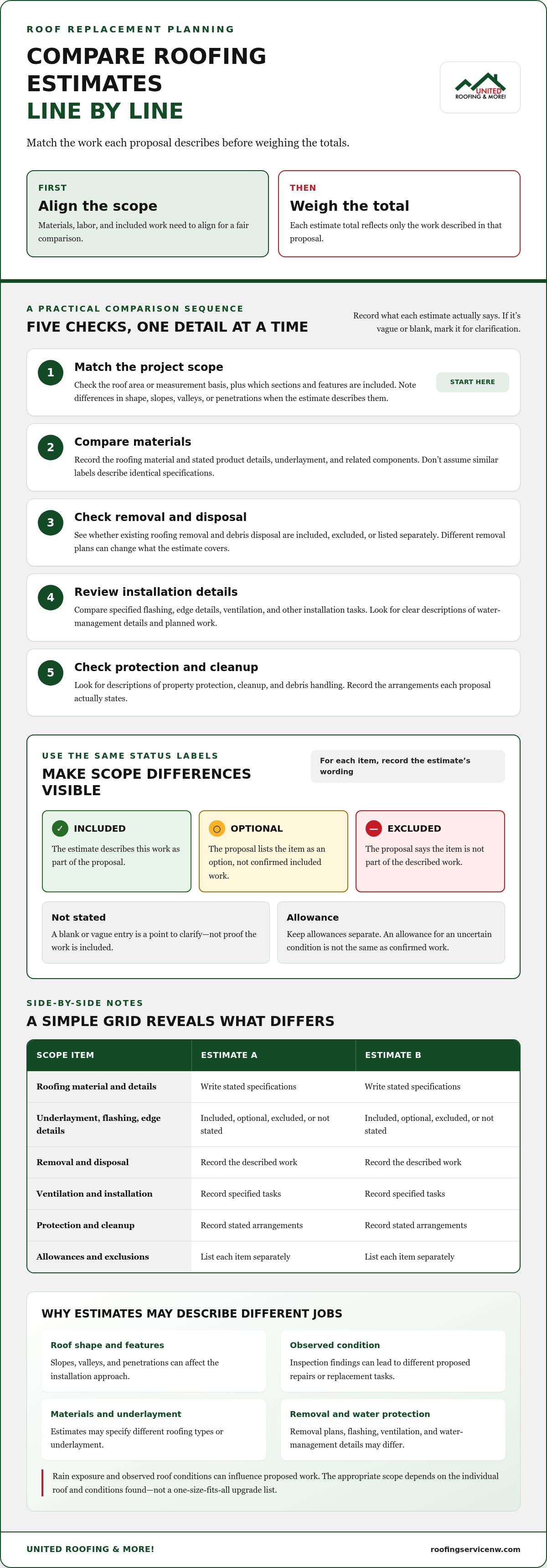
Matching inclusions matters more than comparing totals alone because each total reflects only the work described in that estimate. Use this sequence to build a like-for-like comparison:
- Match the project scope. Check the roof area or measurement basis and note which sections or features are included.
- Compare materials. Record the roofing material, any stated product details, underlayment, and related components.
- Compare removal. Note whether existing roofing removal and debris disposal are included, excluded, or listed separately.
- Review installation details. Compare specified flashing, edge details, ventilation, and other installation tasks.
- Check protection and cleanup. Look for descriptions of property protection, cleanup, and debris handling.
A simple grid helps reveal gaps without forcing unfamiliar terms into a premature yes-or-no decision. Fill each cell with the estimate’s wording, or mark it “not stated.”
| Scope item | Estimate A | Estimate B |
|---|---|---|
| Roofing material and details | Write stated specifications | Write stated specifications |
| Underlayment, flashing, edge details | Included, optional, excluded, or not stated | Included, optional, excluded, or not stated |
| Removal and disposal | Record the described work | Record the described work |
| Ventilation and installation | Record specified tasks | Record specified tasks |
| Protection and cleanup | Record stated arrangements | Record stated arrangements |
| Allowances and exclusions | List each item separately | List each item separately |
Compare roofing materials and installation components
Write down the material type and every product detail the estimate actually states. Don’t assume that similar labels mean identical specifications. Compare underlayment, flashing, edge details, and ventilation where they’re described. An item marked as an allowance is not the same as confirmed work. The National Roofing Contractors Association standards offer additional roofing-industry context as you review terminology and installation descriptions.
Check removal, property protection, and cleanup
Look for explicit descriptions of existing-roof removal and disposal instead of assuming they’re included with installation. Note any stated steps for protecting landscaping, access areas, and the home, along with how debris and cleanup are handled. If one estimate says “cleanup” without detail and another lists specific tasks, record the difference rather than treating the phrases as equivalent.
Once the grid is filled, group each line as included, optional, excluded, or allowance. That makes it easier to see which estimates describe comparable work and where a clarification could affect the comparison. For a project-specific roof replacement discussion, explore roof replacement planning with United Roofing & More!
Is the lowest roofing estimate really the best value?
Not automatically. A lower total may reflect a narrower scope, different material specifications, or work listed outside the main price. It could also reflect a genuinely different project approach. The figure alone can’t tell you which. To judge value, compare the documented work and identify what the completed project may require beyond the stated total.
Keep the comparison neutral. If an estimate doesn’t mention a task, that doesn’t prove the work is being hidden. It means the scope is unclear or the item may be excluded. Record what the document actually says, then compare the estimates on those terms.
| Item to review | Clear scope | Unclear scope | Excluded work |
|---|---|---|---|
| Roofing materials | Material and stated details are described | Broad label with limited detail | Material or component is listed as excluded |
| Removal and disposal | Removal and debris handling are described | “Removal” or “cleanup” lacks detail | Work is explicitly outside the estimate |
| Installation tasks | Specific work is listed | General wording leaves tasks uncertain | Task is identified as not included |
| Uncertain conditions | Allowance or process is explained | Placeholder has no clear definition | Potential work is expressly excluded |
Understand exclusions, allowances, and optional work
An exclusion identifies work that isn’t part of the stated scope. An allowance is a budget placeholder only when the estimate defines it that way; check what it covers and how the document says it will be handled. Optional work is a separate choice, not automatically a required part of replacement. Keep these categories distinct so you don’t compare a base estimate with another that includes additional work.
Weigh materials and workmanship without unsupported promises
Broad descriptions such as “premium” don’t tell you exactly what materials or installation tasks are proposed. Compare the actual specifications stated in each estimate, including any described preparation and installation details. Treat workmanship descriptions as evidence of planned work, not a guarantee of future performance. Don’t assume a label proves longer life or better results; rely on what the estimate documents.
To make the comparison practical, list every unclear or excluded item beside the estimate it belongs to. Then consider whether that item is needed for the project, whether another estimate includes comparable work, and whether the stated total accounts for it. If a task is listed separately, include it in your like-for-like review instead of treating it as part of the main total.
This is the core of how to compare roofing estimates: judge the proposed completed scope, not just the first number on the page. Once the differences are visible, you can weigh project fit and budget without assuming that a lower or higher estimate is automatically the better choice.
Use this roofing estimate checklist before deciding
Once you’ve identified the differences between proposals, put the details into one side-by-side record. This checklist helps you compare the work itself before weighing project timing or payment arrangements. Copy what each estimate actually says, and mark unclear items instead of filling gaps with assumptions.
Create a side-by-side estimate comparison
Use one row for each project component and one column for each estimate. Mark each item as included, excluded, optional, or unclear. Add a brief note whenever descriptions differ, such as when one proposal names a specific installation task and another uses a general phrase. A written record makes scope differences easier to understand and discuss.
- ☐ Project scope: Roof areas and work covered are described.
- ☐ Materials: Roofing material and stated product details are recorded.
- ☐ Underlayment and flashing: Each component’s status is identified.
- ☐ Installation: Specified ventilation and other installation tasks are noted.
- ☐ Removal: Existing roofing removal is marked included, excluded, optional, or unclear.
- ☐ Cleanup: Debris handling and cleanup are described.
- ☐ Protection: Any stated steps to protect the home, landscaping, and access areas are recorded.
- ☐ Exclusions and allowances: Each is listed separately, with its description copied from the estimate.
When you finish, scan for differences that could change the work or leave a task outside the stated scope. For example, “included” in one estimate and “unclear” in another is a meaningful distinction, even if both proposals use similar wording elsewhere.
Plan for project affordability without focusing only on the total
First compare estimates on equivalent scope. Then consider the full proposed work alongside your household budget and project priorities. A lower starting total may not represent the same completed scope if work is excluded or treated as optional. Keep separately listed items visible so your budget reflects the plan you’re actually considering.
Roofing financing is one way to plan for project affordability. Consider it alongside the work included and your budget, not as a substitute for understanding the estimate. Review the available roof financing options as you consider how the project may fit your finances.
Decision matrix: Use these four checks to organize your final review.
| Decision check | What to look for |
|---|---|
| Complete scope | Key project tasks are accounted for or clearly identified as excluded. |
| Clear descriptions | Materials and work are described specifically enough to compare. |
| Property fit | The proposed work reflects the roof and conditions described in the estimate. |
| Affordability | The full scope fits your budget and priorities, including separately listed work. |
This is a practical way to apply how to compare roofing estimates before making a decision. For a project-specific conversation about roof replacement planning, start planning your roof replacement with United Roofing & More!
Compare your project clearly with United Roofing & More!
Your comparison checklist gives you a useful starting point. The next step is a project-specific discussion about your roof and what a replacement plan should cover. United Roofing & More! provides roof replacement, roof installation, roof repairs, and roofing financing for residential and commercial properties across the Pacific Northwest, including Marysville, Seattle, Everett, and Tacoma.
A clear plan should reflect the property and its roofing needs. Roof shape, visible condition, and the proposed work all affect the right scope. Instead of relying on a broad label or headline total, look for a written description of the planned materials and tasks. Those details make it easier to understand what the project involves and how the plan fits your priorities.
What a clear roof replacement plan helps you understand
Defined materials and tasks make proposed work easier to evaluate. You can see what the installation covers, identify items that may need clarification, and compare the plan with your home’s needs. Professional installation supports the goal of long-lasting roof protection, but the estimate should still explain the work being proposed. A clear scope helps set expectations without relying on promises about future performance.
Use your comparison notes to guide the discussion. If an estimate leaves an item unclear, point to that line and explain what you’re trying to understand. Local considerations can vary across Marysville, Seattle, Renton, Everett, Lynnwood, Kirkland, Mount Vernon, Bothell, Edmonds, Shoreline, Sammamish, Redmond, Bellevue, Tacoma, and Kent. The project plan should be tailored to the property, not assumed to be identical across communities.
Explore a roof replacement plan that fits your project
United Roofing & More! works with homeowners and businesses on roof replacement and installation, as well as repairs for roofing needs. Start with your priorities, the roof’s condition, and the differences you noted between estimate scopes. The project plan can then focus on work that fits the property rather than a one-size-fits-all list of upgrades.
Budget matters too. Roofing financing can help manage project costs, but it doesn’t replace the need to understand the scope. Consider the proposed work alongside your budget and priorities so you can assess both the plan and its affordability.
If you’re planning a roof replacement in the Pacific Northwest, bring your comparison notes to a conversation with United Roofing & More! and discuss the work your roof needs. It’s a practical starting point for a replacement plan that fits your property.
Take the Next Step Toward a Roof Plan You Understand
A roofing decision doesn’t have to come down to choosing the first number that feels comfortable. Use what you’ve learned about how to compare roofing estimates to move from reviewing paperwork to planning a roof that fits your property and priorities. A clear conversation can turn remaining questions into a practical next step.
United Roofing & More! is a locally owned Pacific Northwest roofing contractor providing roof replacement, installation, repairs, and financing. Whether you’re planning a full replacement or addressing a roofing concern, a project discussion can focus on the work your property needs and how to approach it within your budget.
Explore roof replacement with United Roofing & More! and take the next step with a clearer sense of what you want from your roofing plan. Keep your project priorities in view as you make your decision.
Frequently Asked Questions
How do I compare roofing estimates?
Start by making a worksheet and copying each proposal’s descriptions into matching rows. This is a practical way to use how to compare roofing estimates: note where an item is described differently, and keep a question beside that line instead of relying on memory. For example, if one estimate names a material detail and another uses a broad category, record the wording so you can evaluate the difference clearly.
What should a roofing estimate include?
A roofing estimate should describe the proposed work clearly enough for you to understand what the project involves. Check whether it identifies the roof areas being addressed, the material category, and the planned tasks. If the document uses a general phrase, note what remains unspecified. You can also record the estimate date and any stated conditions that affect its scope, so you can refer to the same version during your decision process.
Should I always choose the lowest roofing estimate?
No, the lowest estimate isn’t automatically the best fit. Consider whether the proposal addresses the roofing needs identified for your property and whether its descriptions make the plan clear. A lower total may not represent the same project as another estimate, and a higher total isn’t automatically better either. Focus on the documented scope, your priorities, and whether the plan is understandable and suitable.
Why do roofing estimates vary so much?
Roofing estimates can vary because properties and proposed plans vary. A home’s roof shape or visible condition may call for a different scope than a simpler roof, and material selections or removal plans can change the work involved. In Marysville, Seattle, Renton, Everett, Lynnwood, Kirkland, Mount Vernon, Bothell, Edmonds, Shoreline, Sammamish, Redmond, Bellevue, Tacoma, and Kent, the specific property should guide the proposal, not a one-size-fits-all assumption.
What does a roofing estimate exclusion mean?
An exclusion means the estimate doesn’t include a particular task or material. For example, if flashing work is explicitly excluded, don’t treat it as part of the proposed work just because another estimate includes it. Note the exclusion and consider how it affects the overall project plan. If the document doesn’t say whether an item is included or excluded, mark it as unclear rather than assuming what the writer intended.
How can I tell whether roofing estimates cover the same work?
Compare the descriptions item by item, focusing on the work rather than the layout of each document. One proposal might group installation tasks together, while another spells them out separately. Check whether the same project areas and components are addressed, and record any quantities or specifications provided. If a key detail appears in only one estimate, treat it as a scope difference in your comparison rather than a matched item.
Can roofing financing help make a replacement project more manageable?
Roofing financing may offer a way to manage project costs as part of your household budgeting. United Roofing & More! offers financing for roofing projects. Consider your budget and priorities alongside the proposed work, and review the financing information as part of your decision. Don’t assume particular rates, eligibility, or payment terms based on an estimate comparison alone. Keeping the financing decision distinct from the scope review helps you assess both the project plan and its affordability.


