

What if the biggest risk in a roofing project isn’t the roof, but what the contract leaves unsaid? Red flags in a roofing contract can be easy to miss when you’re focused on getting repairs or a replacement underway. Vague work descriptions, unclear charges, or pressure to sign quickly can leave important questions unanswered.
It’s reasonable to want a clear price, a reliable schedule, and confidence about who’s responsible for each part of the project. A written agreement should spell out the work included, the planned materials, how payments are handled, and what happens if the scope changes. If those details are unclear, pause and get them in writing before you sign.
This guide explains which contract terms deserve a closer look for Washington roofing projects. You’ll learn how to assess the scope, payment schedule, change-order process, exclusions, warranties, and responsibilities. Use the checklists to compare your estimate with the agreement and identify unanswered questions before work begins.
Key Takeaways
- Learn what a roofing contract should clarify about project boundaries, materials, timing, and who handles permit-related responsibilities.
- Spot red flags in a roofing contract by looking beyond the deposit amount to payment triggers, written records, and change-order terms.
- Use a simple review sequence to compare the estimate with the agreement and keep important project documents organized.
- Know how to respond when you find unclear language, and recognize when repeated pressure or refusal to document terms calls for a pause.
Red Flags in a Roofing Contract: Start With the Scope of Work
A red flag is any contract term that leaves the cost, work, timing, or responsibility unclear. The scope of work is where those gaps often appear. If the document says only “roof work,” you can’t tell which roof areas are included, what tasks are planned, or where the project stops. That makes it harder to compare bids and understand what you’re agreeing to.
An estimate can help you understand a proposed project, but it isn’t automatically the final agreement. The signed contract and any documents it specifically incorporates should record the agreed project details. Compare the contract with the estimate you relied on. If one includes a detail that the other leaves out, ask for the documents to be reconciled in writing before signing. For a general overview of common agreement elements, see Wikipedia’s Construction Contract entry.
Scope checklist: The written agreement should clearly state the work, materials, exclusions, and cleanup responsibilities. These essentials show what’s included and what may require a separate decision or charge.
Does the contract describe the exact roofing work?
Look for the roof areas involved, the type of work, and clear project boundaries. Does the description identify the specific section being repaired or explain which parts of the roof are being replaced? Broad wording such as “roof work” is a warning sign when it stands in for those details. Repairs and replacement are different scopes. The agreement should describe the work planned for your property, not leave you to infer it from a general label.
Are materials, exclusions, and cleanup spelled out?
Materials should be described clearly enough to distinguish a specific product from a general category, such as shingles or underlayment. If the contract names a product, check that the same description appears wherever the materials are referenced. Review the exclusions next: work left out of the scope may affect expectations and lead to additional charges if it becomes necessary. Cleanup matters, too. Look for written terms covering debris removal and care of the work area.
- Work: Identify roof areas, tasks, and project limits.
- Materials: Record product names or clear material descriptions.
- Exclusions: Note what the quoted scope doesn’t cover.
- Cleanup: Specify who removes debris and tidies the site.
Read the scope alongside the estimate, not in isolation. If the estimate describes a replacement but the contract only says “roof work,” the documents don’t give you a clear picture of the project. Mark the gap and request a written revision stating what will be done. Clear scope language gives both sides a reliable reference as the roofing work moves forward.
Roofing Contract Red Flags in Materials, Permits, and Project Timing
Materials, permit responsibilities, and scheduling details can shape a project just as much as the work description. Red flags in a roofing contract include broad promises that don’t explain which materials are planned, who will handle permit-related steps, or how schedule changes will be communicated. Clear terms help you understand what to expect before work begins and what to do if plans shift.
Manufacturer coverage applies to the roofing product; workmanship coverage concerns installation work, and the written terms should explain each separately. A broad label such as “warranty included” doesn’t tell you what’s covered, what’s excluded, or how to make a claim.
What materials and warranty terms should the agreement identify?
Review material descriptions for enough detail to distinguish product type, relevant quantities, and any listed alternatives. If the agreement allows a substitute, look for an explanation of when that may happen and how the change will be recorded. This gives you a clear reference if the material used differs from the one originally described.
Find the documents that set out manufacturer coverage and any workmanship coverage. Read the exclusions and claim instructions. Check whether the contract refers to separate warranty documents and whether those documents are included with the agreement. Don’t treat a broad warranty label as a complete description until you’ve read the written terms.
Are permit responsibility and the schedule clear?
The agreement should state who handles permit applications and related responsibilities, including any required inspections. Permit processes can differ by location and project. For a home in Marysville, Seattle, or a nearby community, verify current requirements with the applicable city or county permitting authority. Don’t assume one city’s rules apply throughout Washington.
Scheduling language should set expectations without implying every start or completion date is guaranteed. Look for a proposed start window, an estimated project duration or completion expectation, and an explanation of how delays will be communicated. Weather can affect roofing work, so the agreement should describe how weather-related changes are handled and how updated timing will be shared.
- Materials: Are product descriptions, quantities, and alternatives clear?
- Coverage: Are manufacturer and workmanship terms explained separately, with exclusions and claim steps?
- Permits: Does the agreement assign application and inspection responsibilities?
- Timing: Does it explain schedule expectations and delay communication?
If a detail is missing, ask for the agreement to state it plainly before signing. A roofing repair or replacement can proceed with fewer avoidable surprises when materials, local permit responsibilities, and schedule expectations are documented. For roof repair and replacement, explore roof repair and replacement.
Payment and Change-Order Red Flags in a Roofing Contract
A deposit’s size, by itself, doesn’t tell you whether a payment schedule is fair. Check whether each payment has a clear amount, due date, and project-related trigger, with a written record of what it covers. Red flags in a roofing contract include open-ended phrases such as “balance due upon progress” without defining the progress or explaining how payment will be documented.
Does the payment schedule connect payments to project milestones?
Review every payment point, from the initial payment through the final balance. The agreement should explain when each amount is due and what project milestone triggers it. If payment timing, the remaining balance, or the meaning of a milestone is open to interpretation, request clearer wording. A demand for full payment before the work is clearly described is a reason to pause and get the terms explained in writing.
Use this comparison to see whether each payment clause is understandable:
| Payment timing | Trigger | Written record | Question left unanswered |
|---|---|---|---|
| Initial payment | Signing or another stated event | Contract and payment receipt | What does this payment cover? |
| Progress payment | A defined project milestone | Updated invoice or receipt | How is the milestone confirmed? |
| Final payment | A clearly described completion point | Final invoice and receipt | What work must be completed first? |
Check that the payment method and recordkeeping are clear, too. Keep receipts and invoices with your contract so the amount paid and the related project stage are easy to trace. Don’t rely on a verbal explanation to fill a gap in the written schedule.
How does the contract handle changes and financing?
Roofing work can uncover a need to adjust the original plan. The contract should explain how proposed added work is handled before it proceeds. A written change order should describe the revised work, any price adjustment, and how approval is recorded. Without one, you and the contractor may later remember a conversation differently or disagree about whether a charge was approved.
For example, if a proposed change affects the work or cost, ask for the updated terms in writing and review them before authorizing the change. A clause that allows charges without a clear approval step deserves clarification. Keep each signed change order with the original agreement.
If financing is part of the project, review its disclosures separately from the roofing contract. Understand the payment obligations and applicable terms, and identify which document governs each obligation. Clear payment steps, documented changes, and organized records make project costs easier to follow.
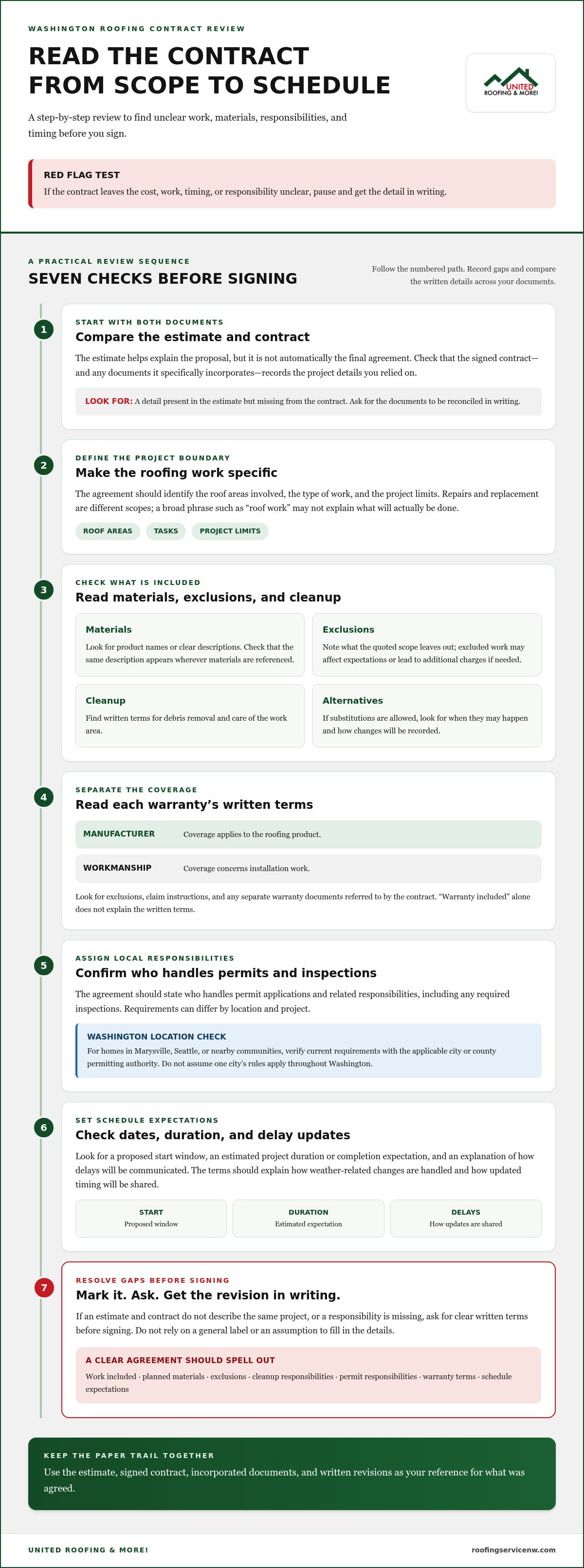
How to Review a Roofing Contract in Washington Before Signing
A careful review doesn’t need to be complicated. Follow the same sequence each time and keep a record of what you checked. This helps you catch red flags in a roofing contract while there’s still time to request a clear written revision.
- Identify the parties. Check that the agreement names the homeowner and contracting business correctly. Compare the business name with the information in Washington State Department of Labor & Industries (L&I) contractor lookup resources.
- Compare the scope. Read the estimate beside the contract. Note differences in the work, materials, project boundaries, or exclusions, and make sure the final agreement reflects the terms you understand.
- Inspect payment terms. Trace each payment to its due date or stated project milestone. Look for unclear triggers, open-ended balances, and charges that aren’t explained in the paperwork.
- Verify responsibilities. Review who handles permit applications and related project steps. Check current contractor information through L&I, and confirm permit rules with the authority for the property’s location.
- Request edits. Ask for unclear or conflicting language to be revised in writing. Review the updated copy before signing, including any amendments or attached documents it refers to.
Which Washington records and local rules should homeowners check?
Use Washington L&I’s contractor lookup resources to review current registration, bond, and insurance information. Compare the details in the state’s current records with the information in the proposal instead of relying only on a number or document supplied with it. Check the records relevant to the contractor and project, and note the date of your search.
Permit rules can vary by jurisdiction. Requirements for a property in Seattle may differ from those in Snohomish County or another Washington community. Confirm current rules with the applicable city or county permitting authority rather than assuming a nearby jurisdiction follows the same process.
What should you do when a clause is unclear?
Pause before signing. Write down the exact clause and ask for its meaning, scope, or payment trigger in a written response. Then compare the revised contract with the estimate and make sure agreed changes appear in the final copy. Don’t sign blank fields or treat a verbal explanation as a substitute for terms in the agreement.
Keep the estimate, signed contract, amendments, written clarifications, invoices, and payment records together. A dated note of questions and responses can help you track which version includes each agreed change.
In the Pacific Northwest, wet weather is a practical scheduling consideration, but it doesn’t predict a specific delay. Check whether the contract explains how schedule updates will be communicated if conditions affect the work. Once the agreement is clear, explore roof repair and replacement options.
Roofing Contract Red Flags: What to Do and Next Steps
Finding unclear language doesn’t always mean you need to walk away. Start with a practical response: pause, identify the uncertainty, request a written revision, and review the final copy before signing. How the issue is handled can help you decide whether it’s a correctable omission or one of the more serious red flags in a roofing contract.
- Pause. Don’t sign while a key term remains unclear or you feel rushed.
- Make a short list. Note the exact wording and what you need clarified, such as what a clause covers or what event triggers a payment.
- Request a written revision. Ask for the explanation or change to appear in the agreement or an attached amendment.
- Review the final copy. Compare it with the estimate and your notes. Make sure the agreed revisions are present and the documents don’t conflict.
When is clarification enough, and when should you pause?
An incomplete clause may be easy to resolve if the company responds clearly and documents the agreed wording. Pause if pressure to sign continues, important terms conflict across documents, or requested changes remain unwritten. Keep copies of the agreement and your written questions. If you’re facing a contract dispute or need an interpretation of your legal rights, seek advice from a qualified legal professional.
Look at the pattern, not just one missing detail. A prompt, written correction can resolve an oversight. Repeated pressure, refusal to put material terms in writing, or paperwork that keeps changing without explanation gives you a stronger reason to stop and reconsider. Take the time you need to understand the agreement.
How can a local roofing conversation make the next step clearer?
Once you’re comfortable with the written terms, you can focus on the roofing work itself. United Roofing & More! provides roof replacement, installation, and repair services for residential and commercial properties in Marysville, Seattle, Renton, Everett, Lynnwood, Kirkland, Mount Vernon, Bothell, Edmonds, Shoreline, Sammamish, Redmond, Bellevue, Tacoma, and Kent. A clear project conversation helps connect your needs with the work being considered.
Project funding is part of planning, too. United Roofing & More! offers roofing financing options to help homeowners and businesses fund roofing projects. Review the financing documents carefully so you understand the obligations and terms they describe.
When the scope, responsibilities, and paperwork make sense to you, contact United Roofing & More! to discuss roof replacement, installation, repairs, or project financing.
Move Forward With a Clear Plan
Knowing how to recognize red flags in a roofing contract puts you in a stronger position to choose your next step. Take the time you need to understand the written agreement. If something is unclear, ask for a straightforward explanation before work begins. A roofing project should start with shared expectations, not unanswered questions.
United Roofing & More! provides roof replacement, installation, and repair services for residential and commercial properties in Marysville, Seattle, Renton, Everett, Lynnwood, Kirkland, Mount Vernon, Bothell, Edmonds, Shoreline, Sammamish, Redmond, Bellevue, Tacoma, and Kent. Roofing financing options are available to help fund projects. Discuss the work you need and review the written terms before moving forward.
Discuss your roofing project with United Roofing & More! Start with a conversation about the work, the scope, and your project funding options.
Frequently Asked Questions
Is it a red flag if a roofing contractor asks for a deposit?
No, a deposit alone doesn’t show whether the terms are fair. Check when it’s due, how it will be applied to the project, and what the agreement says if the work changes or doesn’t proceed. Ask for a receipt and keep it with your contract. If the payment terms are unclear, pause and check current Washington guidance through official state resources before paying.
What should a roofing contract include before I sign?
A roofing contract should identify the parties and explain the work, materials, payment terms, timing, and responsibilities. Also check how the agreement handles changes, cleanup, and warranty documents. As a practical cross-check, compare the business name and project address across the contract, estimate, and attachments. Make sure handwritten edits are incorporated into the final copy, and don’t sign while blanks or conflicting details remain.
Can I cancel a roofing contract after signing in Washington?
Possibly, but cancellation rights depend on the circumstances, the contract, and applicable law. Don’t assume a single cancellation period applies to every roofing project. Read the cancellation section and note any instructions and deadlines stated there. Keep the signed agreement and a record of notices you send or receive. For advice about your specific rights or a disagreement, consult current Washington consumer-protection resources or an attorney.
What happens if the roofer finds damage after removing the roof?
The next steps should follow the contract’s process for concealed damage and added work. Ask for a written description of what was found, along with any proposed scope, cost, or schedule change, before authorizing extra work. Photos can help document the condition and support a clear discussion. Keep them with the original agreement and any signed change orders so the project record shows what changed and why.
Should a roofing contract list who obtains the permit?
Yes. The agreement should state who handles permit applications and any related project steps, while you verify current requirements for the property’s jurisdiction. Rules can differ in Marysville, Seattle, Renton, Everett, Lynnwood, Kirkland, Mount Vernon, Bothell, Edmonds, Shoreline, Sammamish, Redmond, Bellevue, Tacoma, and Kent. Check with the relevant city or county authority; don’t assume nearby communities follow identical processes.
Is pressure to sign a roofing contract the same day a red flag?
Pressure to sign before you’ve had time to review the agreement is a reason to slow down. Red flags in a roofing contract matter most when urgency keeps you from understanding the written terms. Request a copy and take time to read it. After storm damage, distinguish any immediate protective work from a separate decision to authorize a full repair or replacement.
How can I check a roofing contractor in Washington?
Use the Washington State Department of Labor & Industries’ contractor lookup resources to review the business’s available state record. Compare the business name and identifying details shown there with the name on your estimate and contract. Review relevant registration, bond, and insurance information, and verify current requirements through L&I. Keep a dated note of what you checked, but remember that a lookup doesn’t explain the project terms in your agreement.


