
A certificate of insurance can look official and still leave an important question unanswered: Is the coverage active, and does it apply to your roofing project? For a roof replacement, installation, or repair, knowing how to check a roofer's insurance helps you look beyond paperwork and assess whether it relates to the work planned at your home.
It’s reasonable to wonder what could happen if a worker is injured or your property is damaged. A certificate can summarize coverage, but it doesn’t necessarily confirm that a policy is still in force or that its terms cover the work. Checking the details directly can give you a clearer picture before work begins.
This guide explains what documents to request, which details to compare, and how to verify policy information with the insurer or agent. It also covers coverage types, limits, exclusions, subcontractor arrangements, and Washington contractor credentials. Use the checklist to identify questions and clarify project responsibilities before signing or scheduling work.
Key Takeaways
- Learn how to check a roofer's insurance with a practical checklist for reviewing documents, business details, and policy dates.
- Understand what a certificate of insurance can show and why it doesn’t guarantee that every claim or type of roofing work is covered.
- Verify policy information directly with the insurer or agent, then keep a record of the response.
- Washington homeowners can use the L&I contractor lookup to review credentials, but that is separate from confirming policy coverage.
- Use a final checklist to spot missing or inconsistent information and clarify project responsibilities before signing or scheduling work.
Why Check a Roofer’s Insurance Before Roof Work Begins?
Roofer’s insurance is a general term for business policies that may help address certain risks connected to roofing work. Checking the details before a roof replacement, installation, or repair helps you understand what protections may apply if a worker is injured, your property is accidentally damaged, or a project-related dispute arises. It doesn’t guarantee that a particular claim will be paid or resolve disagreements about workmanship.
Coverage depends on the policy wording, exclusions, limits, the work being performed, the business structure, and applicable jurisdictional requirements. That’s why how to check a roofer's insurance means looking beyond a general assurance that the company is insured.
What Does a Roofer’s Insurance Usually Cover?
Different policies address different risks. General liability may apply to certain third-party injuries or property damage, subject to the policy’s terms. For example, if roofing work accidentally damages a neighboring structure, the wording and exclusions help determine whether the event may be covered.
Workers’ compensation is a separate category related to work injuries. Which requirements apply can depend on Washington rules and the roofer’s employment arrangements, so don’t assume a policy or exemption applies based on a brief description. Commercial auto insurance generally relates to vehicles used for business, but it isn’t a substitute for liability or workers’ compensation coverage.
For a roof replacement, property coverage is another distinct consideration. Builder's risk insurance is a type of property insurance associated with buildings under construction. Its terms and applicability vary, so don’t assume it’s included in a roofer’s policies or in your own home coverage.
Why a Certificate of Insurance Is Not the Whole Policy
A certificate of insurance (COI) summarizes selected information, such as the insurer, policy dates, and stated coverage limits. It is not the full insurance contract and, by itself, doesn’t prove that a particular claim or roofing operation is covered.
A certificate is a useful starting point, but the underlying policy controls. Exclusions, covered operations, limits, and conditions can affect whether protection applies to the work planned at your home. A logo on a document or a verbal assurance doesn’t answer those questions.
Keep the distinction clear: paperwork can describe coverage, but it doesn’t replace checking that coverage is active and relevant to the project. Reviewing the details can make conversations about roof repairs or replacement clearer before work starts. Ask for unclear points to be explained in writing.
How to Check a Roofer’s Insurance: A Step-by-Step Checklist
A consistent process makes how to check a roofer's insurance easier to manage before a Seattle- or Marysville-area roofing project. Gather the documents, compare the details, and verify them through contact information you source independently. Keep a record of what you learn.
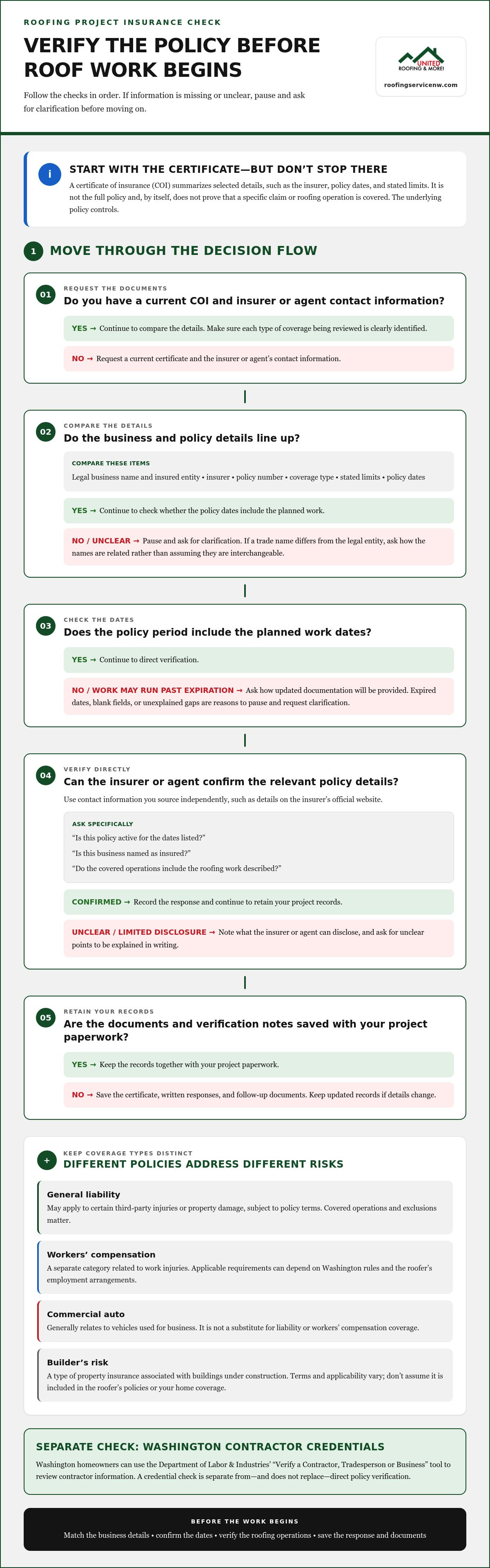
- Request the documents. Ask for a current certificate of insurance and the insurer or agent’s contact information. If you’re reviewing more than one type of coverage, make sure each is clearly identified.
- Compare the details. Match the legal business name and insured entity on the certificate with the name on the estimate or contract. Review the insurer, policy number, coverage type, stated limits, and policy dates.
- Check the dates. Confirm that the policy period includes the planned work dates. If work may continue beyond the listed expiration date, ask how updated documentation will be provided.
- Verify directly. Contact the insurer or agent using independently sourced contact information, such as details on the insurer’s official website. Ask whether the policy is active, whether the named business is insured, and whether the described roofing operations fall within covered operations. Note any limits on what they can disclose.
- Retain your records. Save the certificate, written responses, and follow-up documents with your project paperwork. Keep updated records if details change.
What Details Should You Compare on the Certificate?
Check that the business name is consistent across the certificate, proposal, and contract. A trade name may differ from a legal entity name, so ask for a clear explanation of the relationship rather than assuming the names are interchangeable. Review the policy dates, coverage descriptions, and limits. Mismatched names, expired dates, blank fields, or unexplained gaps are reasons to pause and request clarification.
How to Confirm Coverage With the Insurer or Agent
Ask specific questions: “Is this policy active for the dates listed?” and “Does the policy identify this business and include the roof work described?” Record the date, who you spoke with, and the response. A state credential check is a separate step. Washington homeowners can use the Department of Labor & Industries’ Verify a Contractor, Tradesperson or Business tool to review contractor information, but it doesn’t replace direct policy verification.
Save this checklist: the legal business name matches; insurer and policy details are clear; dates cover the project; roofing operations were discussed; and verification notes and documents are saved. Keep insurance questions part of the same clear planning conversation as your roof replacement or repair project.
Does the Policy Cover This Roofing Job and Everyone Doing the Work?
A current certificate doesn’t prove that every claim will be covered. It’s a snapshot of selected policy details, not a decision about how an insurer would handle a specific incident. Coverage depends on the policy’s terms, including its limits, exclusions, endorsements, named insureds, and covered operations. When checking how to check a roofer's insurance, compare the planned work and the people doing it with the protections described.
| Coverage type | General purpose | What to clarify |
|---|---|---|
| General liability | May apply to certain third-party injury or property damage claims. | Do the covered operations include the roofing work planned at your home? |
| Workers’ compensation | A separate category related to injuries to workers. | How are employees or crews performing the work addressed under applicable requirements and coverage? |
| Commercial auto | Generally relates to vehicles used for business. | Are business vehicles covered under the relevant policy? This coverage isn’t a substitute for the other categories. |
These policies aren’t interchangeable. A limit is the maximum amount available under specified terms, while an exclusion may remove certain situations from coverage. An endorsement can change or add policy terms. Check which business or legal entity is named as insured, too. A related company name on paperwork doesn’t automatically mean the entity doing your roof work is insured.
Do Subcontractors and Roofing Crews Need Separate Verification?
The company you hire may use its own employees, subcontractors, or a mix of crews. Their insurance records and arrangements may differ. Before work begins, clarify who is expected to perform the roofing work and how each relevant business is documented. Don’t assume every subcontractor must carry identical policies. Requirements can vary with the circumstances and applicable rules. If a subcontractor will be involved, include that arrangement in your coverage questions.
What Policy Gaps or Exclusions Should Raise Questions?
Some policies may limit coverage for particular operations, property types, or subcontracted work. Insurance discussions often flag examples such as roofs above a specified height, torch-down applications, and open-roof conditions. These are prompts for clarification, not proof that a particular roofer has an exclusion.
Describe the actual project clearly, including the type of work and who will perform it. If a policy term or answer is unclear, ask the insurer or agent to explain it before authorizing the work. Save the response with your project records. Clear answers help you understand the documents without treating a certificate as a guarantee of coverage.
How Washington Homeowners Can Verify a Roofer’s Credentials
Washington homeowners can check a roofer’s contractor registration through the Washington State Department of Labor & Industries (L&I). The state’s Verify a Contractor, Tradesperson or Business tool lets you search for a business and review its registration information, including bond and insurance status. Use these details as one part of your review, not as proof that a particular insurance policy covers your project.
An L&I credential check reviews contractor information; confirmation from the insurer or agent addresses the policy and its coverage. Keep both checks in your project records. Registration, bond, and insurance requirements can depend on state rules and business circumstances, so rely on current L&I guidance for official requirements and definitions.
Using Washington L&I’s Contractor Lookup
Search by the contractor’s business name or registration number. Compare the identity in the results with the estimate, contract, and insurance documents. If a trade name differs from the listed business, ask for a clear explanation of how the names relate before proceeding. Review the current status and any bond or insurance information displayed, and follow L&I’s explanations for interpreting those fields. Lookup labels and available details may change, so use the agency’s current instructions rather than relying on an old screenshot or saved guide.
Keep the checks distinct. An L&I listing can help you review the contractor’s state credential information, but it doesn’t show every policy term, exclusion, limit, or covered operation. To understand how to check a roofer's insurance, verify policy details separately with the insurer or agent, as described in the checklist above.
Local Project Details Worth Clarifying in the Puget Sound
Whether your home is in Marysville, Everett, Seattle, or another nearby Puget Sound community, describe the planned work accurately when discussing insurance. A focused repair, a full replacement, and work following storm damage may involve different operations. Explain the property type, the scope of work, and whether employees or subcontractors will perform the job. Then ask whether the named business and described operations align with the policy information.
Be specific, but don’t assume local weather creates a particular insurance requirement. The goal is to compare the actual project with the records and get unclear terms explained before work begins. That keeps planning for a roof repair or replacement organized and supports clear communication throughout the project.
Planning a roofing project in the Seattle area? Discuss your roof replacement or repair plans as part of a clear project conversation.
Make an Informed Roofing Decision Before Work Begins
Before you sign an agreement or schedule a roof repair, replacement, or installation, review the insurance information alongside the project paperwork. A careful check won’t guarantee how a future claim will be handled, but it can help you identify unanswered questions and get clearer information before work starts.
Use this final checklist:
- Insurer verified: You confirmed policy details using independently sourced contact information.
- Dates checked: The policy period covers the planned work dates.
- Business matched: The insured business identity aligns with the estimate and project documents, or any difference is explained.
- Work described: The insurer or agent received a clear description of the project and relevant operations.
- Answers documented: You saved the certificate, verification notes, estimate, and written project scope.
Questions to Resolve Before Authorizing Roofing Work
If a name doesn’t match, a date has passed, or an answer is unclear, pause and ask for clarification. Confirm which business is responsible for the work and whether employees or subcontractors will be involved. Ask how relevant coverage information is documented for those parties. Keep a written record of open questions and any response from the insurer or agent. If the explanation changes, request an updated document or written clarification before signing or scheduling.
Keep your records together. The certificate and verification notes show what you reviewed; the estimate and written scope help establish what work was discussed. Having these documents in one place makes it easier to refer to the same project details during planning.
Plan Your Roofing Project With Clear Information
United Roofing & More! provides roof repair, replacement, and installation services in the Pacific Northwest, including Marysville, Seattle, Renton, Everett, Lynnwood, Kirkland, Mount Vernon, Bothell, Edmonds, Shoreline, Sammamish, Redmond, Bellevue, Tacoma, and Kent. Clear project planning includes understanding the work scope, reviewing insurance information, and discussing project costs. Roofing financing options can also help with planning how to manage those costs.
Ready to discuss your roof repair, replacement, or installation? Discuss your roofing project with United Roofing & More! Asking how to check a roofer's insurance is one part of making an informed roofing decision. Keep the conversation clear from the first project details through the final paperwork.
Move Forward With Clear Roofing Project Details
Knowing how to check a roofer's insurance gives you a practical way to make a more informed decision before roof work begins. Request the insurance documents, compare the named business and policy dates with your project paperwork, and verify coverage details directly with the insurer or agent.
A certificate is a summary, not a promise that every claim or roofing operation is covered. Ask how the policy relates to the planned work and the people performing it. In Washington, a contractor lookup is useful for reviewing credential information, but it doesn’t replace confirming policy details with the insurer.
United Roofing & More! is a locally owned and operated roofing contractor serving the Pacific Northwest, with roof replacement, installation, and repair services. Clear project conversations help you understand the work ahead and plan with confidence. Discuss your roof repair or replacement project with United Roofing & More!
Take it one step at a time. With your questions answered and documents organized, you can move forward better prepared.
Frequently Asked Questions
How can I check if a roofer’s insurance is active?
To learn how to check a roofer's insurance, contact the listed insurer or agent using contact details you find independently. Provide the policy number, named business, and planned work dates, then ask whether the policy is currently active and whether the described roofing operations fall within covered operations. Compare the response with the certificate and project paperwork. Note whom you spoke with, when you spoke, and what they confirmed.
Is a certificate of insurance enough to verify a roofer’s coverage?
No. A certificate of insurance summarizes selected details, such as the insurer, policy dates, and stated limits. It isn’t the full policy and doesn’t confirm that every claim, operation, or worker is covered. Use it to identify details for follow-up, then verify policy status and project relevance with the insurer or agent. Policy wording, exclusions, and endorsements determine how coverage applies.
What insurance should a roofing contractor have?
Coverage to ask about may include general liability, workers’ compensation, and commercial auto insurance. They serve different purposes: liability may apply to certain third-party injury or property damage, workers’ compensation relates to worker injuries, and commercial auto generally concerns business vehicles. Requirements and appropriate coverage depend on state rules, business structure, and project details. Don’t assume one policy replaces another or that the same limits apply to every job.
Can I contact a roofer’s insurance company to verify coverage?
Yes. Use contact information you source independently, such as from the insurer’s official website, and have the certificate or policy details ready. Ask whether the policy is active, whether the business named on your project is insured, and whether the described roofing work falls within covered operations. The insurer or agent may limit what they can share, but you can still request clarification. Save any response or follow-up documentation with your project records.
How do I check a Washington roofer’s contractor registration?
Use the Washington State Department of Labor & Industries’ contractor lookup and search by business name or registration number. Compare the result with the identity on your estimate and project documents, and follow the agency’s current guidance for interpreting the status and other displayed fields. Homeowners in Marysville, Seattle, Renton, Everett, Lynnwood, Kirkland, Mount Vernon, Bothell, Edmonds, Shoreline, Sammamish, Redmond, Bellevue, Tacoma, and Kent should treat this as separate from direct insurance-policy verification.
What happens if a roofer’s insurance expires during my project?
If the listed policy expires before the work is complete, don’t assume coverage continues or has ended without checking. Contact the roofer and insurer or agent to clarify the policy status and request current documentation. Ask how the project dates and remaining work are addressed, and keep the response in writing. Before authorizing further work, make sure the business and coverage details are clear and consistent with the project paperwork.
Does a roofer’s insurance cover subcontractors?
Not necessarily. Coverage for subcontracted work depends on the policy terms, named insureds, endorsements, and how the work is arranged. The subcontractor may have separate coverage, or the roofer’s policy may address the arrangement differently. Ask who will perform the work and how relevant coverage is documented. For a specific answer, describe the subcontracting arrangement to the insurer or agent and keep the explanation with your project records.


