
Choosing federal way commercial roofing is about more than picking a material. The right plan accounts for the building’s condition, how it is used, drainage, maintenance needs, and the disruption roofing work could cause.
If you’re weighing repairs against replacement or comparing options for a new building, start with clear, property-specific information. Understand what the roof needs now, how different systems may affect future maintenance, and how the work could affect daily operations.
This guide explains how to assess the factors behind a commercial roofing investment. You’ll compare common system categories based on durability, upkeep, and operational needs, then learn what to expect from an assessment through repair, installation, or replacement. United Roofing & More! provides commercial roof repairs, installation, and replacement, along with roofing financing options to support project planning.
Key Takeaways
- Match roofing options to your building’s use, drainage needs, maintenance priorities, and project requirements rather than looking for one universal “best” system.
- Use documented roof conditions to compare repair, replacement, and new installation scopes.
- Make sure the written project scope identifies work areas, materials, preparation, and cleanup.
- Plan for deliveries, parking, tenants, operating hours, and restricted areas to help limit disruption during roofing work.
- A property-focused assessment, clear communication, and an operations plan can help you make a more confident roofing decision.
Federal Way Commercial Roofing: Start With the Building’s Needs
Property owners often begin with a practical question: should they repair an existing roof, replace it, or install a roof on a new building? The answer depends on more than a visible problem. Building use, occupancy, roof access, and maintenance priorities all shape the work a property needs.
A commercial roof supports the building’s operations as well as its structure. A roof over a busy retail space, for example, may need a work plan that accounts for customer access and deliveries. A building with restricted roof access may need a different inspection and maintenance approach from one that is easier to access. These operational details help shape the project scope alongside roof condition. Commercial roofing decisions may also involve coordinating work across larger roof areas and around tenants, staff, equipment, or business hours.
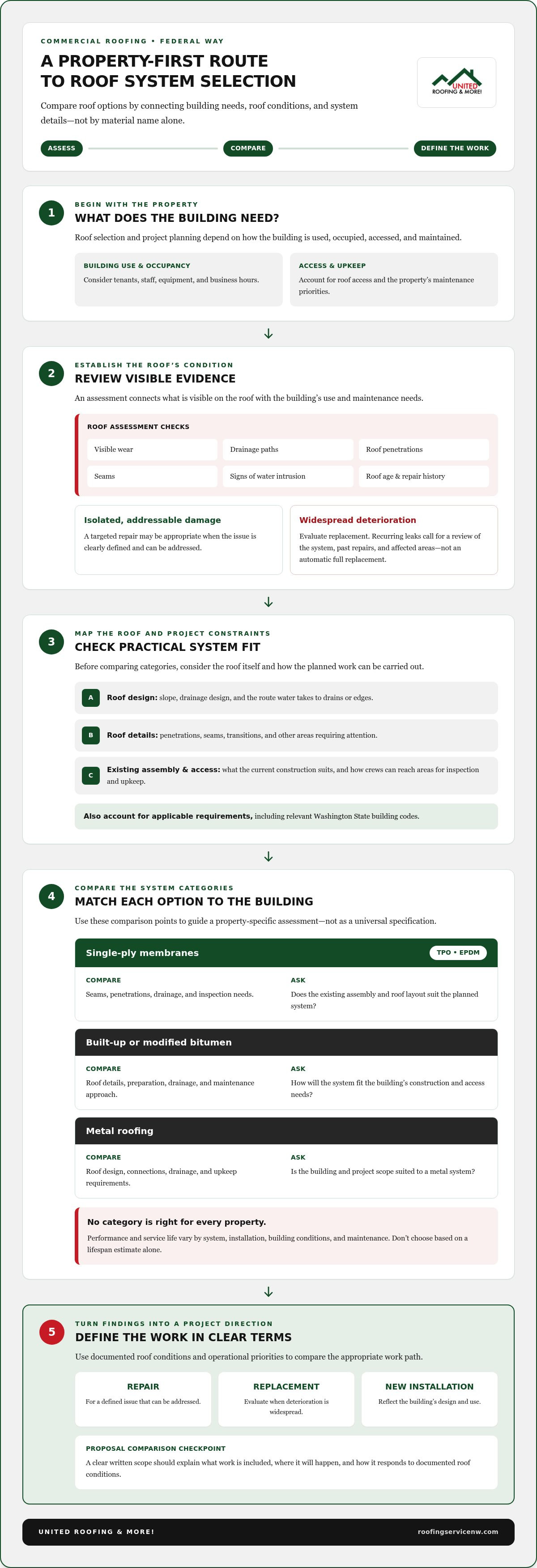
A commercial roof assessment connects visible roof conditions with the building’s use to help identify a practical next step. It’s a useful starting point for a targeted repair, a replacement plan, or a new installation. To understand the range of system categories, review this overview of commercial roofing materials.
What should a commercial roof assessment cover?
An assessment should review visible wear, drainage paths, roof penetrations, seams, and signs of water intrusion. Roof age and repair history add useful context. A newer roof with one clearly defined issue may call for a different response than an older system with repeated problems. Consider the findings alongside the building’s use and maintenance needs rather than treating them as a one-size-fits-all diagnosis.
When might repair or replacement make more sense?
Repair may be appropriate when damage is isolated and can be addressed. Widespread deterioration may point toward evaluating replacement, but recurring leaks don’t automatically mean the entire roof needs to come off. They’re a reason to review the system, previous repairs, and the extent of affected areas. For more context, read this roof replacement guide.
United Roofing & More! provides commercial roof repair, replacement, and installation. Match the work to documented conditions and operational priorities, then use a clear assessment to define the project’s direction.
How to Compare Commercial Roofing Options for a Federal Way Property
Compare roof systems by starting with the building, not a material label. Commercial roof selection depends on system fit and property demands. Roof slope, drainage design, penetrations, access, and the existing roof assembly all affect which options are practical for federal way commercial roofing. Project planning should also account for applicable requirements, including relevant Washington State building codes.
Which commercial roof factors matter beyond material?
Consider how water moves across and off the roof, where drains and penetrations are located, and how crews can reach areas for inspection and upkeep. Then weigh those details against the building’s operations. A property with limited maintenance capacity may prioritize manageable upkeep, while a roof with complex details needs careful attention to those areas in the project scope. Performance and service life vary by system, installation, building conditions, and maintenance, so don’t choose based on a lifespan estimate alone.
How do flat and low-slope roof systems differ?
“Flat” roofs generally have some slope to direct water toward drains or edges. TPO and EPDM are examples of single-ply membrane systems used on commercial roofs. Their seams, transitions, penetrations, and drainage details all matter to how the complete roof performs. Metal roofing is another broad category, and its fit depends on the building, roof design, and project requirements. No category is right for every property.
| System category | What to compare | Project questions |
|---|---|---|
| Single-ply membranes, such as TPO or EPDM | Seams, penetrations, drainage, and inspection needs | Does the existing assembly and roof layout suit the planned system? |
| Built-up or modified bitumen | Roof details, preparation, drainage, and maintenance approach | How will the system fit the building’s construction and access needs? |
| Metal roofing | Roof design, connections, drainage, and upkeep requirements | Is the building and project scope suited to a metal system? |
Use the table as a starting point, not a specification. Existing construction can limit or guide the options, so a project-specific assessment helps establish compatibility before selecting a system. United Roofing & More! provides roof replacement, installation, and repair services. Explore commercial roofing options as you consider the next step for your property.
Federal Way Commercial Roofing: Evaluate Scope, Safety, and Project Value
A sound project decision starts with matching the proposed work to documented roof conditions. A repair scope should identify the specific areas and work involved. Replacement may cover a broader area or roofing system, while a new installation should reflect the building’s design and use. For federal way commercial roofing, comparing options is easier when each proposal explains the work in clear, consistent terms.
A clear written scope helps owners compare proposals by showing what work is included, where it will happen, and how it responds to documented roof conditions.
What should a commercial roofing project scope explain?
Look for enough detail to understand the planned work, not just a broad label such as “repair” or “replacement.” A useful scope should identify:
- Work areas: Which roof sections or specific problem areas are included?
- Materials: What material category is proposed for the repair, replacement, or installation?
- Work stages: What preparation and installation or repair steps are included?
- Site details: What access arrangements, exclusions, and cleanup expectations apply?
These details help show whether a proposed repair addresses the observed issue or covers a larger area. They also make it easier to spot differences between proposals, since similar project descriptions don’t necessarily include the same work.
How can owners weigh project value without relying on price alone?
Compare the proposed scope with the assessment findings, the building’s use, and its maintenance capacity. A repair may be a practical response to isolated damage, while repeated issues or broader deterioration may warrant evaluating a more extensive scope. Consider the operational effect of the work, the upkeep it may require, and the potential consequences of postponing needed repairs. These trade-offs help put a proposal in context.
Safety and site coordination belong in the planning conversation, too. The work plan should address roof access, active work areas, and how people and business activity around the property will be managed. Applicable safety and permit requirements depend on project details, so account for requirements that apply to the specific job in the scope and schedule.
For payment-planning context, see this roofing financing guide. United Roofing & More! provides commercial roof repairs, replacement, and installation, with financing options for roofing projects. A clear scope and open project communication help connect the investment to the roof’s needs and the business’s priorities.
Plan Commercial Roofing Work Around Federal Way Business Operations
A roofing project can affect more than the roof. Staff, tenants, customers, deliveries, and parking may all need to adjust while work is underway. A clear plan helps property teams prepare and keep communication organized. For federal way commercial roofing projects, build the schedule around both the work scope and the way the property operates.
What should property teams prepare before roofing work?
Use this sequence to move from assessment to a workable site plan:
- Review the assessment and scope. Identify the roof areas involved, planned work, and site access needs.
- Name points of contact. Decide who will coordinate between the property team and roofing crew, and who will share updates with staff or tenants.
- Map daily operations. Note operating hours, delivery windows, parking patterns, tenant needs, and areas with restricted access.
- Set the schedule and communication plan. Agree on how updates will be shared and how schedule changes or temporary access adjustments will be communicated.
- Prepare the site. Share relevant expectations for staging, noise, and temporary changes to entrances or parking, where applicable.
Make updates useful and specific. A tenant who relies on a particular entrance needs to know if access will change. A delivery team may need notice if a loading area will be affected. Clear points of contact help prevent messages from getting lost between property management, occupants, and the work crew.
How should Federal Way weather and local requirements factor into planning?
Pacific Northwest weather can affect roofing schedules, so plan around current site conditions and the needs of the specific work. Discuss how the work area will be protected during the project and how schedule updates will be communicated if conditions change. Don’t assume every roof or project follows the same timeline.
Before work begins, verify applicable City of Federal Way permit requirements and Washington building-code provisions for the project. Requirements can depend on the scope, so account for them during planning. A project plan that aligns assessment findings, site logistics, weather considerations, and applicable requirements gives owners a clearer view of what to expect.
United Roofing & More! provides commercial roof repairs, replacement, and installation, with clear project communication to support planning. Discuss your commercial roofing project and take the next step toward a work plan built around your property’s needs.
Choose a Federal Way Commercial Roofing Partner and Take the Next Step
A confident roofing decision connects three things: the roof’s documented condition, a scope that explains the proposed work, and a plan that accounts for how the property operates. For federal way commercial roofing, this approach helps owners focus on what their building needs, whether that means repair, replacement, or new installation.
What does United Roofing & More! bring to a commercial roofing project?
United Roofing & More! is locally owned and operated in the Pacific Northwest and provides commercial roof repairs, replacement, and installation. The right work depends on the property’s condition and use. Clear project communication helps owners understand the scope and how the work relates to their roofing needs. Roofing financing options can also support project planning, helping property owners consider how to approach the investment.
What are the next steps for Federal Way property owners?
Prepare a few practical details before discussing the project. Gather any available roof history, note known leak locations, and outline building-use needs, access considerations, and operational constraints. This information helps clarify the project discussion and shape a scope around the property rather than a generic solution.
- Collect records of previous roof work and repairs.
- Note where leaks or visible concerns have occurred.
- Identify access restrictions, tenants, and important operating needs.
- Discuss how the roof’s condition connects to repair, replacement, or installation options.
For broader workmanship context, review this roofing standards guide. Use it alongside a property-focused discussion, since the scope and priorities differ for each commercial building.
When you’re ready to discuss your property’s roof condition, operational needs, and potential scope, talk with United Roofing & More!
Make a Confident Plan for Your Commercial Roof
A strong roofing decision starts with the building’s needs. Assess the roof’s condition, compare repair, replacement, or installation options against a clear project scope, and plan work around business operations. These steps help Federal Way property owners make choices based on more than roofing material alone.
For federal way commercial roofing, United Roofing & More! provides commercial roof repair, replacement, and installation as a locally owned and operated Pacific Northwest contractor. Roofing financing options can also support project planning. Clear communication helps you understand the work and how it fits your property.
Gather your roof history, note known concerns, and consider building access and daily operations. Then take the next step with a project discussion tailored to your needs. Talk with United Roofing & More! about your commercial roofing project and move forward with greater clarity.
Frequently Asked Questions
Is commercial roofing in Federal Way different from residential roofing?
Yes. Commercial roofing decisions often involve larger roof areas, different building uses, and more coordination around access and business operations. The right approach depends on the property’s structure, existing roof, drainage, and maintenance history, not on one system being right for every building. United Roofing & More! is locally owned and operated in the Pacific Northwest, serving communities including Marysville, Seattle, Renton, Everett, Lynnwood, Kirkland, Mount Vernon, Bothell, Edmonds, Shoreline, Sammamish, Redmond, Bellevue, Tacoma, and Kent.
How do I know whether my Federal Way commercial roof needs repair or replacement?
A professional assessment can help determine whether repair or replacement better fits your roof’s condition. Recurring leaks, visible deterioration, drainage concerns, or damage across multiple areas are reasons to investigate, but no single symptom automatically means the entire roof needs replacement. Review the findings alongside the roof’s age, repair history, and building use. United Roofing & More! provides commercial roof repairs and replacement based on project needs.
What types of commercial roofing systems should I compare?
Compare systems that suit your roof design and building requirements rather than choosing by material name alone. Options may include membrane systems such as TPO and EPDM for flat or low-slope roofs, as well as metal roofing. Consider drainage, the existing roof assembly, penetrations, maintenance capacity, and building operations. These systems aren’t interchangeable, so a project-specific evaluation can help narrow the options that fit your property.
Can commercial roofing work be scheduled around business operations?
Yes. Project planning can account for operating hours, building access, deliveries, parking, tenants, and areas that need to remain available. Before work begins, name a property contact and coordinate how staff, tenants, and other affected teams will receive updates. The schedule and site plan depend on the work scope and property conditions, so clarify temporary access changes and communication expectations as part of planning.
Do Federal Way commercial roofing projects require permits?
Permit requirements depend on the proposed work and applicable local rules. Before proceeding, verify current City of Federal Way permitting requirements and relevant Washington building-code provisions for your specific project. Don’t assume the same requirements apply to every repair, replacement, or installation. Include permit planning and any required approvals in the project discussion so the scope and schedule account for applicable requirements.
How can a business plan for commercial roofing project costs?
Start with a roof assessment and a clear written scope, then compare the proposed work and project assumptions with your building’s needs and operational priorities. Don’t judge a proposal by one figure without understanding what work it covers. United Roofing & More! offers roofing financing options for project planning. Financing terms and eligibility depend on the applicable arrangement, so include payment planning in your decision process.
What should a commercial roofing proposal include?
A useful proposal should explain the work areas, proposed scope, material category, preparation, project stages, and cleanup expectations. It should also make exclusions and site-access assumptions clear, so your property team understands what is and isn’t included. Compare proposals against the same assessment findings and building needs to understand differences in scope and evaluate the proposed work consistently.


