

The less costly option isn’t always the better fit. With PVC vs TPO roofing for commercial buildings, TPO is generally more cost-effective, while PVC offers excellent resistance to chemicals and oils. Both use heat-welded seams, so the right choice depends on roof exposure, performance needs, and applicable code requirements.
It’s easy to focus on the membrane name and overlook the conditions that matter most. A roof exposed to grease or chemicals has different priorities from one where cost and cool-roof requirements are central.
This guide compares thickness, chemical resistance, seam welding, fire performance, codes, and expected service life. You’ll learn where PVC or TPO may suit a building better, what to weigh before deciding, and how to assess the trade-offs without relying on one feature alone.
Key Takeaways
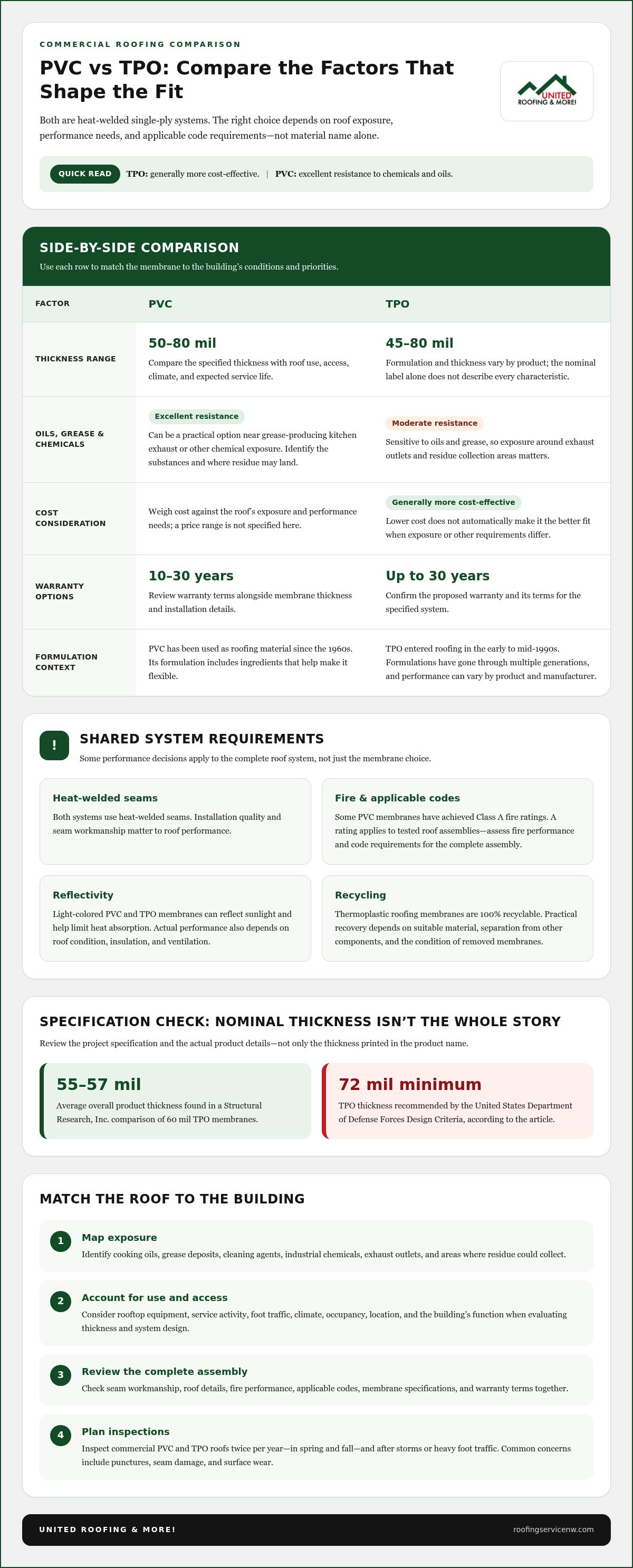
- Compare membrane thickness as well as material: TPO sheets range from 45 to 80 mil, while PVC sheets range from 50 to 80 mil.
- For roofs exposed to oils, grease, or chemicals, PVC’s strong chemical resistance can be an important advantage.
- Both systems use heat-welded seams, so installation quality and seam workmanship matter to roof performance.
- Assess fire resistance and code requirements for the complete roof assembly, not just the membrane type.
- Use your building’s exposure and performance needs to guide the choice, then weigh replacement or installation options accordingly.
Membrane thickness
Thickness affects how a roofing membrane handles foot traffic, rooftop equipment, and daily exposure. TPO sheets range from 45 to 80 mil, while PVC sheets range from 50 to 80 mil. A mil is one-thousandth of an inch. Compare the specified membrane thickness with the building’s use, roof access, climate, and expected service life, rather than choosing by material name alone.
Both membranes are thermoplastics, but their formulations differ. PVC uses polyvinyl chloride with added ingredients that help make it flexible. TPO combines polypropylene and rubber-like polymers, and its formulation influences flexibility and performance. Because manufacturers’ formulations have changed over time, thickness alone doesn’t describe every product’s characteristics.
PVC has been used as roofing material since the 1960s. TPO entered roofing in the early to mid-1990s and has gone through multiple formulation generations. The General Motors Facility Engineering Design Guide describes TPO as being in its second, third, and, in some cases, fourth generation of formulations. This history matters because performance can vary between product generations and manufacturers.
For a warehouse with rooftop service activity, compare the specified thickness with expected traffic. For a restaurant roof exposed to grease, chemical resistance may matter more than thickness. In a colder climate, flexibility and roof assembly design also matter. The roofing system should suit the building’s occupancy, location, and function.
| Membrane option | Thickness range | Key comparison |
|---|---|---|
| TPO | 45 to 80 mil | Formulation and thickness vary by product |
| PVC | 50 to 80 mil | Available range starts above TPO’s listed minimum |
Thickness isn’t the only specification to review. A Structural Research, Inc. comparison of 60 mil TPO membranes found average overall product thicknesses of 55-57 mils. The United States Department of Defense Forces Design Criteria recommends specifying TPO at a minimum thickness of 72 mils, according to the United States Department of Defense. Use the project specification, not the nominal label alone.
For energy efficiency and reflectivity, light-colored PVC and TPO membranes can reflect sunlight and help limit heat absorption at the roof surface. Actual performance depends on membrane color, roof condition, insulation, and ventilation.
Common maintenance concerns include punctures, seam damage, and surface wear. Have commercial PVC and TPO roofs inspected twice per year, in spring and fall, and after storms or heavy foot traffic. Repair needs depend on the damage and the membrane’s condition.
PVC roofing warranty options last 10 to 30 years, while TPO warranties may extend up to 30 years. Review the proposed warranty alongside membrane thickness and installation details. Choose the membrane and thickness that suit the building’s use, exposure, and performance priorities.
PVC membrane composition and chemical resistance
PVC membranes are thermoplastic single-ply roofing materials with strong resistance to chemicals and oils. Thermoplastic roofing membranes are 100% recyclable, offering a material-recovery consideration alongside roof performance.
PVC Resistance to Chemicals, Oils, and Grease
PVC offers excellent resistance to chemicals and oils, making it a practical option where rooftop exhaust may carry grease. TPO has moderate chemical resistance and is sensitive to oils and grease. Around a restaurant kitchen exhaust, that difference can make PVC a stronger fit, though the specific chemicals and how they contact the roof still matter.
Before selecting a membrane, identify what reaches the roof: cooking oil, grease deposits, cleaning agents, or industrial chemicals. Consider the location of exhaust outlets and whether residue can collect nearby. Reviewing these exposures helps match the roofing material to the building’s daily operations, rather than treating every commercial roof as if it faces the same chemical demands.
Chemical Sensitivity and Shrinkage
Chemical sensitivity describes how a membrane responds to substances that contact its surface. TPO’s sensitivity to oils and grease makes exposure an important difference from PVC’s excellent resistance. Shrinkage is a separate concern: membrane movement can stress details and seams, so consider how the roof is secured and how its edges and penetrations are finished.
For example, a facility with regular rooftop servicing should account for both chemical contact and physical disturbance. Include exhaust residue and maintenance activity in the roof assessment. The material choice should reflect actual exposure, while installation details should accommodate movement and transitions in the roof assembly.
PVC’s composition supports its chemical performance, but resistance is no reason to ignore exposure. Identify the substance, its source, and the areas where it may contact the roofing membrane. A restaurant roof near grease-producing exhaust has different demands from a warehouse roof without oil exposure. Weather and routine rooftop activity also affect maintenance needs.
Fire performance is another PVC characteristic to weigh alongside chemical resistance. Some PVC roofing membranes have achieved Class A fire ratings. That rating applies to tested roof assemblies, so consider it in the context of the full assembly design rather than as a guarantee for every PVC membrane or installation.
Thermoplastic roofing membranes are 100% recyclable, but recycling depends on recovering suitable material from the roof system. Separation from other roofing components and the condition of removed membranes affect practical recovery. Consider recyclability during replacement planning, alongside exposure, weather, and the building’s intended use.
When chemical exposure is driving the decision, map exhaust locations and likely residue before comparing membranes. For roof damage around these areas, commercial roofing services can help address repair needs.
Professional installation and seam welding
Installation affects whether a PVC or TPO roof performs as designed. Both thermoplastic membranes rely on secure attachment and carefully welded seams to create a continuous, watertight roofing system.
Roof Attachment and Installation Methods
Roof attachment describes how installers secure the membrane and roof assembly. Common approaches include mechanical fastening, adhesive attachment, and ballasted systems. The right method depends on the roof deck, insulation, building conditions, and project design. For example, a roof with complex equipment needs careful planning around penetrations, edges, and transitions, whether the membrane is PVC or thermoplastic polyolefin (TPO).
Compare the complete installation scope, not just the membrane material. The work should account for substrate preparation, insulation placement, attachment details, drainage, and membrane layout. PVC and TPO can both be installed in different assembly configurations, so the material alone doesn’t dictate one attachment method. These details affect labor requirements and the finished roof’s ability to manage water and movement.
Seam Welding and Installation Quality
Heat-welded seams join sheets of both PVC and TPO. Installers use heat to fuse overlapping membrane edges, then check that the seams are consistently bonded. Poorly prepared or unevenly welded joints can leave vulnerable areas where water may enter. Corners, penetrations, and roof edges need particular care because they involve transitions rather than broad, uninterrupted membrane runs.
Flexibility also shapes installation details. The membrane must be laid and secured to suit the roof’s geometry, including curbs, drains, and equipment supports. Installers plan how sheets meet around these features and how the assembly accommodates movement. Consistent workmanship supports watertight details and long-term performance; the material name alone can’t make up for rushed preparation or incomplete seam checks.
Material and installation costs vary by project. TPO is generally more cost-effective than PVC, but the total also depends on roof size, existing conditions, insulation, attachment method, access, and detail complexity. The project price is provided after a quote request; factors include material selection, labor, roof preparation, and installation details.
For a fair comparison, request scopes covering the same roof area and assembly components. Check that each proposal identifies the membrane type, attachment approach, insulation work, edge and penetration details, and seam-welding procedures. This makes differences easier to understand than comparing a membrane-only figure with a complete roofing system installation.
Finally, consider how the assembly contributes to energy efficiency. Membrane installation is just one part of roof performance; insulation, drainage, and detailing matter too. A complete project plan should explain how the specified PVC or TPO membrane works with those components, so the installed system, not just the sheet, meets the building’s needs.
Fire resistance
Fire performance depends on the complete roof assembly, not just its thermoplastic membrane. Fire performance should be evaluated for the complete roof assembly rather than inferred from the membrane material alone. Some PVC roofing membranes have achieved Class A fire ratings. Assembly documentation and the building’s exposure are important parts of the comparison.
A Class A rating describes fire performance under a tested assembly configuration. It isn’t a blanket rating for every PVC membrane or roof design. Insulation, deck, attachment, and other assembly components affect the system tested. For example, when replacing a roof, compare the proposed assembly’s fire documentation with the building’s requirements instead of relying on the membrane label alone.
The United States Department of Defense Forces Design Criteria says TPO should only be allowed on roofs with an anticipated life of 10 years or less, according to the 2012 criteria. This guidance is specific to that design document. It highlights why building owners should consider the project’s intended service life and applicable performance requirements when weighing membrane options.
Durability also involves resistance to tears, punctures, and impact. TPO roofing is more tear-resistant than PVC, but more prone to punctures. That difference matters on roofs with frequent service access, tools, or equipment movement. A maintenance route near rooftop units, for example, can expose either membrane to dropped tools or sharp-edged objects, making traffic control and protective details important.
Hail creates another kind of impact exposure. It can stress the membrane and underlying roof assembly; the effect depends on the impact, support, and system construction. Tear resistance and puncture resistance are distinct properties, so neither alone guarantees protection from damage. Compare the specified membrane and full assembly with the building’s exposure, not just one material characteristic.
Manufacturers’ product specifications help distinguish one membrane formulation from another. Review fire performance, thickness, and assembly configuration together. A roofing contractor can use these details to match the material to the roof deck, insulation, and anticipated use. Ask for a description of the proposed system as a complete assembly, including how it addresses edges, penetrations, and rooftop equipment.
For a practical comparison, list the building’s fire-performance needs, expected roof life, and impact risks. Then match those demands to assembly documentation and membrane properties. A low-traffic office roof and one with regular mechanical servicing face different wear patterns. The right durability choice reflects the building’s actual exposure, while fire performance must be assessed at the assembly level.
Building codes and roof performance requirements
Code requirements can shape the choice before membrane preferences do. Cool-roof requirements may apply, making reflectivity a project requirement rather than simply an optional feature. For PVC vs TPO roofing for commercial buildings, start by identifying the rules that apply to the building’s location and project, then compare complete roof assemblies against them.
A cool-roof requirement focuses attention on the roof surface and its ability to reflect sunlight. Both PVC and TPO are available in reflective options, but performance depends on the selected membrane and assembly. For example, a warehouse in a hot climate may prioritize reflectivity, while an industrial building may also need chemical resistance near exhaust outlets.
Use a practical review before deciding on a material. First, identify the building’s jurisdiction and applicable code requirements. Next, list its performance needs, such as fire resistance, strength, drainage, and expected exposure. Then match the proposed membrane and assembly to those needs. This process helps prevent one feature, such as reflectivity, from outweighing other building requirements.
- Cool-roof criteria: Compare the specified membrane’s reflective performance with the applicable project requirements.
- Fire performance: Review the roof assembly, not only the membrane label, against the building’s fire-resistance needs.
- Exposure: Account for rooftop equipment, foot traffic, weather, and chemicals that may affect the roof.
Roof performance also depends on components beneath the membrane. Insulation, attachment, drainage, and edge details all influence how the system functions. For example, a low-slope roof with ponding concerns needs a drainage plan as well as a membrane choice. The project scope should clearly describe these components so the proposed assembly can be evaluated as a whole.
Keep the building’s occupancy and function in view. A commercial kitchen may place more weight on chemical resistance around grease-producing exhaust. A building with regular rooftop maintenance may prioritize durability and puncture resistance. Roof replacement should account for these conditions alongside code requirements, rather than assuming PVC or TPO is automatically the better option.
Make the final decision by comparing documented assembly performance with the building’s code requirements and operating conditions. If you’re planning a compliant roof installation, discuss your commercial roofing project and its performance priorities.
United Roofing & More!: Roof Replacement
United Roofing & More! helps commercial property owners move from comparing membranes to planning roof replacement or installation. Turn to the team when an aging roof, recurring leaks, or damage calls for a clear next step. Roof repairs can address problems that don’t yet require replacement, while a replacement project provides an opportunity to choose a system suited to the building’s exposure, use, and performance priorities.
Once you’ve weighed PVC and TPO, connect the decision to the roof’s actual condition and project needs. Roofing financing options are available to help manage project costs. The next step is to discuss your building and the roofing work it needs.
Contact United Roofing & More! to discuss your commercial roofing project.
Make the Next Roofing Decision Count
Your decision about PVC vs TPO roofing for commercial buildings can shape plans for future maintenance, rooftop upgrades, and capital spending. Think beyond the immediate project. Consider how the building may be used over time, whether equipment or operations could change, and how the roof plan fits your broader property priorities.
A clear project scope helps turn planning into action. United Roofing & More! offers commercial roof replacement and installation, with roofing financing options to help manage project costs. Discussing your building’s needs can help you move from comparing materials to choosing a practical next step for the roof.
Contact United Roofing & More! to discuss your roofing project. A thoughtful plan can make the next decision feel more manageable and keep your building’s needs at the center.
Frequently Asked Questions
What is the Difference Between PVC & TPO Roofing?
PVC and TPO are different thermoplastic membrane materials, with distinct chemical resistance and performance characteristics. For example, a restaurant roof exposed to kitchen grease may favor PVC, while a project prioritizing material economy may consider TPO. Compare the building’s exposure, roof assembly, and project requirements together. The right choice should reflect how the roof is used, not just the membrane’s name.
What Is Single-Ply Roofing?
Single-ply roofing uses one flexible membrane layer as the roof’s weatherproofing surface. The membrane sits over other components, such as insulation and a supporting deck, so “single-ply” doesn’t mean the entire roof contains only one layer. For example, a commercial building may have a single-ply membrane above insulation and attachment materials. The full assembly’s design affects system performance.
Why Do Customers Buy a TPO Roof?
Customers choose TPO for its cost-effectiveness and reflective membrane options. A building owner comparing roofing proposals may consider TPO when managing upfront project spending is a priority. The decision should also account for how the roof will be used, the building’s exposure, and the complete assembly. Compare specifications and scopes of work, not just material labels, to understand what each proposal includes.
Are TPO and PVC the Same?
No. TPO means thermoplastic polyolefin, while PVC means polyvinyl chloride. Both are flexible thermoplastic roofing membranes, but they are separate materials with different formulations and performance traits. For example, a building exposed to grease has different material-selection needs from an office roof without that exposure. Identify the building’s operating conditions first, then compare the specific membrane and assembly proposed.
Have TPO Roofs Been Failing?
TPO roofs can develop problems, as any roofing system can, but the word “failure” doesn’t identify a single cause. Installation quality, membrane formulation, seam condition, rooftop traffic, and exposure can all affect performance. A practical first step is to document where water appears, note nearby drains or equipment, and look for visible damage from a safe vantage point. Those details help clarify the issue and repair scope.
Is TPO Cheaper Than PVC?
TPO is generally more cost-effective than PVC, but the project’s total scope matters. Roof size, existing conditions, insulation, attachment choices, and complex details can change the comparison. For example, proposals using the same membrane may cover different preparation or edge work. Compare complete scopes side by side, including materials and installation, so your decision reflects the whole project rather than a membrane-only figure.
What Are Others Saying About TPO?
Discussion of TPO often focuses on its cost-effectiveness, reflective options, and the importance of product formulation and installation. Those points don’t replace a project-specific evaluation. A property manager planning a reroof can compare manufacturer specifications, proposed assembly details, and the building’s operating needs. Look for details tied to the exact membrane and system under consideration, rather than assuming every TPO product performs identically.
What Does TPO Stand For?
TPO stands for thermoplastic polyolefin. It names the material used in TPO roofing membranes, not the entire roof assembly. A commercial roofing system also includes components such as the supporting deck, insulation, attachment materials, and perimeter details. Knowing the abbreviation helps you read a proposal, but the product specifications and assembly scope explain what will actually be installed.


