
Roof financing can help cover repairs or a replacement, but the loan program sets the terms and eligible work. Home improvement loans for roofing include options such as home equity loans, personal loans, and HUD Title 1 property improvement loans. With FHA Title 1 loans, amounts below $7,500 are typically unsecured; loans of $7,500 or more must be secured by a mortgage or deed of trust on the property.
A damaged or aging roof can’t always wait, and choosing how to pay for the work can feel like a project of its own. The right financing option depends on whether you want to use home equity, how quickly you need funds, and whether you prefer a secured or unsecured loan.
This guide explains what roof financing may cover and compares home equity loans, HELOCs, personal loans, and HUD Title 1 loans. You’ll also learn the key program rules to understand before deciding which path fits your roofing project.
Key Takeaways
- Match the financing option to your priorities, including access to home equity, repayment structure, and whether you want the loan secured by your home.
- Compare personal loans with home equity options to understand how funding speed, interest rates, and collateral can affect your decision.
- Review HUD Title 1 rules closely, especially how the loan amount determines whether the loan is secured.
- Check program eligibility requirements, since home repair assistance can depend on factors such as income, age, property type, and location.
- Understand the work your roof needs before choosing financing, so you can compare options against the repair or replacement project.
Financing with a HELOC or home equity loan
Home improvement loans for roofing can include home equity loans, HELOCs, personal loans, and government programs. Compare how each option handles collateral, funding, interest, and repayment before selecting a way to pay for roof repairs or replacement.
Home Equity Financing Options
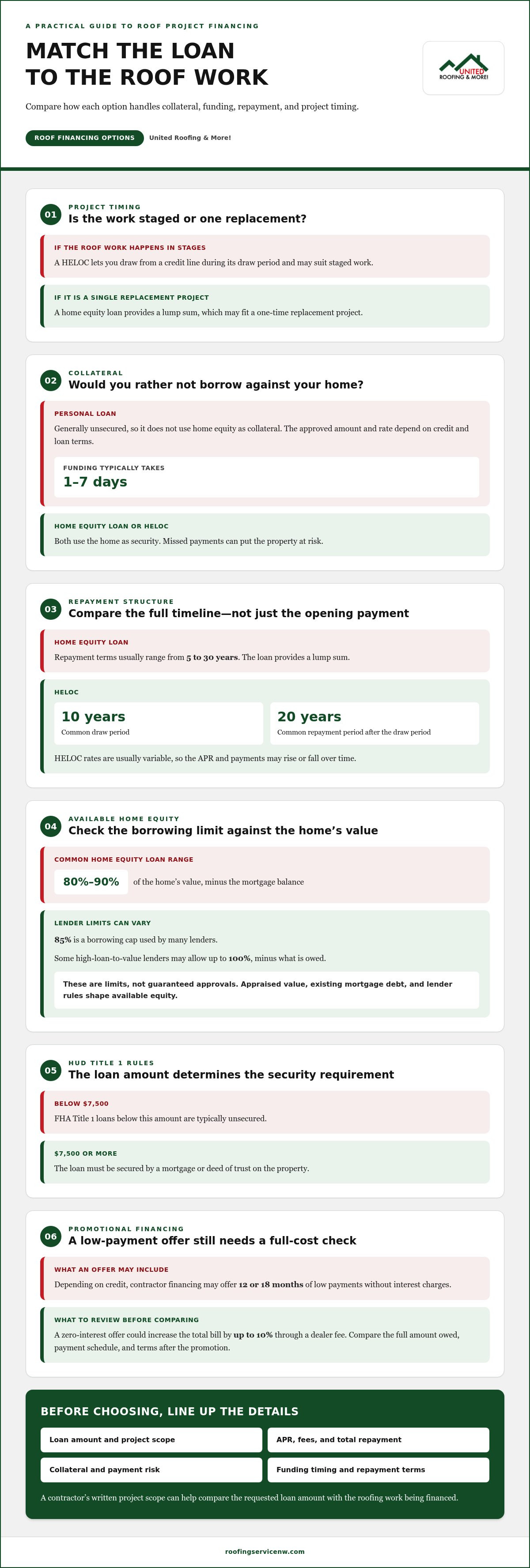
A home equity loan provides a lump sum, while a HELOC lets you draw from a credit line during its draw period. Both use your home as security, so missed payments can put your property at risk. A HELOC may suit staged work; a lump-sum loan may fit a single replacement project. Compare the application process and funding timeline with the repayment structure.
Loan Rates and Repayment Terms
Home equity loan repayment terms usually range from five to 30 years. A HELOC commonly has a 10-year draw period, followed by a 20-year repayment period. HELOC interest rates are usually variable, so the APR and payments may rise or fall over time. Compare the full repayment plan, not just the opening payment or interest rate.
Personal loans can finance roof repairs without using home equity as collateral. Their rates and terms depend on credit and the loan agreement. Federal options include HUD’s Title 1 and 203(k) programs.
Home Equity and Loan-to-Value Limits
Home equity loans commonly allow borrowing 80% to 90% of a home’s value, minus the mortgage balance. Many lenders cap borrowing at 85% of the home’s value, while some high-loan-to-value lenders may allow up to 100%, minus what’s owed. These are limits, not guaranteed approvals. Appraised value, existing mortgage debt, and lender rules shape available equity.
USDA Section 504 home repair loans have a fixed 1% interest rate and a 20-year term. Federal, state, and local governments may offer repair assistance, but eligibility depends on program rules and location. Grants or rebates, where offered, also have specific conditions, so review eligible work and application requirements before including assistance in your roofing budget.
Roof Loan Interest Deductions
Interest on a roof replacement loan isn’t automatically deductible. Whether it qualifies depends on applicable tax rules and how the loan is structured and used. Keep loan and project records, and consider how you spent the funds when assessing your tax situation.
Contractor financing can have promotional terms that deserve close review. Offers may include 12 or 18 months of low payments without interest charges, depending on credit. A zero-interest offer could increase the total bill by up to 10% through a dealer fee. Compare the full amount owed, payment schedule, and terms after the promotion before accepting.
Compare home improvement loans for roofing by looking beyond the initial payment. Review the collateral, total repayment, and how you can use the funds.
Personal loans compared with home equity loans
Personal loans, home equity loans, HELOCs, and contractor financing differ in collateral, funding, interest, and repayment. Personal loans are generally unsecured; home equity loans and HELOCs use the home as security, while contractor financing follows the lender’s offer and terms.
Roofing loans can be secured or unsecured. A personal loan usually requires no property collateral, while a home equity loan or HELOC secures the debt with the borrower’s home. For contractor financing, the agreement determines whether collateral is required.
Personal Loans for Roofing Work
Unsecured personal loans can suit homeowners who want to finance a roof without borrowing against home equity. The approved amount and rate depend on credit and loan terms. Funding typically takes one to seven days, which can help when a repair needs prompt attention.
Compare the APR, payment amount, and repayment period in each offer. A lower payment can reflect a longer term, which may increase total interest paid. Personal loans can also cover repairs rather than a full replacement, if the amount requested matches the work. A contractor’s written project scope helps you compare the loan amount with the roofing work being financed.
Home Equity Loans and HELOCs
A home equity loan provides a lump sum, while a HELOC allows borrowing from a credit line. Home equity loans commonly allow borrowing of 80% to 90% of the home’s value, minus the mortgage balance. Repayment terms usually range from five to 30 years. A HELOC commonly has a 10-year draw period followed by a 20-year repayment period, and its variable interest rate can change over time.
Home equity loans and HELOCs provide access to home equity, but your home serves as collateral. If you don’t make payments, the property may be at risk. Compare the proposed loan amount with your existing mortgage and the lender’s valuation, then consider whether a lump sum or flexible draws better match the project’s payment schedule.
Contractor Financing and Other Sources
Contractor financing can link payment options to a roofing project, but terms vary by offer. Some offers include 12 or 18 months of low payments without interest charges, depending on credit. A zero-interest offer could increase the total bill by up to 10% through a dealer fee. Read the full payment schedule and total amount due, including what happens when a promotional period ends.
For a fair comparison, line up the loan amount, APR, fees, collateral, funding timing, and repayment terms across your sources. Homeowners over age 62 may qualify for a Home Equity Conversion Mortgage, a government-insured reverse mortgage. Its eligibility and terms differ from personal loans and HELOCs, so assess it separately rather than treating it as a standard home equity loan.
If project timing and payment options are part of your decision, explore roofing financing options alongside the loan types above.
Program rules and state requirements
Federal, state, and local housing assistance can help eligible homeowners pay for repairs or improvements. Program rules differ, so identify the property, household, and work requirements before choosing an application path.
The USDA Section 504 Home Repair program is governed by the Housing Act of 1949, as amended, and 7 CFR Part 3550, according to the Office of the Federal Register, National Archives and Records Administration. The program offers loans to low- and very-low-income homeowners to repair, improve, or modernize homes, or remove health and safety hazards.
Section 504 loans have a fixed 1% interest rate and a 20-year term. Applicants must own and occupy the home, live in an eligible rural area, and be unable to obtain affordable credit elsewhere. These criteria shape whether a roof repair can fit the program. A home equity loan, by contrast, relies on available equity and lender underwriting.
Section 504 grants have narrower rules. Applicants must be at least 62 years old, and grant funds must remove health and safety hazards. Compare the grant conditions with the repair needed before relying on this assistance.
State and local governments may also offer home repair loans or programs. In Washington State, homeowners seeking **home improvement loans for roofing** can explore local municipal assistance and regional housing programs designed to support property upgrades.
Community-based housing programs can have local eligibility rules tied to income, age, property type, or location. Start by identifying the government or housing organization administering the program, then compare its eligible work and repayment conditions. USDA Section 504 applications are accepted year round through local Rural Development offices. A roof project must fit the program’s repair or safety purpose, not simply the homeowner’s preferred scope.
Some programs serve specific audiences. USDA Section 504 grants focus on homeowners aged 62 or older who need health and safety hazards removed. Other assistance may prioritize households by income or property location. Approval depends on the named program’s criteria, not merely on the need for roofing work.
A “Rate Beat Program” is a lender’s rate offer, not the same thing as a government housing program. Read its written terms for the rate being compared, repayment conditions, and any fees. Distinguish that private offer from HUD Title 1 or USDA Section 504 rules, which define separate program requirements.
Unsecured personal loans for roof projects
An unsecured personal loan can finance a roof project without using the home as collateral. That flexibility can suit a repair or replacement when a homeowner wants a set loan amount and predictable scheduled payments. The lender’s offer determines the final amount, APR, and repayment period.
Rates vary widely. Roof-financing personal loans have APRs ranging from 5.99% to 35.99%. Another broad personal-loan range is 6% to 36%, with the lowest rates often going to borrowers with credit scores of 690 or higher. Homeowners seeking the lowest roof-financing rates are advised to aim for a credit score of 780. These figures describe ranges, not a promised rate for an individual applicant.
Funding speed can be useful when a roof issue needs prompt attention. Personal loans for roof financing typically fund within one to seven days. The application usually requires details about the requested amount and the borrower’s finances. Before applying, match the project estimate to the amount you plan to borrow. A smaller repair may not call for the same loan amount as a full replacement.
Unsecured personal home improvement loans don’t place a mortgage lien on the home as collateral. Instead, the lender evaluates the application and credit profile. Review the offered APR, payment schedule, repayment period, and any fees together. A longer repayment period may reduce each scheduled payment while extending the time needed to repay the balance. Compare the full agreement, not just its first payment.
Use this practical sequence to assess a personal loan for roofing:
- Set the requested amount using the written roofing project estimate.
- Compare lender offers by APR, repayment period, fees, and monthly payment.
- Check whether the proposed funding date fits the contractor’s project schedule.
- Confirm the loan proceeds and payment terms align with the work being financed.
For example, a homeowner financing a partial repair can compare a loan sized to that specific scope with a larger replacement loan. Credit score and loan term affect available amounts, while APR and repayment length shape the total borrowing commitment. Choose an offer that fits both the project and the household budget.
Personal loans aren’t the only way to borrow. A HELOC or home equity loan uses the home as security, while an unsecured personal loan doesn’t pledge home equity. Contractor financing may offer a separate payment arrangement, so compare its written terms with personal-loan offers. A side-by-side review clarifies how each option handles funding, collateral, and repayment.
HUD Title 1 property improvement loans
HUD Title 1 is a federal home improvement loan program that can help finance eligible property repairs and improvements. For homeowners considering roof work, its standout feature is how the loan amount affects collateral. Loans below $7,500 are typically unsecured, while loans of $7,500 or more must be secured by a mortgage or deed of trust on the property.
That threshold matters before submitting an application. A smaller repair may fall below it; a larger project may require using the home as security. A property appraisal isn’t a substitute for understanding the loan’s collateral terms. Review the proposed amount and security documents so you know whether the property is pledged.
HUD insures home renovation and repair loans through Title 1 and 203(k) programs. Title 1 is a property improvement loan, while 203(k) combines eligible repairs or improvements with a mortgage. They are different financing routes. Focus on Title 1’s amount-based security rule when comparing it with personal loans or home equity borrowing.
Keep application steps clear and documented. First, define the roof work and requested loan amount. Next, review the lender’s repayment terms, interest rate, fees, and collateral requirements. Then compare the agreement’s total payments with your project funding needs. An advertised discount or low initial payment doesn’t replace a review of the full terms.
- Confirm the loan amount and whether the property secures it.
- Read the repayment schedule and total payment obligations.
- Match the financing request to the written roofing project scope.
- Keep the loan agreement and project records together.
HUD-approved lenders are recommended for Title 1 and 203(k) loans to help prevent contractor fraud and inflated estimates. Keep the project scope and financing paperwork consistent. If the roofing estimate changes, compare the revised work and amount with the loan terms before relying on the original plan.
Title 1 can be worth considering when the project fits a property-improvement loan and its collateral terms suit your situation. Its threshold is especially important: below $7,500, loans are typically unsecured; at $7,500 or more, a mortgage or deed of trust is required. That distinction helps homeowners compare Title 1 with financing that doesn’t secure debt against the home.
Have a roof project in mind? Discuss your roofing project and consider how its scope aligns with your financing plan.
United Roofing & More!: Roof Replacement
United Roofing & More! helps homeowners move from financing decisions to roofing work. If widespread damage or an aging roof calls for replacement, the company provides Roof Replacement and Roof installation services. For leaks or isolated damage, Roof repairs may be the more suitable next step.
Once you understand your financing options, consider how the work fits your budget and chosen payment plan. United Roofing & More! also offers Roofing financing for its services, so you can consider the project and payment together. Review the work needed, then decide whether repair or replacement suits the roof’s condition.
Contact United Roofing & More! to discuss your roofing project, or visit roofingservicenw.com.
Move From Financing Choice to Roofing Plans
Choosing home improvement loans for roofing is one part of preparing for the work. Connect the financing decision with the roof’s actual needs. A clear project scope can help you avoid borrowing for unnecessary work or overlooking important repairs. Consider the loan terms and roofing plan together as you decide what comes next.
United Roofing & More! offers Roof Replacement, Roof installation, and Roofing financing. If you’re planning a roof project, consider how these services fit the work you have in mind and the payment approach you’ve chosen. The goal is a practical next step, not a rushed decision.
Contact United Roofing & More! about your roofing plans and take the next step with a clearer path forward.
Frequently Asked Questions
What does roof financing cover?
Roof financing can pay for eligible roofing work, including repairs, installation, or replacement, depending on the loan’s terms. For example, a project could involve repairing storm damage or replacing worn roofing materials. Some programs restrict eligible work: USDA Section 504 assistance focuses on repairs, improvements, modernization, or removing health and safety hazards. Match the proposed work to the financing agreement before using funds.
How much does it cost to replace a roof?
The work required depends on the roof, so there isn’t one figure that fits every home. Roof area, design, material choice, access, and damage to underlying parts can affect the project scope. A replacement involving structural repairs differs from one limited to roofing materials. A detailed written estimate helps define the work and compare financing amounts without treating a general national figure as your project price.
How long does an application take?
Application timing depends on the lender’s review of your credit, income, requested amount, and project details. Funding time is a separate measure: U.S. personal loans for roof financing typically fund within one to seven days. To prepare, gather the project estimate and the financial information requested in the application. Ask how the lender defines its timeline, including whether it means review, approval, or funds arriving.
How may funds be used?
Use loan proceeds for the roofing work allowed by the specific agreement. A personal loan may fund a roof project according to its loan terms, while government programs can set narrower purposes. USDA Section 504 assistance covers repairs, improvements, modernization, or removal of health and safety hazards. Keep the estimate and work description aligned with the program’s eligible uses, especially if a project combines roof work with other repairs.
How much money can I get?
United Roofing & More! serves the Seattle Metropolitan Area, including Marysville, Seattle, Renton, Everett, Lynnwood, Kirkland, Mount Vernon, Bothell, Edmonds, Shoreline, Sammamish, Redmond, Bellevue, Tacoma, and Kent. The approved loan amount depends on the financing option and application.
Is there a deadline to apply?
USDA Section 504 home repair applications are accepted year round through local Rural Development offices. For USDA’s California Single Family Housing Repair program, applications are accepted on an ongoing basis from October 1 through September 30. Other state or local programs can have their own application windows and funding conditions. Identify the program you’re applying to, then use its stated schedule to plan your application.
What are the terms of the loan or grant?
USDA Section 504 home repair loans have a fixed 1% interest rate and a 20-year term. A grant must be repaid if the property is sold in less than 3 years. Title 1 loan security also depends on the amount borrowed.
What are current interest rates and loan terms for roofing loans?
Roof-financing personal loan APRs range from 5.99% to 35.99%. Home equity loan repayment terms usually range from five to 30 years, while HELOC rates are usually variable. United Roofing & More! lists APRs from 9.99% to 19.99%, with repayment terms up to 12 years or 12 months for a same-as-cash loan. Compare APR, repayment length, and payment terms together.


