

You notice a faint, musty smell in the attic or a tiny tea-colored stain on the upstairs ceiling. You check the roof from the driveway, but everything looks solid. Finding hidden roof leaks is rarely as simple as spotting a missing shingle. Water is a master of disguise. It often enters at one point, runs down a structural rafter, and drips ten feet away from the actual hole. This elusive behavior leads to "patch jobs" that fail. It leads to invisible mold that spreads quietly behind your walls. You need a solution that actually works.
It's stressful to deal with water damage when you can't see the source. You want the leak stopped for good. You want to avoid the constant anxiety of a surprise roof replacement. We agree that your home deserves better than a temporary fix. This guide teaches you how to track water to its true entry point. You'll learn to identify subtle signs of trouble before they become disasters. We'll also show you how to find a contractor who provides professional diagnostics and flexible roofing financing to keep your home protected.
Key Takeaways
- Understand why water stains on your ceiling are rarely directly below the source due to how moisture tracks along rafters and pipes.
- Identify subtle warning signs like musty attic odors and bubbling paint that signal a moisture problem before it causes structural damage.
- Master safe DIY techniques for finding hidden roof leaks, including the attic blackout method and the two-person hose test.
- Learn how professional tools like infrared and thermal imaging cameras can see through walls to pinpoint moisture that the human eye misses.
- Get clarity on the "repair vs. replace" decision and discover how flexible roofing financing can make your home's protection affordable.
Why Finding Hidden Roof Leaks is a Challenge for Homeowners
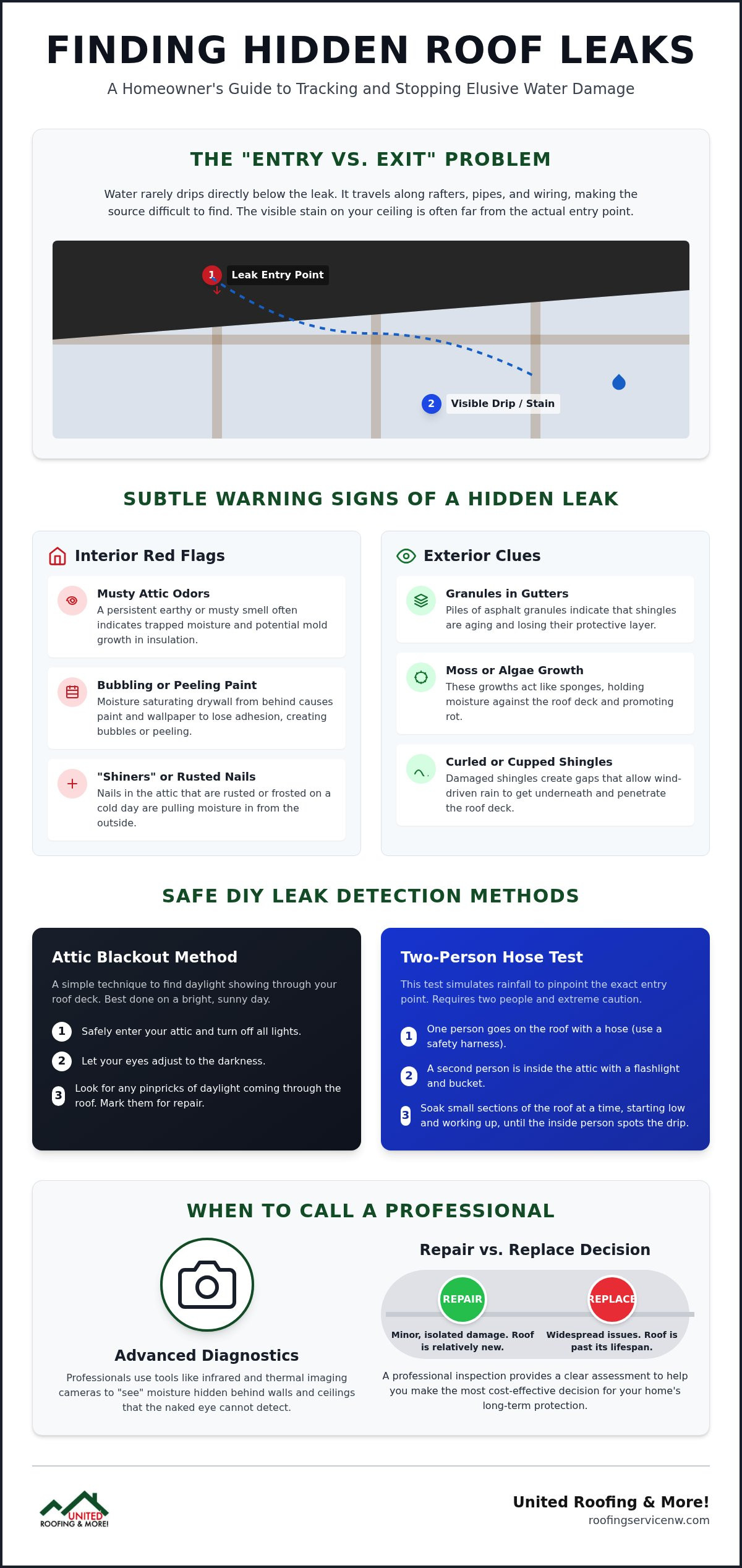
Water is a persistent enemy. It doesn't always fall straight down once it enters your home. This creates the "Entry vs. Exit" problem. The damp spot on your bedroom ceiling is rarely directly beneath the hole in your roof. Instead, finding hidden roof leaks requires tracking water across several feet of structural components. Water uses surface tension to "track" along the underside of rafters, plumbing pipes, and even electrical wiring. It travels until it hits an obstruction or a low point. That is where it finally drips onto your insulation or drywall.
In the Pacific Northwest, we face a unique "slow-burn" leak scenario. Our constant drizzle can saturate roofing materials without ever causing a dramatic drip. This moisture often moves through capillary action. This process pulls water uphill between overlapping shingles or under compromised flashing. These hidden leaks are far more dangerous than obvious gushers. They feed wood rot and mold growth for months before you notice a single sign of trouble.
The Science of Water Travel in a Roof System
Gravity and surface tension work together to hide moisture. When water enters a breach, it clings to the wood. It can move horizontally along a beam for a surprising distance. The pitch of your roof also changes the game. Steeper roofs may cause water to move faster and further from the entry point. Meanwhile, your attic insulation acts like a massive sponge. It can hold significant amounts of water for an entire season. By the time the moisture reaches your ceiling, the structural damage is often already well underway. It's a silent process that requires a professional eye to catch early.
Common Myths About Locating Roof Leaks
Many homeowners believe a new roof is immune to moisture. This is a common mistake. Poor installation or faulty materials can lead to leaks immediately. Another myth is that you only need to look for missing shingles. In reality, a tiny crack in a vent boot or a single backing-out nail is enough to cause a disaster. Don't assume leaks only happen during heavy downpours. In areas like Seattle and Marysville, a light, steady mist can be just as destructive. It keeps the roof deck damp for days, eventually leading to structural failure. If you're worried about the cost of these repairs, we offer roofing financing to help you protect your home without the financial stress.
Subtle Warning Signs of a Hidden Leak in Your Home
You don't need a massive storm to cause significant damage. In the Pacific Northwest, our constant drizzle does the most harm through "slow-burn" moisture intrusion. Finding hidden roof leaks requires you to look for evidence that doesn't involve a bucket on the floor. Start with your nose. A persistent musty odor in the attic or upper floors often signals trapped moisture in your insulation. Check your ceiling lines and corners. Peeling paint or bubbling wallpaper usually means water is slowly saturating the drywall from the inside out. This moisture often travels along rafters before settling in your walls.
Interior Red Flags You Might Be Missing
Go into your attic on a cold day. Look for "shiners." These are nails that missed the rafters and stick out into the open air. If they look rusted or have white frost on them, they are pulling moisture from the outside. This is a classic sign of a slow leak or poor ventilation. Watch for darkening wood around your skylights or inside closets. These spots are often overlooked but show water stains early. A sudden spike in indoor humidity or localized mold growth on an exterior wall is another major red flag. Water might be tracking down a wall stud far from the actual roof breach. Catching these signs early is the best way to avoid the stress of a full roof replacement.
Exterior Clues That Suggest Hidden Trouble
Your gutters tell a story. If you see piles of granules, your shingles are degrading and losing their water-shedding ability. In our climate, moss and algae growth are more than just an eyesore. They act like sponges, holding dampness against your roof deck for weeks. Examine your roof drip edge. If it's damaged or lifting, water can easily bypass your gutters and rot your fascia boards. Curled or cupped shingles are also dangerous. They create gaps that allow wind-driven rain to push underneath the primary barrier.
Finding hidden roof leaks often feels like detective work for roof leaks, but catching these signs early prevents rot from spreading. If you spot these issues, a professional roof repair assessment can help you decide on the best next steps. We focus on clear dialogue and transparency, ensuring you understand exactly what's happening with your home. Our team is ready to help you find a solution that fits your budget through flexible financing options.
DIY Methods for Finding Hidden Roof Leaks Safely
Finding hidden roof leaks doesn't always require high-tech equipment. You can start your detective work with a few simple techniques. One of the most effective methods is the "Attic Blackout." Head into your attic on a bright, sunny day. Turn off all the lights and wait for your eyes to adjust. Look for tiny pinholes of daylight peeking through the roof deck. Even a hole the size of a nail can allow significant water intrusion during a Marysville rainstorm. Mark these spots with a permanent marker so you can find them from the outside later.
If the blackout doesn't reveal the source, try the "Hose Test." This requires two people and a clear line of communication. One person stays in the attic with a flashlight while the other is on the roof with a garden hose. Start low. Soak the area just above the gutters for several minutes before moving higher. Focus on "penetrations" like vents, chimneys, and skylights. These are the most common failure points. When the person in the attic sees a drip, measure the distance from the leak to the nearest ridge or gable. This helps you pinpoint the exact shingle that needs attention on the exterior.
Conducting an Attic Inspection
Safety is the top priority when you're finding hidden roof leaks from the inside. Never step on the insulation or the drywall ceiling between the beams; you will fall through. Always walk on the wooden ceiling joists or bring a piece of plywood to create a stable platform. Look for "trails" or dark watermarks on the underside of the roof deck. These stains often lead directly back to the entry point. Don't ignore wet insulation. Because insulation acts like a sponge, it can stay damp for weeks after the rain stops. If a section of fiberglass feels heavy or looks compressed, you've found a slow, hidden leak.
Is it a Leak or Condensation? The 'False Leak' Test
In Seattle and Marysville, the weather often creates "false leaks." During our cold, humid winters, poor attic ventilation causes moisture from your shower or kitchen to trap against the cold roof deck. This moisture turns into frost on the nail heads. When the sun hits the roof, the frost melts and drips, mimicking a real leak. Check your nail heads for rust or white "frosting" to see if condensation is the culprit. This is why calculating roof pitch is vital for proper airflow. If your attic can't breathe, your roof will rot from the inside out regardless of how new the shingles are. We offer flexible roofing financing to help you upgrade your ventilation and protect your home's structural integrity.
When to Call a Professional for Leak Detection
DIY methods are great for simple issues, but they have clear limits. Climbing onto a steep roof is dangerous. If your home has complex geometry, high gables, or multiple roof levels, you should stay on the ground. Finding hidden roof leaks on a complicated structure requires specialized safety gear and years of experience. We see many homeowners try to fix a leak themselves, only to miss the actual entry point. This leads to wasted money on "patch jobs" that don't stop the water. Professional detection ensures the job is done right the first time.
Advanced Leak Detection Technology
Professionals use tools that can see through your ceiling and walls. We don't just guess where the water is moving. We use technology to confirm it. High-tech diagnostics save you money by preventing unnecessary tear-offs. Our team follows master roofing standards to ensure every inspection is thorough and accurate. These tools include:
- Thermal Imaging: These cameras detect temperature differences. Wet insulation stays cooler than dry materials, creating a clear "moisture map" on our screens.
- Moisture Meters: We use these to determine if your roof deck is still structurally sound or if wood rot has already begun.
- Electronic Detection: For flat or low-slope roofs, this technology identifies even the smallest breach in a waterproof membrane.
- Drone Inspections: Drones allow us to get high-resolution views of hard-to-reach areas like chimney flashings and high peaks without the risk of a fall.
The Risk of Ignoring a Small Leak
A small drip might seem like a minor annoyance, but it's a ticking clock. Water is highly destructive to your home's skeleton. Once moisture enters your attic, it begins to soften wooden rafters and ceiling joists. This structural compromise can eventually lead to a sagging roofline. There is also a significant electrical risk. Water often tracks along wiring until it reaches light fixtures or outlets. This creates a fire hazard that most homeowners never see coming.
The longer you wait, the more expensive the solution becomes. A small repair is affordable. However, if the moisture spreads to your interior walls and insulation, the cost of a full roof replacement becomes much more likely. We want to help you avoid that stress. Our goal is to catch the problem while it's still manageable.
Don't let a hidden leak damage your home's value. Our expert roofing team is ready to provide a clear, honest assessment of your roof's condition. We offer flexible roofing financing to ensure you can protect your home today and pay over time. Reach out for a professional diagnostic and get the peace of mind you deserve.
From Detection to Protection: Roof Repair and Financing
Once you've finished the hard work of finding hidden roof leaks, you need a partner to provide a permanent solution. United Roofing & More! is a locally owned and operated expert serving the Seattle and Marysville areas. We understand the specific challenges of the Pacific Northwest climate. Our team doesn't just apply a "band-aid" fix. We dig deep to ensure the structural integrity of your home is restored. We believe in transparency and keeping you informed throughout every step of the service process.
The biggest question we hear is whether to repair or replace. It's a tough call. A general rule of thumb used by industry pros in 2026 is that if repair costs exceed 30% of a full replacement, it's time for a new roof. Age is also a factor. If your roof is over 20 years old, a patch might only be a temporary delay. We provide honest, no-nonsense assessments to help you make the right financial choice for your family. We focus on long-term trust rather than high-pressure sales tactics.
Our Professional Repair Process
Our approach starts with a comprehensive inspection. We provide transparent diagnostic reports so you see exactly what we see. We don't just find the leak; we identify why it happened. This might involve matching high-quality materials to your existing shingles for a seamless look. We prioritize durable repairs that stand up to our region's constant moisture. Open dialogue is our signature. You'll never be in the dark about the status of your project or the final cost estimation. Our goal is your total peace of mind.
Making Quality Roofing Accessible
We know that an unexpected leak causes immediate financial stress. No home should go unprotected because of budget concerns. This is why we offer flexible roofing financing options. We've lowered the barrier to entry, making it easy to get the expert care you need right now. Whether you need a simple repair or a full roof installation, we provide payment solutions that fit your life.
Don't wait for the next storm to turn a small drip into a major disaster. Get a fast, no-nonsense estimate today. Contact United Roofing & More! to stop your hidden leak and protect your investment. We are your supportive partner in every roofing crisis. Let's get your home back to its best condition with professional service and clear, affordable pricing.
Secure Your Home Against Hidden Water Damage
Your home is your biggest investment. Don't let a silent drip compromise its structural integrity. We've explored how water travels along rafters and why the source of a stain is rarely directly above it. Mastering the art of finding hidden roof leaks requires patience and a keen eye for subtle signs like musty odors or rusted nail heads. Acting fast is the only way to prevent wood rot and mold from spreading behind your walls. Early detection keeps your repair costs manageable and protects your family's safety.
United Roofing & More! is your supportive partner in every roofing crisis. We are locally owned and operated in the PNW. Our team has deep expertise in our unique high-moisture climate challenges. We use advanced diagnostics to find the root cause of every leak, ensuring a permanent fix. We also offer flexible roofing financing to ensure your home stays protected without financial strain. Schedule your expert leak inspection with United Roofing & More! today. We're ready to provide the professional repairs and peace of mind you deserve. Your roof is in good hands.
Frequently Asked Questions
How do I find a roof leak that only happens when it rains hard?
Leaks that only appear during heavy downpours often involve wind-driven rain or overwhelmed drainage systems. High water volume can push moisture under shingles or through compromised flashing that stays dry during light mist. You should check your valley areas and chimney intersections. These spots are prone to failure when water pools quickly. Simulating these conditions with a garden hose is a great way to start finding hidden roof leaks safely.
Can a roof leak cause a fire if it hits electrical wires?
Yes, a roof leak can absolutely cause an electrical fire. Water is a conductor and often tracks along electrical wiring until it reaches light fixtures, junction boxes, or outlets. This moisture causes short circuits and sparks that can ignite nearby dry insulation or wooden framing. If you see water dripping from a ceiling fan or light, turn off the power at the breaker immediately and call a professional for help.
Is a small roof leak always an emergency?
Every leak is an emergency because water damage is cumulative. Even a tiny drip can saturate your insulation and feed toxic mold growth within 48 hours. Small leaks often indicate that the structural wood beneath your shingles is already rotting. Waiting to address the issue only increases the final repair bill. We offer flexible roofing financing to help you handle these emergencies before they require a total roof replacement.
What does a professional roof leak detection service cost?
Professional leak detection costs vary based on the complexity of your roof and the technology used. Factors like roof pitch, the number of stories, and the presence of complex gables influence the final price. While some companies charge a flat diagnostic fee, others include it in the total repair estimate. We focus on transparent dialogue regarding all costs. We also provide payment solutions to make expert diagnostics accessible for every homeowner.
Why does my roof leak in the winter but not the summer?
If your roof leaks only in winter, the culprit is likely attic condensation or ice dams. During cold months, warm air from your home hits the freezing roof deck and turns into frost. This frost melts and drips, mimicking a leak. Ice dams occur when snow melts and refreezes at the gutters, backing water under your shingles. Proper ventilation and calculating roof pitch are essential to preventing these seasonal moisture issues.
How long can I wait to fix a hidden roof leak?
You should not wait at all to fix a hidden leak. Moisture begins compromising your home's structural skeleton the moment it enters. Within weeks, wood rot can weaken rafters and cause sagging. Mold can also become a health hazard for your family. Addressing the problem immediately is the best way to save money. If you're worried about the upfront cost, our roofing financing options make it easy to start repairs today.
Does homeowners insurance cover finding hidden roof leaks?
Homeowners insurance typically covers leaks caused by sudden covered perils like wind, hail, or a fallen tree limb. However, most policies do not cover leaks resulting from a lack of maintenance or normal wear and tear. Finding hidden roof leaks early is your responsibility as a homeowner. We recommend reviewing your specific policy details. We can provide the professional documentation and clear estimates your insurance adjuster may require for a claim.
Can I fix a hidden roof leak myself with sealant?
Sealant is a temporary band-aid and not a permanent fix for a hidden leak. Applying caulk or roofing cement often traps moisture inside the roof structure, which accelerates wood rot. It also makes it harder for a professional to find the true entry point later. For a durable solution, you need to replace the damaged shingles or flashing. Our team provides expert roof repairs that address the root cause of water intrusion.


