

Replacing a roof is a practical time to decide what to do about existing skylights. For homeowners in Marysville, Seattle, and nearby Pacific Northwest communities, making that decision early can clarify the cost to replace skylights with new roof work and help prevent surprises in the project scope.
A skylight that appears to be in good shape may be suitable to retain, while an older or damaged unit may warrant a closer look. The right choice depends on its condition, the roof work around it, and whether you want to keep or change the existing opening.
This guide explains what can affect a project estimate, including skylight size and type, roof access, flashing, and any decking or interior work involved. It also compares retaining a skylight, replacing it in the same opening, or changing the opening. Reviewing these decisions alongside your roof replacement can make it easier to understand the full scope before work begins.
Key Takeaways
- The cost to replace skylights with new roof work depends on the project scope and site conditions, not one standard figure.
- Consider the skylight unit separately from its flashing, surrounding roofing, and roof opening.
- Compare retaining the existing skylight, replacing it within the same opening, or changing the opening to understand how each option affects coordination and scope.
- Before approving a roof replacement estimate, document concerns, identify priorities, and clarify the included work and assumptions.
- Reviewing skylight concerns as part of roof planning can help Pacific Northwest homeowners prepare for the project.
Cost to Replace Skylights With a New Roof: What Shapes the Estimate?
Planning a roof replacement and deciding what to do with a skylight can feel like two projects competing for the same budget. The main variable is scope: roof work, the skylight and its opening, and any interior work may be separate tasks or coordinated in one project. That’s why the cost to replace skylights with new roof work varies from home to home in Seattle and across the region.
A useful estimate reflects the existing conditions and the changes you want. The number, type, and size of skylights, roof access, the condition of each opening, and interior finishing can all affect the work involved. One fixed skylight in an accessible roof with a sound opening is a different scope from multiple vented units on a steep roof where interior finishes also need attention.
A useful estimate accounts for the roof, skylight opening, and related interior work at your home, not just the price of a skylight unit.
Which parts of the project may affect the estimate?
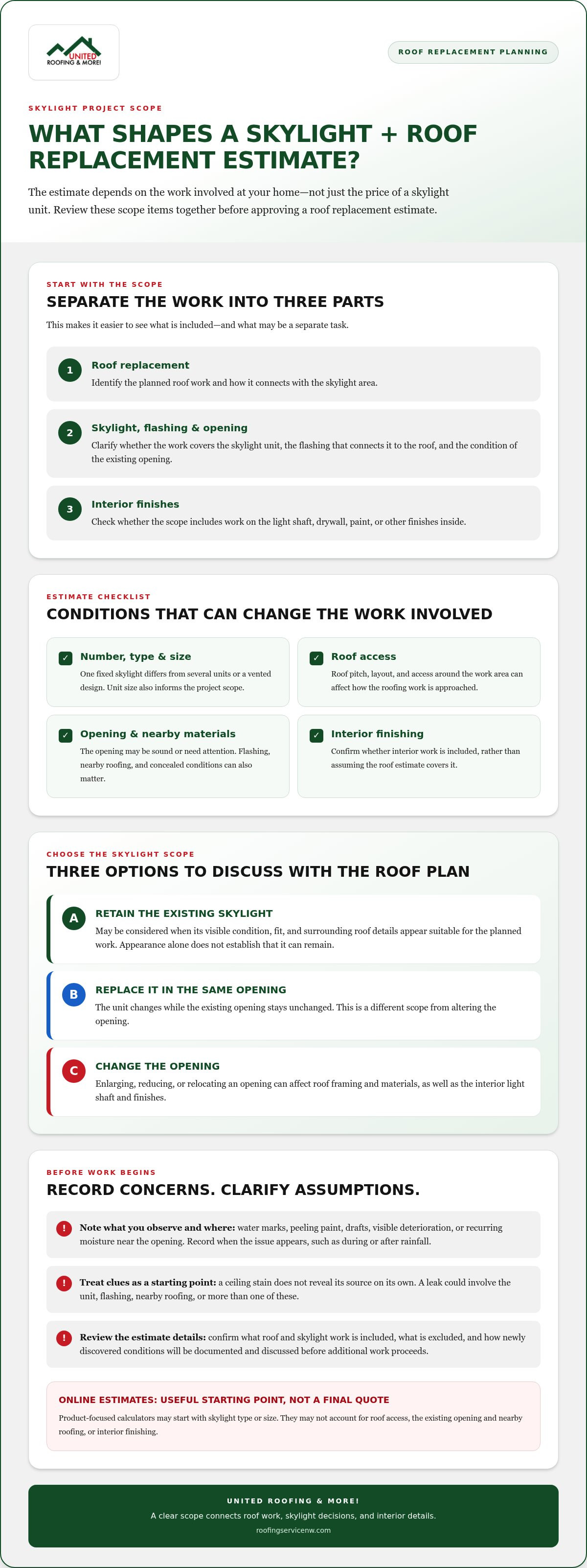
Separate the roofing scope from the skylight and interior scope. Roof replacement covers the planned roof work. Skylight-related work may involve the unit, its connection to the roof, and finishes around the interior opening. Knowing which items are included helps prevent gaps between the roof plan and decisions about the skylight.
- Number and type of units: One fixed skylight differs from several units or a vented design. For a general overview of skylight types, see Skylight (Wikipedia).
- Roof access: Roof pitch, layout, and access around the work area can affect how the roofing work is approached.
- Opening condition: The existing opening may be sound, or it may need attention once surrounding materials are examined.
- Interior finish: Clarify whether the scope includes work on the light shaft, drywall, paint, or other finishes inside.
For example, replacing a unit within an unchanged opening differs from altering the opening to fit a different size. Either choice can affect coordination between roof and interior work.
Why can online skylight estimates differ from a reroofing estimate?
Online calculators can help with early budget planning, but product-focused tools usually begin with details such as skylight type or size. They may not account for roof access, the condition of the existing opening and nearby roofing, or interior finishing. Those details matter when planning skylight work alongside roof replacement.
Use an online estimate as a starting point, not a final quote. A clear project scope identifies what the roof replacement includes, what skylight-related work is planned, and how concealed conditions could affect the work. Review assumptions and exclusions before approving the estimate so you understand how each part fits together.
How Skylight Condition and Roof Scope Change the Replacement Decision
An existing skylight may look fine from inside even when nearby roof materials show wear. A ceiling stain may signal a problem without revealing its source. These signs help identify what needs attention, but they don’t determine the solution on their own. Consider the unit, flashing, roof covering, and interior opening together.
The condition of the skylight and the condition of the roof around it are related, but they are not the same assessment. A leak could involve the skylight unit, the flashing that connects it to the roof, nearby roofing materials, or more than one of these. Identifying the likely source helps define what belongs in the roof replacement scope.
Before work begins, note what you’ve observed and where: water marks, peeling paint, drafts, visible deterioration, or recurring moisture near the opening. Record when the issue appears, such as during or after rainfall. These clues help focus the discussion, but an assessment is needed to identify the cause.
When might keeping an existing skylight be considered?
Retaining a unit may be an option when its visible condition, fit, and surrounding roof details appear suitable for the planned work. Consider how it meets the roof, the condition of the flashing and nearby materials, and whether the existing setup fits the reroofing scope. Appearance alone doesn’t establish that a skylight can remain.
Keeping the unit avoids changing the skylight itself, but the roof work still needs to account for it. If concerns emerge later, addressing them may require separate work. Discussing the unit while planning the roof replacement makes this trade-off clear before the scope is set.
When might replacement or a changed opening enter the discussion?
Clouding between panes, visible damage, recurring moisture, or difficulty operating a vented unit are reasons to include the skylight in project planning. These signs don’t prove the unit needs replacement. Consider its condition alongside the opening and the roof details around it.
Replacing a unit within the existing opening differs from enlarging, reducing, or relocating that opening. A change can affect roof framing and materials, as well as the interior light shaft and finishes. It may expand the work beyond the roof itself. Make sure the proposed scope describes which roof-related tasks and interior changes are included.
Some conditions, such as deteriorated material beneath the visible roof surface or damage around the opening, may only become apparent as work progresses. Clarify how newly discovered conditions will be documented and discussed before additional work proceeds. This gives you a clearer basis for understanding any scope changes.
United Roofing & More! is locally owned and operated in the Pacific Northwest and provides roof replacement services. Planning the roof scope alongside skylight-related concerns can help bring the project details into focus. Learn more about roof replacement services.
Replace, Retain, or Change the Skylight During a New Roof?
A new roof doesn’t automatically mean every skylight must be replaced. The right choice depends on the unit’s condition, the surrounding roof details, and your priorities, such as keeping the current layout or changing the amount of daylight. Compare the options before settling the scope. This makes the cost to replace skylights with new roof work easier to understand as a project decision, not an automatic add-on.
| Option | Scope and coordination | Uncertainty and questions to resolve |
|---|---|---|
| Retain the existing skylight | Plan the roof replacement around the current unit and its position. | Does the unit appear suitable to remain, and how will the roof details around it be addressed? |
| Replace within the existing opening | Coordinate the roof work with a replacement unit that fits the current opening. | Is the opening in suitable condition, and what unit and related work are included in the scope? |
| Alter the opening | Coordinate changes to the roof opening with any affected framing and interior finishes. | How will the changed opening affect the roof and interior scope, and what conditions could alter the plan? |
What should homeowners weigh when comparing the options?
Start with the skylight’s apparent condition and any nearby roof concerns. Then consider whether the current size and position provide the daylight you want. Keeping a unit preserves the existing layout. Replacing it within the same opening keeps its location but adds coordination. A new or altered opening can change the room’s light and may involve more roof and interior work.
Also consider disruption inside the home. Work on the light shaft or other finishes may be part of the plan. The best fit depends on the property and selected scope, so treat each option as something to assess rather than a universal recommendation.
How can a clear scope reduce uncertainty?
Make sure the written scope distinguishes roof replacement tasks from skylight-unit decisions and interior finishing. It should state what work is included, what assumptions guide the plan, and what is excluded. Agree on how newly discovered conditions will be documented and discussed before they change the scope. Clear notes give everyone a shared reference point.
For a broader look at planning roofing work, the complete local roof replacement guide can help you prepare for reroofing decisions. Review the roof and skylight choices together, then settle on the approach that fits your home and priorities.
Planning Skylight Replacement With a New Roof in Washington
Preparation turns a broad discussion about skylights and roofing into a clearer project plan. For homeowners in Marysville, Seattle, Renton, Everett, Lynnwood, Kirkland, Mount Vernon, Bothell, Edmonds, Shoreline, Sammamish, Redmond, Bellevue, Tacoma, and Kent, the cost to replace skylights with new roof work depends on the property and agreed scope, not a blanket local figure. Gather useful details first, then review how the roof, skylight concerns, and any interior work fit together.
Plan for weather, too. Pacific Northwest conditions can affect when exterior work can safely proceed, so scheduling should account for the forecast and conditions at the property. Before approving changes to a skylight opening, verify any permit or code requirements that apply to the project with the appropriate local authority. General online information is not a substitute for current local guidance.
- Document concerns. Note how many skylights you have, where they are, and what you’ve observed, such as a water mark, visible wear, or difficulty operating a unit. Photos taken from a safe location can help you describe the issue.
- Gather available records. Collect past roof or skylight paperwork, product details, and notes about previous repairs if you have them. These records provide context but don’t confirm the current condition.
- Identify priorities. Decide whether you’d prefer to retain the existing unit, consider replacement within the current opening, or explore changing the opening. Note whether your main goal is to address a concern, preserve the room’s current daylight, or change it.
- Clarify the scope and review the estimate. Compare the written plan with your priorities. Look for separate descriptions of roof work, skylight-related work, and interior finishes, along with clear assumptions and a process for discussing conditions discovered during the project.
What details should homeowners gather before reviewing a scope?
A simple room-by-room note can make the discussion more focused. Include each skylight’s approximate location, visible concerns, and any past repair information you can find. Then state your preference, even if it’s tentative. For example, you may want to keep the existing layout but be open to discussing a change if the roof or opening requires a different approach.
How should the estimate and payment plan be reviewed?
Read the estimate as a scope document, not just a total. Make sure roof replacement tasks are distinguishable from skylight and interior tasks, and that assumptions or potential changes are written plainly. Roofing financing is also available to help homeowners and businesses fund roofing projects. Review the applicable details for your project without assuming particular terms or eligibility. Learn more about roof financing options for Marysville and Greater Seattle.
For a roof plan shaped around your property, start planning your roof replacement with United Roofing & More!, a locally owned and operated Pacific Northwest contractor.
Plan Your Roof Replacement With United Roofing & More!
A roof replacement involves more than choosing roofing materials. If your home has skylights, decisions about them can affect the project scope and your planning. United Roofing & More! provides professional roof replacement and installation for residential and commercial properties in the Pacific Northwest. A clear conversation about the roof, skylight-related concerns, and your priorities can make the planned work and its assumptions easier to understand.
What to expect when discussing a roof replacement project
Start with your roof’s condition and needs. Share what you’ve noticed, such as a leak, visible wear, or a concern near a skylight, and explain what you want the project to accomplish. This helps organize the roof replacement scope and identify how skylight decisions relate to the broader plan.
Be clear about your preferred outcome. You may want to keep the current skylight layout, consider a change, or simply have the roof work and its assumptions described clearly. Distinguish skylight-unit and interior work from roofing tasks in the written scope. That way, you can see what the roof replacement covers without confusing it with separate skylight decisions.
If you’re also dealing with a roof leak, storm damage, or general wear, roof repair may be relevant to the project discussion. United Roofing & More! provides roof repairs to address these concerns and help maintain the integrity of the roofing system.
Make the next step straightforward
Bring your questions, notes, and available roof records to the conversation. Focus on what the roof replacement includes, how skylight-related concerns affect the plan, and which assumptions could change if concealed conditions are found. A well-defined scope gives you a clearer basis for reviewing the project before approving the work.
United Roofing & More! provides roof replacement and installation services for Pacific Northwest property owners. Share your goals and questions to discuss the roof scope and your priorities. For additional preparation, the roof replacement guidance for local homeowners can help you understand the broader planning process.
Roofing financing is available to help homeowners and businesses fund roofing projects. Review this option alongside the roof scope as you plan your next steps. Whether you’re weighing roof replacement, have repair concerns, or want to understand how skylight decisions fit into the roofing plan, start with a clear discussion of your home and priorities.
Turn Your Roof Plans Into a Clear Next Step
Before moving ahead, decide what you want the project to accomplish. Is your priority a dependable roof replacement, a clearer plan for a skylight concern, or a better understanding of how the work fits your budget? Writing down your priorities can focus the next conversation and help you compare the proposed scope with what matters to your household.
The cost to replace skylights with new roof work is best considered in the context of the full project, not as an isolated decision. United Roofing & More! provides professional roof replacement and installation in the Pacific Northwest, with roofing financing available as an option to consider. Bring your questions and goals forward, and take the time you need to understand the proposed work.
Discuss your roof replacement project with United Roofing & More! Start with your priorities and the roof work you need to plan.
Frequently Asked Questions
How much does it cost to replace skylights with a new roof?
There isn’t one reliable figure for every project. The cost to replace skylights with new roof work depends on the agreed scope and conditions at the home, including the number of units and whether work involves an existing opening or interior finishes. Across Seattle, Marysville, Renton, Everett, Lynnwood, Kirkland, Mount Vernon, Bothell, Edmonds, Shoreline, Sammamish, Redmond, Bellevue, Tacoma, and Kent, a property-specific estimate is more useful than a broad local assumption.
Is it cheaper to replace a skylight when replacing the roof?
Coordinating skylight-related work while planning the roof project may simplify planning, but it doesn’t guarantee a lower total cost. The result depends on the work involved, how it fits with the roofing scope, and whether interior work is needed. Compare what a combined project includes with the work required for each task separately. Don’t assume that reroofing automatically creates savings.
Can I keep my existing skylight when I get a new roof?
Retaining an existing skylight may be an option, depending on its condition and the details around it. A unit that operates normally may still have concerns at its connection to the roof, while a visible issue doesn’t by itself establish that the unit must be replaced. Share any drafts, stains, or operating problems during planning so the roof scope accounts for the skylight.
What factors affect the cost of replacing a skylight during reroofing?
The estimate can reflect the number and type of skylights, roof access, the state of the existing opening, and any related interior finish work. The chosen scope matters too: keeping the opening as-is differs from changing its size or location. For example, a plan that affects a room’s ceiling or light shaft may involve work beyond the roof surface. Make sure each part is described clearly in the estimate.
What happens if roofers find damage around a skylight during replacement?
If concealed damage becomes visible during work, document what was found and explain how it affects the planned scope. The affected area may need attention before the roof work can be completed as intended. Review the proposed change, how it relates to the original plan, and any estimate revision before additional work proceeds. Clear communication keeps decisions tied to the actual condition.
Does replacing a skylight require changing the roof opening?
Not necessarily. A replacement may be planned for the existing opening if the selected approach and site conditions allow it. Changing the opening is a separate scope decision that can affect roof materials and the interior area around the shaft. Consider whether you want to preserve the current skylight location and daylight pattern or make a change, then include any added work in the project plan.
Should skylights be replaced before or after a new roof is installed?
Decide how to handle the skylight before roof work begins so the project scope reflects your plans. The physical sequence depends on the work and how the roof and skylight tasks are coordinated. If you’re retaining a unit, make that clear in the roofing plan. If the unit or opening will change, account for that work and any interior effects in the sequence. Don’t leave the decision until after planning the roof work.


