

Imagine waking up to a ceiling leak just weeks after paying for a full replacement. You've called the contractor three times, but your messages go straight to voicemail while water ruins your drywall. It's a nightmare scenario that leaves many Washington homeowners feeling helpless and financially drained. If you're stuck with shoddy workmanship or an abandoned project with United Roofing & More!, knowing how to file a complaint against a roofer in WA is your first step toward a solution. You don't have to settle for a failing roof or a lost investment.
Washington state laws changed recently to give you more protection. As of July 1, 2026, the new Homeowner Recovery Program is officially active, providing a vital safety net when a contractor's bond isn't enough. We understand the stress of structural damage and the confusion of legal codes. This guide shows you exactly how to navigate the Department of Labor & Industries (L&I) system. We'll break down the process of accessing a contractor's $15,000 or $30,000 bond and explain when to use small claims court. You'll gain a clear, step-by-step path to hold your roofer accountable and finally get the leak-free home you deserve.
Key Takeaways
- Identify the specific red flags, such as job abandonment or safety violations, that qualify for a formal dispute in Washington.
- Learn the exact steps for how to file a complaint against a roofer wa through the Department of Labor & Industries (L&I) portal.
- Discover how to access a contractor’s mandatory surety bond or the state's new 2026 Homeowner Recovery Program to recoup financial losses.
- Build a bulletproof case by organizing a documentation checklist that includes signed contracts, change orders, and timestamped damage photos.
- Ensure future peace of mind by partnering with transparent local experts in Marysville and Seattle who prioritize clear dialogue and professional standards.
Recognizing When to File a Complaint Against Your Washington Roofer
Your home is likely your biggest asset. When a contractor fails to deliver, it's more than a nuisance; it's a financial threat. Knowing how to file a complaint against a roofer wa starts with identifying the line between a minor delay and a legal breach. Poor communication is frustrating, but it usually doesn't hold up in court. However, abandonment or using subpar materials are actionable offenses that demand immediate attention. If your roofer stops showing up or ignores safety protocols, your home's structural integrity is at risk.
A botched roof replacement can instantly tank your property value. Errors like improper flashing or poor ventilation lead to mold and rot that cost thousands to fix. In Washington, you have a two year window from the date of completion or abandonment to take action against a bond. Waiting until the damage becomes permanent is a mistake. Acting quickly ensures you can access the resources needed to make things right before the Pacific Northwest weather causes further decay.
Contractual Violations and Workmanship Issues
Contractors in Marysville or Seattle must follow strict WA building codes and manufacturer specifications. A common violation involves "bait and switch" tactics. This happens when a roofer substitutes high quality shingles for inferior products without your consent or a signed change order. Another critical issue is negligence during the project. If a crew leaves your roof deck exposed to rain, causing internal leaks, they've breached their duty of care. These workmanship failures aren't just mistakes; they are violations of the professional standards you paid for. Documenting these errors with photos is essential for your L&I claim.
Financial and Administrative Red Flags
Financial red flags often surface before the first shingle is laid. Be wary of any roofer asking for an unusually large deposit before work starts. Under RCW 18.27.114, contractors must provide a disclosure statement for projects over $1,000. If they skip this, it's a major warning sign. In areas like Sammamish, we see cases where contractors fail to pay their subcontractors. This can result in a lien being placed against your property, even if you've paid your bill in full. This is why contractor surety bonds exist. They provide a financial cushion for homeowners when a business fails to meet its obligations. Always verify that a roofer's registration number is active and matches their advertising. At United Roofing & More!, we contrast this behavior by providing clear dialogue and transparent financing options to keep your project on track without hidden surprises.
The Washington State Department of Labor & Industries (L&I) Process
The state government provides a specific framework for dispute resolution. If you're wondering how to file a complaint against a roofer wa, you must start with the Department of Labor & Industries. This agency regulates contractor registration and safety. While they don't act as your personal attorney, their official records are the strongest evidence you have. Following the state's established steps ensures your grievance is documented in the public record, which is essential for any future legal action.
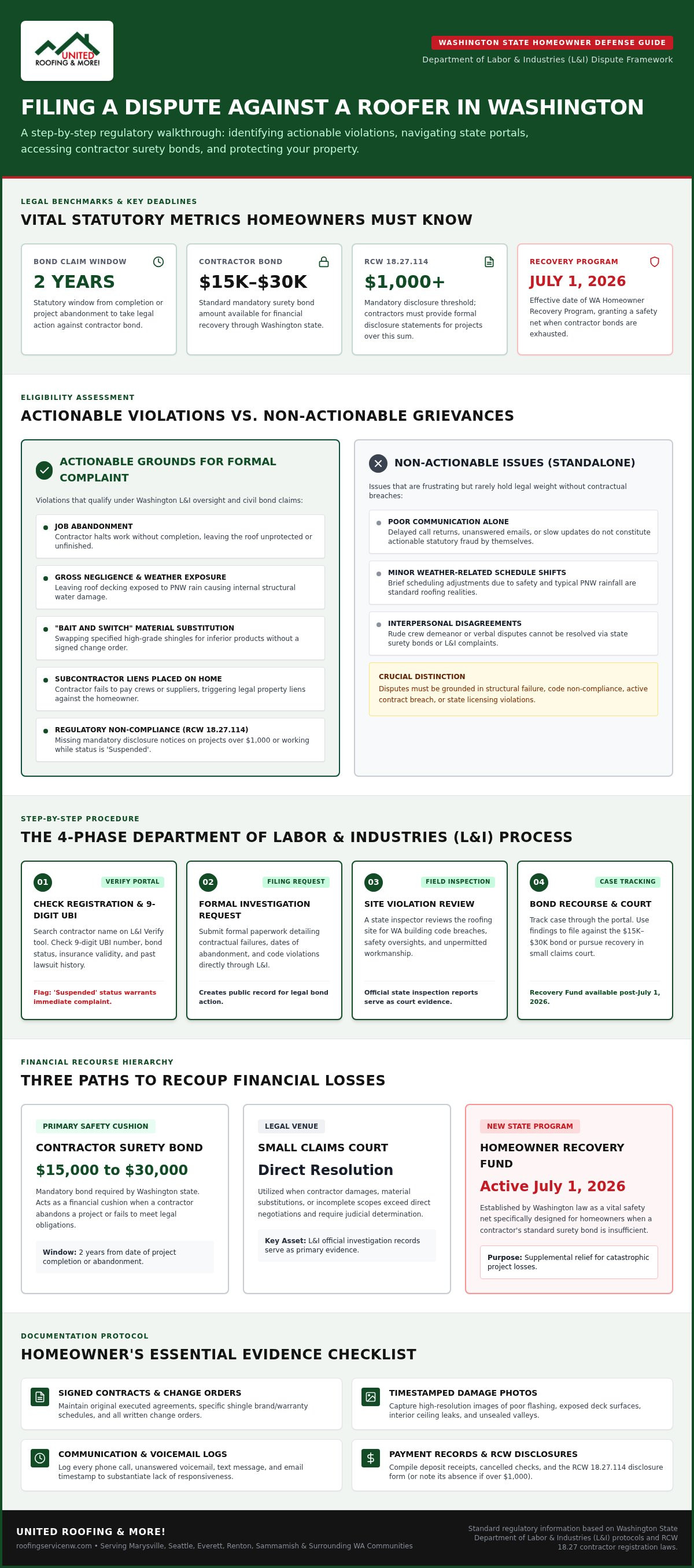
The process moves through four distinct phases. First, you verify the contractor's status. Second, you file the formal paperwork. Third, an inspector reviews the site for violations. Finally, you track the case through the state portal. This structured approach helps move your dispute from a private argument to a state-monitored investigation. If you're currently facing a project failure, we recommend starting this process immediately to protect your rights.
Using the L&I Verify Tool Effectively
Before filing paperwork, check your contractor’s current standing. Use the online portal to look up companies operating in Everett or Renton. An active registration is mandatory for any legal roofing work. If you see a 'Suspended' status, it's an immediate trigger for a formal state complaint. This status usually means the contractor let their insurance or bond lapse. You can find a roofer's nine digit UBI number by typing their business name into the search bar on the L&I Verify a Contractor site. This tool also reveals past lawsuits and bond history, showing you if the contractor has a pattern of project failures.
Filing the Request for Investigation
The next step is submitting a formal Request for Investigation. This document initiates the official Washington State Department of Labor & Industries dispute process. You'll need to provide your contract dates, proof of payment, and specific details about the alleged violations of the Contractor Registration Act (RCW 18.27). Be as detailed as possible when describing the workmanship issues.
It's vital to know the difference between a safety complaint and a monetary dispute. L&I inspectors focus on building code violations and registration infractions. They can issue citations and fines to the contractor for poor workmanship or safety risks. However, L&I cannot force a roofer to give you a refund. For financial recovery, you'll need to pursue their bond or use small claims court. To avoid these headaches entirely, it's best to work with a team that prioritizes clear dialogue and professional roof repairs from the start.
Once your request is submitted, an L&I inspector may visit your property. They assess whether the work meets state standards. You can track the progress of your complaint through the state's secure portal using your case number. This keeps you informed as the state determines if the contractor broke the law.
Alternative Paths: Small Claims Court and the Contractor Surety Bond
When state fines and investigations aren't enough to cover your losses, you must look toward financial recovery. Most homeowners think L&I pays out for damages, but that's a common misconception. The real safety net is the contractor's surety bond. This is a three party agreement that ensures funds are available if a roofer breaches their contract or fails to finish a project. Understanding how to file a complaint against a roofer wa involves knowing how to trigger these financial protections effectively. It's about moving from administrative complaints to legal recovery.
The Washington State Attorney General's contractor guide provides essential context for these situations. It outlines your rights regarding deceptive practices and construction liens. If you used roofing financing to fund your project, your urgency is even higher. You still have a debt to your lender even if the work is substandard. Recovering these funds through a bond or court judgment is the only way to protect your credit and your home.
How to File a Claim Against a Roofer’s Bond
To access a roofer's bond, you cannot simply call the bonding company. You must file a lawsuit in the Superior Court of the county where the work was performed. In Washington, specialty contractors like roofers must maintain a $15,000 surety bond. General contractors carry a $30,000 bond. You must serve the summons and complaint to L&I along with a $66.20 processing fee. L&I then legally serves the contractor and the surety company. This process is technical, but it's the only way to "reach" the bond money reserved for residential homeowners. Remember, you have a two year window from the date the work ended to start this action.
Small Claims Court in Seattle and Snohomish County
If your dispute is under $10,000, Small Claims Court is a faster, more accessible option for individuals. This is common for smaller roof repairs or partial replacements in cities like Lynnwood or Seattle. You begin by filing a 'Notice of Claim' at your local District Court. One unique rule in Washington Small Claims is that attorneys are generally prohibited from representing parties. You'll represent yourself and speak directly to the judge. This levels the playing field for homeowners.
Your evidence is the backbone of your case. A second opinion from a reputable, registered roofer is vital. A written estimate from a different company showing the cost to fix the mistakes provides the judge with a concrete dollar amount for your damages. Bring your original contract, proof of payment, and high resolution photos of the defects. This clear dialogue with the court, backed by expert documentation, is how you win a judgment and secure the funds needed for a proper, leak-free roof.
Preparing Your Evidence: The Homeowner’s Documentation Checklist
Winning a dispute requires more than just a valid grievance; it requires undeniable proof. Documentation is your leverage. It transforms your personal frustration into a legal reality that state agencies and courts can act upon. Learning how to file a complaint against a roofer wa is only half the battle. The other half is proving your case with a paper trail that leaves no room for doubt. If you're facing a project failure, you need to stop and organize your files immediately.
Start by gathering every version of your contract. This includes the original signed agreement, all written estimates, and any change orders you authorized. Don't rely on verbal promises. If it isn't in writing, it didn't happen in the eyes of the law. You also need a comprehensive communication log. Save every text message, print every email, and note the date and time of every unanswered phone call. This log demonstrates the roofer's pattern of behavior and their failure to address your concerns.
Photographic and Physical Evidence
Photos don't lie. Take high resolution images of the roof from multiple angles. Focus on technical details like improper roof drip edge installation, which is a common cause of fascia rot in the Pacific Northwest. If the exterior failure has caused interior damage, document it. Capture water stains on your ceiling, damp insulation in the attic, or warped drywall. A deficiency report is a formal, written evaluation by a neutral roofing expert that identifies specific workmanship failures and estimates the cost of corrective action. This report is your strongest piece of evidence when filing a claim against a bond.
Financial and Administrative Records
Your financial records prove the roofer's obligation. Compile your cancelled checks, bank statements, and credit card receipts. Washington state law requires contractors to provide a 'Notice to Customer' disclosure statement for any residential project over $1,000. If your roofer failed to provide this under RCW 18.27.114, they've committed an infraction. This violation can be a major factor in your L&I investigation.
You must also track 'Lien Releases' from material suppliers. In Washington, if a roofer doesn't pay for the shingles or vents, the supplier can place a lien on your home even if you've already paid the contractor. These releases prove you've cleared your obligations. If you're worried about the quality of your current project, request a professional roof inspection to get a clear, documented look at your home's condition before the damage gets worse.
Avoiding Future Disputes: Choosing a Reliable Washington Roofer
Preventing a roofing disaster is always better than managing one. If you've spent time researching how to file a complaint against a roofer wa, you already understand the emotional and financial toll of a bad hire. The best way to protect your home in the future is to vet your contractor for more than just a low price. You need a partner who values transparency and professional standards. Look for master roofing standards to ensure your installation is backed by industry leading manufacturers. A reliable roofer provides clear, written warranties and transparent financing options that ensure quality isn't sacrificed for cost.
The Importance of Local Accountability
Local presence isn't just about convenience; it's about legal reach. 'Storm chasers' or out of state contractors are significantly harder to hold accountable because they often lack a physical footprint in the Pacific Northwest. It's much harder to serve a legal summons to a PO Box than to a physical office in Bothell or Renton. Before signing a contract, verify the business has a local address in cities like Kent or Marysville. This ensures they'll be around to honor their warranty if a leak occurs three years down the road.
A contractor who truly understands the specific roof pitch challenges of PNW homes is vital. Our region's heavy rainfall and moss growth require specialized knowledge of drainage and ventilation. Out of state crews might not realize how a steep pitch affects shingle loading or gutter capacity in Seattle's climate. Hiring locally means hiring someone who lives with the same weather patterns you do and knows how to build a roof that lasts.
Transparency and Peace of Mind with United Roofing & More!
At United Roofing & More!, we believe that clear dialogue is the foundation of every successful project. We've built our reputation on being a reliable, hardworking, and transparent local expert. Our team avoids high pressure tactics and focuses on keeping you informed throughout the entire service process. We provide jargon-free communication so you always know the status of your roof repairs or replacement. This commitment to honesty prevents the very issues that lead to state complaints and legal disputes.
We lower the barrier to quality work through financial flexibility and complimentary diagnostic services. By offering roofing financing, we help homeowners avoid cutting corners that lead to structural water damage. Our professional credentials and tenure in the Marysville and Seattle areas speak for themselves. We treat your home with the respect it deserves, ensuring a finished, leak-free roof every time. Contact United Roofing & More! for a transparent, stress-free roofing experience.
Secure Your Home and Your Peace of Mind
Dealing with a failed roofing project is exhausting, but you now have the tools to fight back. You know that documentation is your strongest weapon and that the L&I investigation process is your first official step toward justice. Whether you pursue a small claims judgment or file a lawsuit against a contractor's bond, staying organized will lead you to a resolution. Understanding how to file a complaint against a roofer wa ensures you aren't left footing the bill for someone else's mistakes. Taking action today protects your home's value and your financial future.
At United Roofing & More!, we believe you shouldn't have to navigate these stresses alone. As a locally owned and operated expert in Marysville and Seattle, we prioritize clear dialogue and customer peace of mind. We specialize in professional roof replacement and offer flexible roofing financing to ensure your project is done right the first time. Don't let a bad experience compromise your home's safety. Schedule a professional roof inspection with United Roofing & More! to get your project back on track. You deserve a durable, leak-free roof and a contractor you can actually trust.
Frequently Asked Questions
Can I file a complaint if the roofer wasn't registered in Washington?
Yes, you can report an unregistered contractor to the L&I fraud hotline immediately. While the state can issue civil penalties up to $10,000 for working without a license, your financial recovery options are limited. Since there is no surety bond to claim against, you'll likely need to pursue the individual in civil court. Homeowners in Seattle or Marysville should always verify registration before any work begins to ensure they have access to state-backed protections.
How long do I have to file a complaint against a roofer in WA?
You have exactly two years from the date the roofing work was substantially completed or abandoned to take legal action against the contractor's surety bond. This strict deadline is set by Washington law under RCW 18.27.040. If you wait longer than two years, you lose your right to access the bond funds reserved for residential homeowners. Residents in Everett or Renton should document issues early to avoid missing this critical window for recovery.
What happens after I submit a complaint to L&I?
After you submit a Request for Investigation, an L&I inspector reviews the case and may visit your property to assess the workmanship. They check for violations of state building codes or registration laws. If the inspector finds proof of negligence, they will issue citations and fines to the contractor. While L&I doesn't personally collect money for you, their official findings serve as powerful evidence for your small claims case in Lynnwood or Snohomish County.
Does it cost money to file a complaint with the state?
Filing a formal Request for Investigation with L&I is a free service for all Washington residents. However, if you decide to sue the roofer to recover money from their bond, you'll encounter specific legal fees. These typically include a Superior Court filing fee of $200 to $240 and a $66.20 service fee paid to L&I. Knowing how to file a complaint against a roofer wa requires balancing these administrative costs against the total value of your roofing damages.
Can the Washington Attorney General help me get my money back?
The Attorney General’s Consumer Protection Division tracks patterns of unfair or deceptive business practices across the state. They don't usually act as a private attorney to recover money for individual homeowners in Bellevue or Kirkland. Instead, they use your complaint to build larger cases against contractors who habitually scam the public. For direct financial reimbursement, you should focus on the L&I bond claim process or the new 2026 Homeowner Recovery Program.
What should I do if a roofer puts a lien on my house?
Check if the contractor provided the mandatory "Notice to Customer" disclosure before the project started. If they skipped this requirement for a project over $1,000, the lien might be unenforceable. You should also verify if the roofer paid their subcontractors and material suppliers. Homeowners in Sammamish or Edmonds can often resolve these disputes by showing proof of payment or filing a complaint with L&I to investigate the contractor's financial practices.
Is a verbal agreement for roof repairs binding in Washington State?
Verbal agreements are technically binding but nearly impossible to enforce in a state investigation or court. Washington law requires contractors to provide a written contract and a signed disclosure statement for residential roofing projects exceeding $1,000. Without a written document, it's very difficult to prove the original scope of work or the agreed price. Always insist on a written contract to protect your home in Tacoma or Bothell from shoddy workmanship and hidden fees.
How do I find out if a roofer has previous complaints against them?
You can use the L&I "Verify a Contractor" tool to see a business's full history of lawsuits, bond claims, and safety infractions. This public database is the most reliable way to check if a roofer in Marysville or Seattle has a history of project failures. It also shows if their registration or insurance is currently suspended. Checking this tool is a vital part of how to file a complaint against a roofer wa because it reveals if the contractor is a repeat offender.


