
What does it mean when shingles curl? If you’re searching “curling shingles what does it mean,” treat lifted edges as a sign to look more closely, not as a diagnosis of your roof’s condition. The pattern and any other changes on or inside your home can help determine what to do next.
Curled shingles can be associated with aging, attic heat or moisture, or installation issues. Lifted edges may also leave shingles more exposed to wind and rain. But a few curled shingles don’t automatically mean the entire roof is failing. The extent of the curling and the roof’s overall condition matter.
This guide covers common causes, warning signs that deserve prompt attention, and what you can safely observe from the ground. You’ll also learn how a roofing evaluation can help determine whether repair or replacement is appropriate. United Roofing & More! serves residential and commercial properties in the Seattle Metropolitan Area, with clear communication throughout each project. When you’re ready to discuss what you’ve noticed, Get a Free Quote!
Key Takeaways
- “Curling shingles what does it mean” depends on the pattern and the roof’s overall condition. Curling is a visible clue, not a diagnosis on its own.
- Note whether curling appears in one area or across several sections, and whether you’ve noticed indoor signs such as staining or water entry.
- Observe the roof from the ground and take photos if it’s safe. Don’t walk on the roof or attempt repairs from an unsafe position.
- A roofing evaluation can help determine whether roof repair or replacement fits the roof’s actual condition.
- United Roofing & More! provides roof repair and replacement in the Seattle Metropolitan Area. Get a Free Quote! to discuss your roof concern.
Curling Shingles: What Does It Mean for Your Roof?
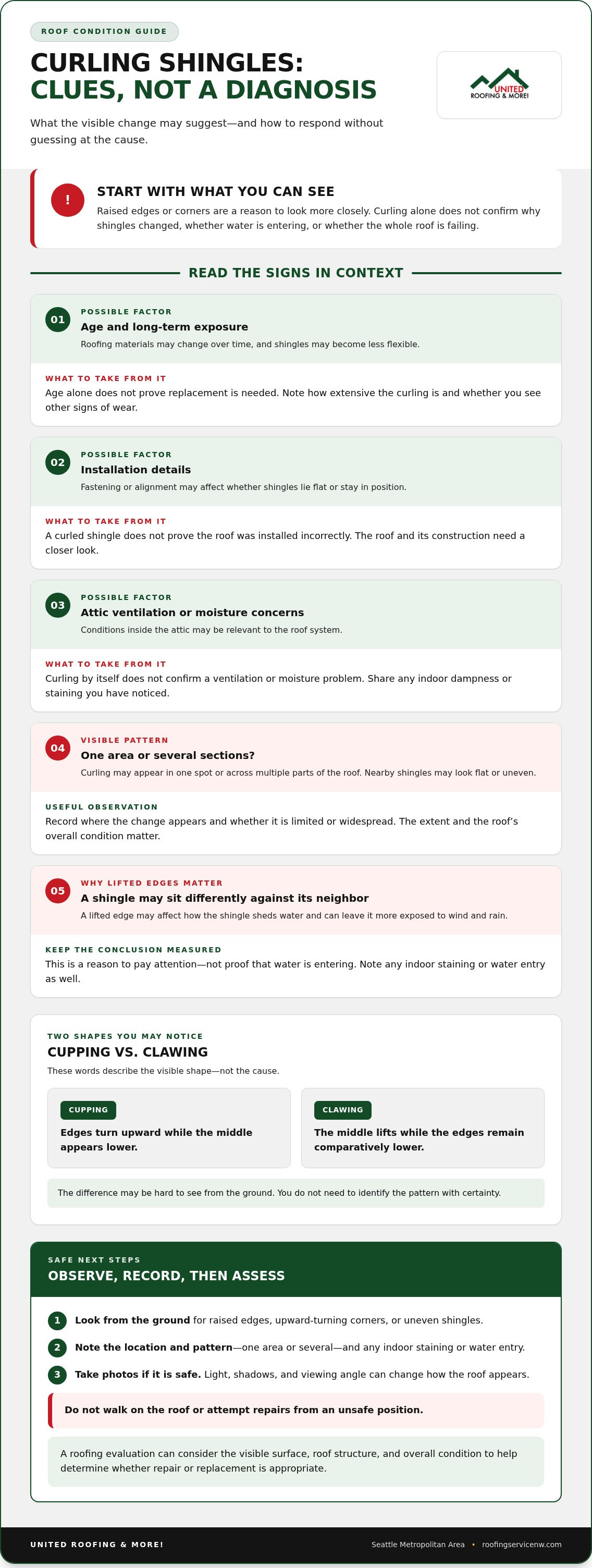
If you’re asking, “curling shingles what does it mean for my roof?”, start with what you can see. Curling describes shingle edges or sections lifting or turning away from their usual flat position. It may be a small corner that no longer lies flush, or a more noticeable pattern across several shingles.
Curling shingles are a visible symptom, not a confirmed diagnosis of the cause or the roof’s overall condition. Their appearance can point to an area that needs a closer look, but it can’t show by itself why the shingles changed or what repair is needed. Asphalt shingles are a common roofing material; this overview of asphalt shingles provides general background on how they’re made and used.
A lifted edge may affect how a shingle sheds water because it no longer sits in its usual position against the neighboring course. That’s a reason to pay attention, not proof that water is entering the roof. The pattern and any other signs on or inside the home help put the change in context.
What curling shingles look like from the ground
Look for raised edges, corners turning upward, or shingles that appear uneven beside the rows around them. One section may look wavy or irregular while nearby shingles seem flat. Note where you see the change and whether it appears in one area or in several places.
Light and viewing angle can affect how a roof looks. Shadows may make a flat edge appear raised, and a different vantage point may reveal or hide unevenness. Observe from a safe spot on the ground with a clear view. Don’t climb onto the roof to get closer.
Cupping and clawing: two common curling patterns
Cupping describes shingles whose edges turn upward while the middle appears lower. Clawing is the reverse: the middle lifts while the edges remain comparatively lower. These terms describe the visible shape, not the reason the shingle changed.
The distinction may not be clear from the ground, especially when shadows or roof angles make details hard to see. You don’t need to identify the pattern with certainty. A photo taken from a safe location can help you record what you noticed and explain it later.
Focus on observable details: which part looks raised, where it appears, and whether nearby shingles look different. Neither cupping nor clawing proves a particular cause, installation issue, or repair need. A closer evaluation can help determine what the visible change means for the roof as a whole.
United Roofing & More! provides roof repair and roof replacement for Seattle Metropolitan Area homeowners and businesses. The right next step depends on the roof’s actual condition, not one symptom alone. Call now for FREE Estimate!
Why Do Roof Shingles Curl? Common Causes to Understand
“Curling shingles what does it mean?” doesn’t have one answer. Shingles can curl for several reasons, and similar-looking changes can have different causes. What you see on the surface is useful information, but it doesn’t reveal what’s happening beneath the shingles or inside the attic.
Age and long-term exposure can gradually change roofing materials. Shingles may become less flexible over time, but age alone doesn’t prove that replacement is necessary. Consider how extensive the curling is and whether you see other signs of wear. An evaluation of the roof as a whole can help put the change in context.
How age, installation, and exposure may contribute
Installation details may also play a part. If shingles weren’t fastened or aligned as intended, they may not lie flat or stay in position as expected. That possibility doesn’t prove the roof was installed incorrectly. Determining the cause requires a closer look at the roof and its construction.
Exposure can vary across one roof and between homes. Roof orientation, nearby structures, and shade can affect how much sun or wind different sections receive. Seattle-area properties don’t all have the same exposure, so don’t assume local conditions explain curling without considering the specific roof.
Why ventilation, moisture, and roof layers matter
Attic conditions may also be relevant. Ventilation and moisture concerns can affect the roof system, but curled shingles alone don’t confirm either one. If you notice indoor signs such as dampness or staining, share those observations during a roofing evaluation rather than trying to inspect hidden areas yourself.
Existing roof layers can make it harder to understand how the shingles and underlying materials are performing. A layered roof doesn’t automatically have curled shingles or another problem, but the added construction may complicate a full assessment. A roofing professional can consider the visible surface along with the roof’s structure and history.
As you consider possible causes, separate what you’ve observed from what you’re concluding. Note whether curling appears in one section or across several areas, and whether you know of previous roof work. Those details can guide an evaluation, but they don’t establish the cause on their own. Avoid treating age or ventilation as the explanation until the roof has been assessed.
United Roofing & More! provides roof repair and roof replacement in the Seattle Metropolitan Area. The next step should reflect the roof’s condition, not a guess based on one symptom. To discuss what you’ve observed, explore roof repair and replacement guidance and Get a Free Quote!
Are Curling Shingles Serious? Signs That Change the Level of Concern
Curling deserves attention, but it doesn’t automatically mean your roof is failing. One raised corner is different from curling across several roof sections. Neither observation alone determines whether you need a repair or a full replacement. The pattern, whether it’s changing, and the roof’s overall condition all matter.
Lifted edges may make it harder for shingles to shed water as intended, and shingles that appear displaced may need a closer look. That doesn’t prove water has entered the roof or that damage has occurred. Check whether the curling appears alongside other warning signs.
When curling may call for prompt attention
Some signs call for a timely response. Active water entry, new indoor water staining, or shingles that appear visibly displaced should be brought to a roofing professional’s attention promptly. These signs don’t prove a particular cause or confirm hidden damage, but they are important information about the roof’s condition.
Take note if curling seems to be spreading or appears across a broad area. A change over time can help distinguish a stable, isolated concern from a pattern that deserves closer attention. Record what you can safely see and when you noticed it. You don’t need to assess the roof yourself.
- Water entering the home or fresh interior staining
- Shingles that appear loose, missing, or displaced
- Curling that is worsening or visible across multiple areas
If water is coming inside, don’t wait for a clearer view of the roof before seeking guidance. Describe what’s happening indoors and where you’ve seen exterior changes. Avoid climbing up to inspect or attempting a repair from an unsafe position.
Why curling does not automatically mean full replacement
The right response depends on more than the presence of curling. A roofing evaluation considers the cause, how much of the roof is affected, and the condition of the roofing system overall. A limited issue may be suitable for roof repair. Broader wear or other concerns may lead to a roof replacement recommendation. A view from the ground can’t determine which option fits.
Replacing an entire roof based only on one visible symptom may skip the evaluation needed to understand the issue. On the other hand, assuming a widespread or worsening pattern needs no attention could delay a useful assessment. The goal is a clear explanation of what’s visible and what next step suits the roof.
If you’re considering a larger project, the complete local roof replacement guide can help you understand the process. United Roofing & More! provides roof repair and roof replacement in the Seattle Metropolitan Area, with clear communication throughout the project. Get a Free Quote! to discuss what you’ve noticed and the next step.
What Should You Do If You Notice Curling Shingles?
If you’re still wondering “curling shingles what does it mean” for your home, start by collecting clear, safe observations. You don’t need to diagnose the roof or decide on a repair yourself. A few useful details can help a roofing professional understand what you’ve noticed and evaluate the roof’s condition.
- Look from a safe place on the ground. Choose a spot with a clear view. Don’t climb onto the roof, lean out of a window, or use a ladder to get closer.
- Record what you see. Note which roof area appears affected and whether curling seems limited or spread across multiple sections. Look for visible missing or displaced shingles, but don’t approach them.
- Take photos if conditions are safe. Use a ground-level view and, if helpful, take another photo later from the same spot. Comparing photos can show whether the appearance has changed.
- Note indoor changes. Keep track of new ceiling or wall staining, dampness, or active water entry, including where and when you noticed it.
- Seek professional guidance. Share your observations so the roof can be evaluated before deciding whether repair or replacement is appropriate.
How to document curling shingles safely
Keep notes simple: identify the side or general area of the roof, describe whether shingles look raised, missing, or displaced, and record when you first noticed the change. Photos can provide helpful context, but don’t risk a fall to get a better angle. Avoid entering an unsafe attic or going onto the roof to check hidden areas.
Ground-level observations can describe a roofing concern, but they can’t confirm its cause. A photo may show a visible change, but it can’t establish the condition of the layers beneath the shingles or whether a repair will address the issue.
What a roofing professional can help determine
A professional evaluation can consider the visible shingles alongside the broader roof condition. That assessment helps determine whether roof repair or roof replacement is the more suitable next step. If you’ve noticed changes near the roof edge, components there also relate to how water is directed away from the roof; this roof drip edge guide explains the role of that edge detail.
Share your photos and notes, including any indoor symptoms. United Roofing & More! serves the Seattle Metropolitan Area and keeps customers informed throughout the roofing process. The founding team brings over 15 years of industry experience. A free estimate can help clarify the next step based on the roof’s condition. Get a Free Quote!
Curling Shingles in the Seattle Area: Get Clear Next Steps
If you’re in the Seattle Metropolitan Area and wondering, “curling shingles what does it mean for my property?”, choose a clear evaluation over a guess based on one visible sign. Curling can look concerning, but the right response depends on the roof’s overall condition. A professional can help determine whether roof repair or roof replacement is appropriate.
United Roofing & More! provides roof repair and roof replacement for residential and commercial properties in the Seattle Metropolitan Area. The goal is to understand the roof’s condition and explain a practical path forward. A visible symptom can start the conversation, but it shouldn’t decide the project on its own.
How United Roofing & More! helps you understand the next step
The founding team brings over 15 years of industry experience to roofing projects. That experience supports a careful evaluation of the roof’s condition, so the next step can reflect what the project needs. Roof repair or roof replacement may be appropriate, depending on the findings. Curling alone doesn’t settle that decision.
Clear communication matters when you’re trying to understand what’s happening and what comes next. United Roofing & More! stays in constant communication with customers until the roofing job is done. Share what you’ve noticed, including where shingles appear curled and whether you’ve seen changes indoors. Those details help frame the conversation without taking the place of a professional evaluation.
Whether it’s a home or commercial property, the process should leave you with a better understanding of the roof’s condition and the recommended work. If repair is suitable, replacement may not be needed. If broader concerns are found, the team can explain why replacement is being considered. Recommendations should be based on the roof itself, not an assumption tied to one symptom.
Request a free estimate for roof repair or replacement
Before reaching out, gather any photos you’ve taken safely from the ground and note the areas that caught your attention. Mention indoor staining or active water entry, too. You don’t need to identify the cause or inspect the roof yourself. Straightforward observations give the team a useful starting point for discussing the concern and next steps.
United Roofing & More! offers a free estimate for roof repair and roof replacement. The company serves the Seattle Metropolitan Area, including Marysville, Seattle, Renton, Everett, Lynnwood, Kirkland, Mount Vernon, Bothell, Edmonds, Shoreline, Sammamish, Redmond, Bellevue, Tacoma, and Kent. Discuss curling shingles and get guidance based on the project’s condition. You don’t need to decide between repair and replacement from the ground. Get a Free Quote!
Turn Roof Concerns Into a Clear Next Step
A curled shingle can leave you wondering what to do next. Rather than deciding on a repair from the ground, use what you’ve observed to start a practical conversation about your roof. “Curling shingles what does it mean” points to a concern worth understanding, not a conclusion you have to reach on your own.
For property owners in the Seattle Metropolitan Area, a clear evaluation can help replace guesswork with an informed next step. United Roofing & More! provides roof repair and roof replacement based on the project’s condition, along with a free estimate. The team keeps customers informed throughout the roofing job, so you know what to expect as the work progresses.
Ready to talk through what you’ve noticed? Get a Free Quote! Contact United Roofing & More! to discuss your roof and request a free estimate.
Frequently Asked Questions
Can you walk on a roof with curling shingles?
No. Don’t walk on a roof to check curled shingles. The surface may be uneven, and stepping on shingles can dislodge or damage them. Even a roof that looks easy to access can be hazardous, especially near an edge or on a sloped section. Use binoculars or a camera from a safe place on the ground, then share what you can see with a roofing professional.
Can curled shingles damage the roof if they are left alone?
They can leave parts of the roof more exposed, but the result depends on the condition and extent of the curling. For example, a lifted edge may be more vulnerable to movement and may not shed water as intended. That doesn’t prove damage has occurred. Record visible changes and seek professional guidance if curling spreads or you notice missing shingles or indoor staining.
Will replacing a few curled shingles fix the problem?
Replacing a few shingles may address a localized issue if the surrounding roof is otherwise in suitable condition. It may not resolve a broader concern, such as curling across multiple areas or a problem affecting the roof beneath the shingles. A professional can evaluate the affected section and nearby materials before recommending a repair. Don’t assume that a small visible area means the issue is limited to those shingles.
Do curling shingles affect a roof warranty?
They may raise questions under a particular warranty, but the effect depends on the warranty’s wording and the circumstances. Review the document for terms about maintenance, installation, repairs, and what to do if a problem appears. Keep dated photos and records of roofing work. For a specific coverage question, contact the warranty provider or manufacturer and describe the condition accurately, without assuming a claim will be accepted or denied.
Can I flatten curled shingles myself?
It’s safer not to try. Applying heat, adhesive, or pressure can damage the shingle or affect nearby roofing materials, and accessing the roof creates a fall risk. A quick DIY fix may also hide a larger issue without addressing its cause. From the ground, note the location and take a photo if it’s safe. Then have a roofing professional determine whether the shingle can be repaired or needs replacement.
How can I tell whether curling shingles are getting worse?
Compare dated photos taken from the same safe ground-level spot. Look for more affected areas, edges that appear more raised, or shingles that seem newly displaced or missing. Also record new indoor marks, such as ceiling staining. Light and viewing angle can change how a roof looks, so compare several observations over time rather than relying on one photo to judge whether the condition has progressed.
Can curling shingles be a problem even if there is no leak?
Yes. No visible water indoors doesn’t confirm that the shingles are in good condition. Curling can indicate that roofing materials have changed, and lifted sections may not perform as intended. That doesn’t mean water has entered the home or that damage is certain. If you’re asking “curling shingles what does it mean,” treat the appearance as a reason to monitor the roof and seek an evaluation if it changes.


