
Imagine it is a rainy Tuesday in Marysville, and you are staring at a fresh water spot on your ceiling. You know a full commercial roof installation is inevitable, but the fear of shutting down your shop or draining your cash reserves keeps you from acting. It is a tough spot to be in. The Pacific Northwest's 42 inches of annual rainfall doesn't care about your production schedule, and waiting too long only makes the eventual repair costs climb.
We believe your roof should be a strategic financial asset, not a source of constant stress. This guide helps you take total control of your facility's future. You will learn how to navigate the 2026 Washington State Energy Code, choose between TPO and PVC membranes, and utilize flexible payment options that keep your business moving. We are going to break down the "25% rule" for local permits and show you exactly how to get a leak-free system that lasts 20 years or more. From material selection to final inspection, here is everything you need to know about protecting your investment in the Seattle area.
Key Takeaways
- Learn how the 2026 Washington State Energy Code and the "25% rule" impact your material choices and long-term property value.
- Compare TPO and PVC membranes to find a high-reflectance, waterproof solution that stands up to the heavy rainfall in Marysville and Seattle.
- Discover how a specialized commercial roof installation process minimizes tenant disruption and keeps your business operations running smoothly.
- Identify the critical differences in drainage systems and insulation needs that separate commercial projects from standard residential roofing.
- Explore flexible roofing financing solutions that allow you to invest in a leak-free, 20-year roof without straining your immediate cash flow.
Why Commercial Roof Installation in the PNW Requires a Specialized Approach
Operating a business in Marysville or Seattle means dealing with one of the most challenging climates in the country. Your facility faces an average of 39 to 42 inches of rainfall every year. This isn't just about heavy storms; it's the relentless, fine drizzle that defines our region. A standard commercial roof installation that works in a dry climate like Arizona will often fail here within just a few years. Standard methods simply don't account for the constant dampness that can degrade adhesives and compromise structural integrity.
The moisture is only half the battle. Buildings located near the Puget Sound must also withstand significant wind-uplift. When wind hits a large flat surface, it creates a vacuum effect that tries to pull the roof upward. If your system isn't engineered for these specific pressures, the wind can peel the membrane away from the deck. We focus on localized reinforcements that generic contractors often skip.
The PNW Moisture Challenge
The consistent humidity in the Pacific Northwest creates a unique risk for trapped moisture. If a contractor installs a roof during a brief break in the rain without proper moisture mitigation, water can become trapped within the insulation layers. This leads to "blistering" in common types of commercial roofing like TPO or PVC. Once moisture is sealed inside, it creates a breeding ground for mold and rot that destroys your decking from the inside out.
To prevent this, we prioritize specialized vapor barriers and high-performance adhesives that cure correctly even in high-humidity conditions. Our teams are trained to manage the installation window carefully. We use moisture-detection tools to ensure every layer is dry before the next one goes down. It's about keeping the building envelope bone-dry from day one, even when the sky is grey.
Local Building Codes and Compliance
Staying compliant in Marysville and Seattle requires more than just good workmanship; it requires a deep understanding of the 2021 Washington State Energy Code (WSEC). This code, which took full effect in July 2024, mandates specific insulation R-values and requires "cool roofs" with high-reflectance surfaces for many projects. These rules are designed to lower energy costs, but they add complexity to the planning phase.
One critical regulation to watch is the "25% rule." If you repair or replace more than 25% of your roof's total area, the law often requires the entire system to be brought up to current energy codes. This can drastically change your project's scope and budget. Local expertise ensures you don't get hit with surprise costs or permit delays from the Seattle Department of Construction and Inspections. We handle the technical details so you can focus on your business.
Understanding Commercial Roofing Systems: Materials for 2026
Choosing the right material is the most important decision in your commercial roof installation project. In 2026, the focus has shifted toward high-reflectance "cool roofs" that meet the latest Washington State Energy Codes. Whether you manage a warehouse in Marysville or a retail center in Seattle, your choice impacts everything from monthly utility bills to long-term maintenance costs. You need a system that handles the rain while keeping your overhead low.
TPO vs. PVC: Which Membrane Wins?
Single-ply membranes are the standard for low-slope buildings across the Pacific Northwest. TPO (Thermoplastic Polyolefin) is the regional leader, making up over 50% of installations in the PNW. It is highly cost-effective and offers excellent heat-reflective properties. This helps your building stay cool during those increasingly warm Seattle summers. It is a reliable, budget-friendly choice for most retail and office spaces.
However, for restaurants or industrial sites with chemical exposure, PVC (Polyvinyl Chloride) is the superior choice. PVC offers better resistance to oils, greases, and harsh chemicals that might be vented onto the roof. According to the National Roofing Contractors Association, proper material selection is the foundation of a system that survives decades of environmental stress. We help you weigh these options based on your specific facility type and long-term goals.
The Resurgence of Commercial Metal Roofing
Metal roofing is no longer just for industrial sheds. It has become a premium choice for high-visibility retail spaces and modern office buildings. It is a 50-year solution that handles extreme weather and heavy rainfall with ease. Metal also integrates perfectly with modern HVAC systems and solar panels. If you are looking for aesthetic appeal and unmatched longevity, metal is the gold standard for 2026.
Modified Bitumen remains a reliable multi-layer option for high-traffic flat roofs. It uses asphalt combined with polymer modifiers for extra toughness. If your current roof is still structurally sound but nearing the end of its life, roof coatings are a smart way to delay a full replacement. These coatings act as a liquid-applied membrane that seals minor leaks and reflects UV rays. It is an excellent way to preserve your business cash flow while still getting a leak-free result. If you aren't sure which system fits your budget, you can explore our roofing services to see how different materials perform in the local climate.
Commercial vs. Residential Roofing: Key Differences for Property Managers
Property managers often mistake commercial roofing for a larger version of residential work. It's not. Residential projects focus heavily on curb appeal and steep slopes. A commercial roof installation focuses on engineering, drainage, and structural loads. You're managing thousands of square feet of flat surface where water has nowhere to go but down through dedicated internal systems. The complexity increases as you move from small retail shops to large-scale industrial warehouses.
Liability and warranty standards also differ significantly. Residential warranties often focus on the shingle itself. Commercial warranties are much more robust. They often cover both materials and labor for 20 years or more. This is because the financial stakes for a business are much higher. A leak doesn't just ruin a ceiling; it stops production and threatens your inventory. We provide the professional credentials and tenure you need to feel secure in this long-term investment.
Drainage and Slope Management
Even a "flat" roof needs a slope. While homeowners worry about shingles, you need to worry about calculating roof pitch to ensure water moves toward scuppers, drains, and internal gutters. Standing water, or "ponding," is the primary enemy of your roof's longevity. If water stays on your roof for more than 48 hours, it can void your warranty and cause structural fatigue.
We use tapered insulation systems to create artificial slopes on perfectly level building decks. This ensures gravity does the work for you. In the Marysville and Seattle corridors, where drizzle is constant, efficient drainage is the difference between a roof that lasts and one that fails in five years. We design these systems to handle the heavy PNW runoff without stressing your building's structural frame.
The Logistics of Roof-Mounted Equipment
Your roof isn't just a lid; it's a platform for heavy machinery. Commercial roofs often support massive HVAC units, exhaust fans, and electrical conduits. Each piece of equipment requires a "curb" and specialized flashing to remain watertight. Unlike a residential vent, these penetrations are complex and require precision sealing to prevent moisture intrusion.
If these curbs aren't integrated correctly into the membrane, they become the primary source of leaks. We ensure that every HVAC penetration is double-sealed and reinforced. We also verify that your building's structure can handle the weight of modern, high-efficiency equipment during the commercial roof installation phase. It's about maintaining a watertight seal around complex geometry while keeping your essential business systems running.
The 5-Step Commercial Roof Installation Process: Minimizing Disruption
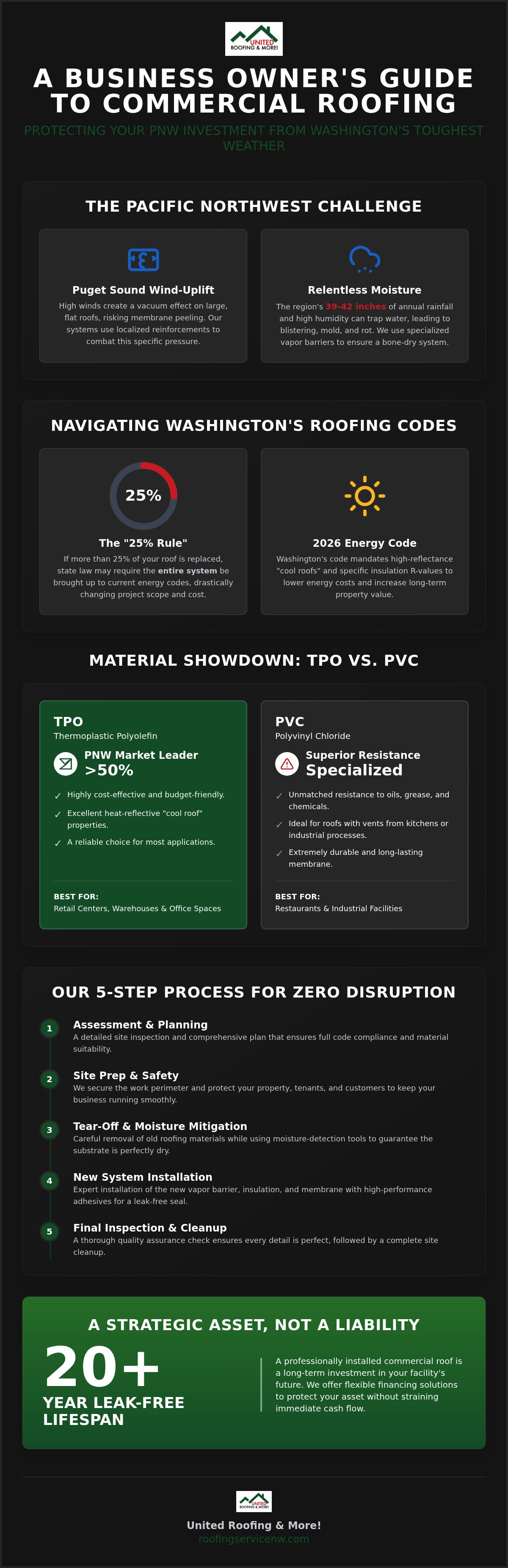
Many business owners dread the noise and chaos of a construction site. We understand that your operations cannot simply stop. A successful commercial roof installation follows a precise, five-phase roadmap. This process is designed to protect your tenants, your customers, and your bottom line. We prioritize clear communication so you are never left wondering about the status of your project.
Phase 1 begins with a comprehensive site analysis and safety planning. We don't just look at the membrane; we evaluate the underlying deck and structural loads. Phase 2 involves material staging and tenant notification. We set up our equipment to keep your daily operations moving. Phase 3 is the tear-off and substrate preparation. This is the critical inspection phase where we identify and fix any hidden rot. Phase 4 is the actual membrane or metal installation, featuring precision seam welding. Finally, Phase 5 is the quality audit and warranty certification. This ensures your new system meets every local code and manufacturer requirement.
Minimizing Business Interruption
We know you have a business to run. Strategic staging is our priority. We keep parking lots and main entrances clear so your customers can still reach you. For occupied buildings, we employ strict noise and odor management protocols to keep the environment professional. If your facility has high-traffic needs during standard business hours, we offer night and weekend installation options. This flexibility ensures your productivity stays high while we work overhead. It is about getting the job done without getting in your way.
Safety and Liability Management
Safety is not just a checklist; it's a core value. Every site we manage is fully OSHA compliant. We take proactive steps to protect your employees and customers from falling debris or equipment hazards. Following master roofing standards is non-negotiable for our teams. These standards ensure that the site remains secure and the final product meets the highest industry benchmarks.
A professional installation protects your liability as a property owner. We lead with our professional credentials to give you peace of mind throughout the build. We maintain a clean, organized job site from the first day to the final inspection. If you are ready to upgrade your facility with a team that respects your schedule, you can schedule your commercial roof installation today.
Investing in Your Asset: Financing and Professional Installation
Investing in a new roof is a major decision for any Marysville business owner. It is not just about stopping a leak. It is about protecting your equity. A high-quality commercial roof installation significantly increases your property value and curb appeal. It also lowers your monthly overhead by meeting the strict 2026 energy standards we discussed earlier. Proactive owners know that a new system is often cheaper than the cycle of endless roof repairs that never quite solve the problem. Stop throwing money at temporary patches. Invest in a system that lasts 20 years or more and provides true peace of mind.
The return on investment extends beyond just energy bills. A modern, high-reflectance roof protects your HVAC equipment from overworking during the summer. It prevents structural rot that can lead to massive "hidden" costs down the line. We help you view this project as a strategic facility upgrade rather than a simple maintenance expense. We provide transparent, no-nonsense estimates that break down every cost so you can make an informed choice for your company's future.
Roofing Financing for PNW Businesses
We believe financial constraints should never stand in the way of building safety. That is why we offer specialized roofing financing for local businesses. This turns a sudden capital crisis into a predictable, manageable expense. Our application process is fast and transparent. We work with you to find payment plans that preserve your cash flow for other business needs like payroll or inventory. You get the protection you need today without draining your reserves. It is a supportive way to handle a large-scale commercial roof installation without the stress of a massive upfront hit.
Choosing Your Commercial Partner
Local accountability is everything in the Seattle area. You need a partner who understands the specific wind and rain loads of the PNW. When you are reviewing a commercial roofing contract, look for these specific markers of quality:
- Clear, documented timelines for staging and completion
- Verification of specialized commercial insurance and bonding
- Detailed material lists that match the 2026 energy code requirements
- Explicit safety plans for your employees and customers
We lead with our professional credentials and a hardworking, transparent approach. We are here to be your long-term facility partner, not just a one-time contractor. Our goal is to make the entire process as easy and accessible as possible. We keep you informed at every stage of the build. Schedule your expert commercial consultation today. Let us show you how a professional installation can work for your budget and your building.
Secure Your Facility's Future Today
Your building is one of your most significant investments. Protecting it from the unique challenges of the Marysville and Seattle climate requires more than just a standard approach. You now understand how climate-specific engineering and the latest energy codes impact your facility's long-term value. By selecting high-performance materials and a partner who understands local building regulations, you ensure your business remains dry and compliant for years to come.
A successful commercial roof installation shouldn't be a source of stress or financial strain. We are a locally owned and operated team in the PNW, and we specialize in high-durability commercial systems designed for our specific weather patterns. With expert commercial financing available, we help you preserve your cash flow while securing your building envelope. It's time to stop worrying about leaks and start focusing on your business growth.
Get Your Professional Commercial Roof Estimate & Financing Options and take the first step toward a worry-free facility. We look forward to supporting your business with clear dialogue and expert workmanship.
Frequently Asked Questions
How long does a commercial roof installation typically take?
A standard commercial roof installation typically takes between one and three weeks to complete. The exact timeline depends on the square footage of your facility and the complexity of the existing system. Weather is the biggest variable in the Seattle area. We plan our staging carefully to minimize downtime. Smaller retail shops might finish in a few days, while large industrial warehouses require a more extended schedule to ensure every seam is perfectly welded.
What is the best type of roof for a flat commercial building in Seattle?
TPO and PVC are the most effective options for flat buildings in the Pacific Northwest. These single-ply membranes are heat-welded at the seams, which creates a monolithic, waterproof barrier. TPO is popular for its cost-effectiveness and heat reflectivity. PVC is often better for facilities like restaurants that vent grease or chemicals. Both systems handle our heavy annual rainfall far better than traditional asphalt or built-up roofing systems used in the past.
Can I install a new commercial roof over an existing one?
You can often install a new membrane over an existing one, a process known as a recover. However, Washington State building codes generally limit commercial buildings to two total roof layers. We must also verify that the current insulation is dry and the structure can handle the additional weight. If moisture is trapped in the old system, a full tear-off is necessary to prevent rot and ensure your new warranty remains valid.
How much does a commercial roof replacement cost in Marysville?
The total cost depends on several factors, including the material chosen and the complexity of your building's drainage. Local energy codes in Marysville also impact the final investment, as they mandate specific insulation R-values for 2026. While we don't provide flat rates, we focus on providing transparent estimates that account for every technical detail. Investing in a high-quality installation today prevents the expensive cycle of constant repairs and high energy bills later.
Does a new commercial roof come with a warranty?
Yes, a professional installation includes both manufacturer and workmanship warranties. Manufacturer warranties typically cover the roofing membrane for 20 to 30 years. Workmanship warranties cover the actual installation process performed by our team. We provide detailed documentation for all coverage levels to give you total peace of mind. These warranties are essential for protecting your business asset and ensuring that any future issues are handled without additional financial stress for your company.
How do you prevent leaks during the installation process in rainy weather?
We prevent leaks by working in manageable sections that we can seal before the end of each workday. This tie-in process ensures that your building remains watertight even if an unexpected drizzle starts overnight. Our teams monitor local weather radar constantly to choose the best installation windows. We also use temporary covers and specialized moisture-detection tools to protect your inventory and interior spaces throughout the entire construction phase of your project.
Is financing available for commercial roof replacements?
We offer specialized roofing financing to help businesses manage large-scale projects without draining their cash flow. These flexible payment plans allow you to address critical facility needs immediately while spreading the cost over time. The application process is fast and transparent, designed to fit within your company's annual budget. It's a supportive way to handle an essential upgrade while keeping your capital available for payroll, inventory, and other important operational costs.
What maintenance is required after a new commercial roof is installed?
Regular maintenance is the key to reaching a 25-year lifespan for your system. You should schedule professional inspections at least twice a year, ideally in the spring and fall. This involves clearing debris from scuppers and drains to prevent ponding water. We also check the flashing around HVAC units and vents for any signs of wear. Proactive care ensures your warranty remains in good standing and helps you catch minor issues before they become expensive leaks.


