
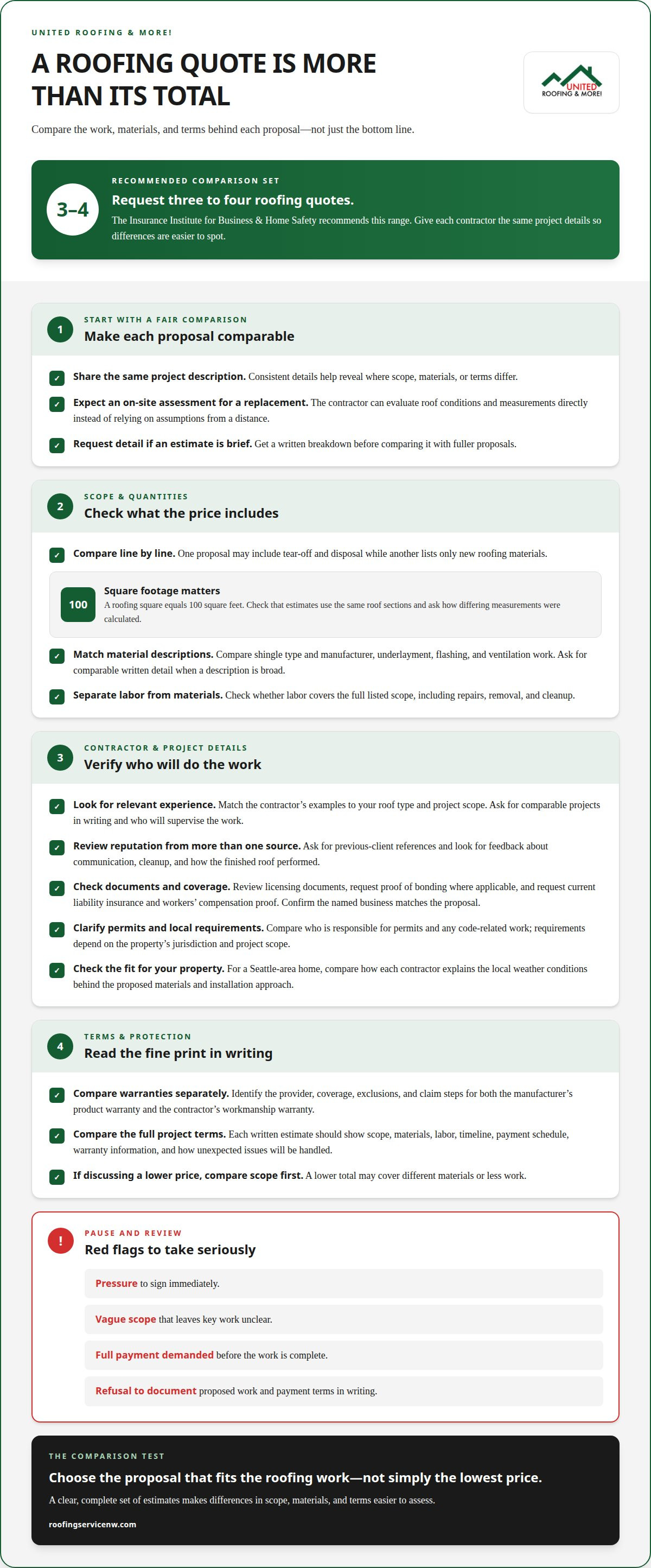
Request three to four roofing quotes, the number recommended by the Insurance Institute for Business & Home Safety. Knowing how to get multiple roofing quotes gives you a clearer basis for comparing proposed work, materials, and project scope before choosing a contractor.
It’s tempting to focus on the lowest estimate, especially when a roof project is a major decision. But quotes are useful only when you can see what each includes and compare more than the total.
This guide explains how many estimates to request, what information to share, and how to assess a contractor’s experience and reputation. You’ll also learn how to compare scope, materials, timelines, and payment terms so you can weigh proposals and choose the one that best fits your needs.
Key Takeaways
- Request three to four roofing quotes to build a useful basis for comparison.
- Look beyond the total: assess each contractor’s experience, reputation, licensing, and insurance.
- Give contractors the same project details, then compare the work scope, materials, timeline, and payment terms side by side.
- Use the estimates to identify differences and choose a proposal that fits your roofing needs, not simply the lowest price.
1. Evaluating contractor experience and reputation
Match each estimate to the contractor’s experience with your roof type and project scope. A replacement involving layered shingles, steep sections, or possible decking damage calls for relevant examples, not just a general claim of roofing experience. Request a written description of comparable projects and ask who will supervise the work. Then compare the findings from the roof assessment with the work listed in the estimate. Specific observations are easier to evaluate than broad promises.
Local knowledge matters because roofing conditions vary by region. For a Seattle-area property, consider whether the contractor can explain how the proposed materials and installation approach suit local weather. Ask what conditions informed the recommendation, then compare the explanation with the written scope. A contractor familiar with the area should connect the proposed work to your property so you can judge whether it fits.
Check reputation using more than one source. Ask for references from previous clients, then look for feedback about communication, cleanup, and how the finished roof performed. Compare those details with the written proposal. One reported example described a roof replacement that had no leaks after recent storms, about a year and a half after installation. That history can be useful, but every roof and installation is different.
Permits and local building codes can affect the work included in a roof replacement estimate. Requirements depend on the property’s jurisdiction and project scope, so compare whether each proposal identifies permit responsibilities and any code-related work. This makes differences easier to spot before you choose a proposal.
Red flags include pressure to sign immediately, a vague scope that leaves key work unclear, or a demand for full payment before the work is complete. Pause if the contractor won’t put the proposed work and payment terms in writing. Compare the written scope with the materials and labor discussed during the estimate. Clear documentation gives you a practical way to judge whether the proposal matches the conversation.
2. How Many Roofing Quotes Should You Actually Get?
Aim for three to four roofing quotes. That gives you several proposals to compare without making the decision harder than necessary. Give each contractor the same project description so differences in scope, materials, and terms stand out. If an estimate is unusually brief, request a detailed written breakdown before comparing it with the others.
Review licensing documents as part of each proposal rather than relying on verbal assurances. Requirements vary by location, so confirm that each document applies to the contractor and proposed work. Request proof of bonding where applicable, and keep these records with the estimates. Note any differences in business names or project details that need clarification.
Roofing contractors should carry liability insurance and workers’ compensation coverage. Request current proof of both, then check that the named business matches the contractor on the proposal. These policies address different risks, so one isn’t a substitute for the other. If the paperwork lists dates or project limits, compare them with the planned work before deciding.
Read warranty information alongside the price and scope. Ask each contractor to identify the warranty provider, what work or materials it covers, any exclusions, and how to make a claim. A manufacturer’s product warranty and a contractor’s workmanship warranty are different documents, so review them separately. The contract should record the terms and explain how unexpected issues will be handled.
Three to four complete proposals can reveal whether you’re comparing similar work or different solutions. If financing is part of your decision, explore roofing financing options as you consider how the project fits your budget.
3. Why comparing roofing estimates matters
Compare each proposal line by line, not just by its total. One estimate may include tear-off and disposal, while another lists only new roofing materials. Different scopes make totals misleading. Matching project details helps reveal whether a price difference reflects materials, labor, or work one contractor left out.
Check the roof area and measurements in every estimate. If one proposal describes a different square footage, ask how the contractor calculated it and whether the same roof sections were included. A roofing square equals 100 square feet. Clear measurements make it easier to compare quantities, material coverage, and the labor included in each bid.
Review material descriptions and labor separately. Compare shingle type and manufacturer, underlayment, flashing, ventilation work, removal, and cleanup. Check whether labor covers the full scope, including any listed repairs. If one estimate names a material and another uses a broad description, request comparable detail in writing. That turns a vague price difference into a specific comparison.
Compare workmanship and manufacturer warranties as separate terms. Note who provides each warranty, what it covers, and any exclusions or claim steps. A product warranty and a contractor’s workmanship coverage address different parts of the project. The proposal should make those distinctions clear instead of relying on a general statement that the work is covered.
A roofing estimate for a replacement should follow an on-site assessment. This lets the contractor evaluate roof conditions and measurements directly, so the written scope reflects the property rather than assumptions made from a distance.
Ask for a detailed written estimate that shows scope, materials, labor, timeline, payment schedule, warranty information, and how unexpected issues will be handled. These details give you a consistent basis for comparing proposals.
Ask whether the scope or terms can be adjusted to fit your budget. If you discuss matching another price, compare the materials and included work first. A lower total may cover a different project.
4. How many roofing quotes to request
Request three to four estimates for a practical comparison. The Insurance Institute for Business & Home Safety recommends getting three to four roofing quotes. Use that as a starting point, then check whether each proposal describes the same project. A larger stack won’t help much if estimates cover different work or leave key details unclear.
Knowing how to get multiple roofing quotes starts with preparing one consistent project description. Include your property location, the work you’re considering, and any roof concerns you’ve noticed. Share the same details with each contractor. If one proposal covers a repair while another assumes replacement, clarify the scope before comparing them.
Plan the request process so estimates are based on comparable information. Arrange for each contractor to assess the property, then request a written proposal explaining the recommended work. Keep assessment notes with each estimate. This makes it easier to spot when different measurements, materials, or assumptions are driving different recommendations.
When planning how to get multiple roofing quotes, judge proposals by their usefulness, not just their number. If estimates conflict, identify the exact difference and ask for clarification. Another proposal may help if you still can’t tell whether the scope fits the project. If the existing estimates clearly address the same work, more quotes may add little.
Keep a simple comparison record with each proposal, inspection notes, and questions that remain unanswered. The goal is to understand the choices available and select a scope that fits your roof’s needs. Ready to discuss your project? Request a roofing quote.
Some commenters recommend at least three estimates from well-known local roofing contractors, while a commenter in Southern California suggests aiming for 5 roofing quotes.
United Roofing & More!: Roof Replacement
United Roofing & More! provides roof replacement and installation for homeowners planning a new roof. If your estimates point toward replacement, its roofing services can help with the project. Roof repairs are also available for issues that call for repair instead.
Use the proposals you’ve gathered to explain your needs and compare the recommended work. Clear scope and material details make it easier to understand which option fits your property. Roofing financing is also available to help manage project costs.
For support with roof replacement, installation, repairs, or financing, contact United Roofing & More!
Make Your Next Roofing Decision With Confidence
Use your estimates as a planning tool, not just a final selection. Before committing, decide what matters most for your home: the proposed approach, materials, project terms, or how the work fits your budget. That priority can help you choose between proposals with different solutions without simply chasing the lowest total.
A clear process for getting multiple roofing quotes also gives you a strong starting point for discussing your project. Keep your preferred proposal and remaining questions together so the next conversation focuses on the choices that matter to you. When you’re ready to move from comparing estimates to planning roof replacement or installation, United Roofing & More! also offers roofing financing.
Contact United Roofing & More! to discuss your roofing project and take the next step with confidence.
Frequently Asked Questions
How Many Roofing Quotes Should You Actually Get?
Request three to four quotes to get a useful range of proposals. The Insurance Institute for Business & Home Safety recommends three to four roofing quotes. Share identical project details with each contractor, then compare whether their recommendations address the same roof areas. If estimates describe different work, clarify the scope before treating the totals as comparable.
What Happens If You Skip This Process?
With only one or two bids, it’s harder to judge whether the proposed scope and price are reasonable. One estimate might include tear-off and disposal while another excludes them, making a direct comparison misleading. Without other proposals, you may miss those differences or have less context for deciding whether the recommended materials and work fit your needs.
How many roofing quotes should homeowners get?
Three to four detailed estimates are a practical target for most homeowners. Consider another proposal if the existing bids describe noticeably different scopes or leave important questions unresolved. The goal isn’t to collect the largest number; it’s to build a clear comparison set. Keep each contractor’s written proposal and assessment notes together so you can review the differences accurately.
What information should I provide for accurate roofing estimates?
Provide the property location, the work you believe is needed, and any known roof concerns. Mention visible leaks, storm damage, or areas that may need attention, and explain whether you’re considering repair or replacement. For example, photos of a ceiling stain can help show where a leak appears inside. Ask contractors to base their proposals on the same project details.
How do roof warranties, materials, and labor affect quotes?
Material selection, labor requirements, and warranty terms shape what each proposal covers. A quote specifying a shingle and underlayment gives you more to compare than one with broad material descriptions. Read the manufacturer’s warranty separately from workmanship coverage, and note who handles claims. For example, check whether the proposal lists installation labor and cleanup as included work.


