
The most sustainable roof for a Pacific Northwest home may not be the one with the boldest green label. A material with recycled content can still be a poor fit if it struggles with frequent rain, needs intensive upkeep, or must be replaced sooner than expected. Choosing environmentally friendly roofing materials means looking at the roof’s full life, not just one environmental claim.
It’s reasonable to want a roof that’s better for the environment and dependable in wet weather, without stretching your project budget or adding too much maintenance. The challenge is balancing those priorities. Material choice, installation quality, and local conditions all shape how well a roof performs over time.
This guide compares common options, including metal, asphalt shingles, cedar, tile, and slate. You’ll learn how their durability, resource use, and upkeep differ, and what makes each a potential fit for Pacific Northwest homes. Use these tradeoffs to plan a roof replacement or installation with a clearer picture of what matters for your property and what to discuss during project planning.
Key Takeaways
- Judge environmentally friendly roofing materials by sourcing, service life, maintenance, and end-of-life options, not by one green claim alone.
- Compare common roof types to see how durability, repair needs, and disposal pathways may affect their overall environmental value.
- Start your material choice with your roof’s condition, building design, and exposure to Pacific Northwest rain and moisture.
- Factor in drainage, ventilation, structural capacity, and maintenance access when planning a roof system for your property.
- Connect material priorities with roof replacement and installation planning to make project decisions that suit your building and needs.
What Makes Roofing Materials Environmentally Friendly in the Pacific Northwest?
A roof’s environmental value isn’t determined by a “green” label or one attractive feature. To compare environmentally friendly roofing materials, look at where their raw materials come from, how long the roof is expected to serve, what care and repairs it needs, and what happens to it at the end of its useful life. A renewable or recycled material may have benefits, but weigh those benefits against the complete roof’s performance.
Local performance matters in Seattle, Marysville, and the wider Pacific Northwest, where frequent rain and persistent moisture make drainage and moisture management central to roof planning. Material choice is only one part of the decision. Underlayment, flashing, ventilation, and installation all contribute to how the assembly handles water and holds up over time.
How to assess a roof’s environmental footprint
A lifecycle assessment considers a material’s impacts across production, use, repair, and disposal. “Embodied impact” refers to environmental effects tied to making and supplying a material, including the resources and energy involved. Without a product-specific assessment, don’t assume one material has a lower total impact than another based on a single claim.
Consider service life and repairability alongside recycled or renewable content. A roof that can be maintained and repaired may avoid premature replacement, while its eventual reuse, recycling, or disposal also affects its overall footprint. When comparing products, look for documentation that applies to the specific product rather than relying on general claims about a whole material category.
Why wet regional conditions matter
In the Pacific Northwest, consider how the roof will shed water, manage moisture, and suit the building’s exposure. Roof shape, nearby trees, shade, and maintenance access can all affect practical upkeep. A material that suits one home may not suit another, so assess the property rather than treating any option as universally best.
Think in terms of a complete roof system, not a surface material in isolation. The roofing layer works with underlayment, flashing at transitions, and ventilation to manage moisture and protect the structure. A weak detail can undermine an otherwise durable material. For a different approach to roofing, Green Roofs describes planted roof systems and their potential environmental benefits, including stormwater management. These systems also have distinct design and structural considerations, so they aren’t a direct fit for every building.
For a replacement or installation, connect environmental priorities with the building’s condition and local exposure. Compare sourcing, expected service, maintenance needs, and end-of-life options for the specific products you’re considering. That gives you a more useful basis for a decision than any single headline claim.
Compare Environmentally Friendly Roofing Materials by Performance and Tradeoffs
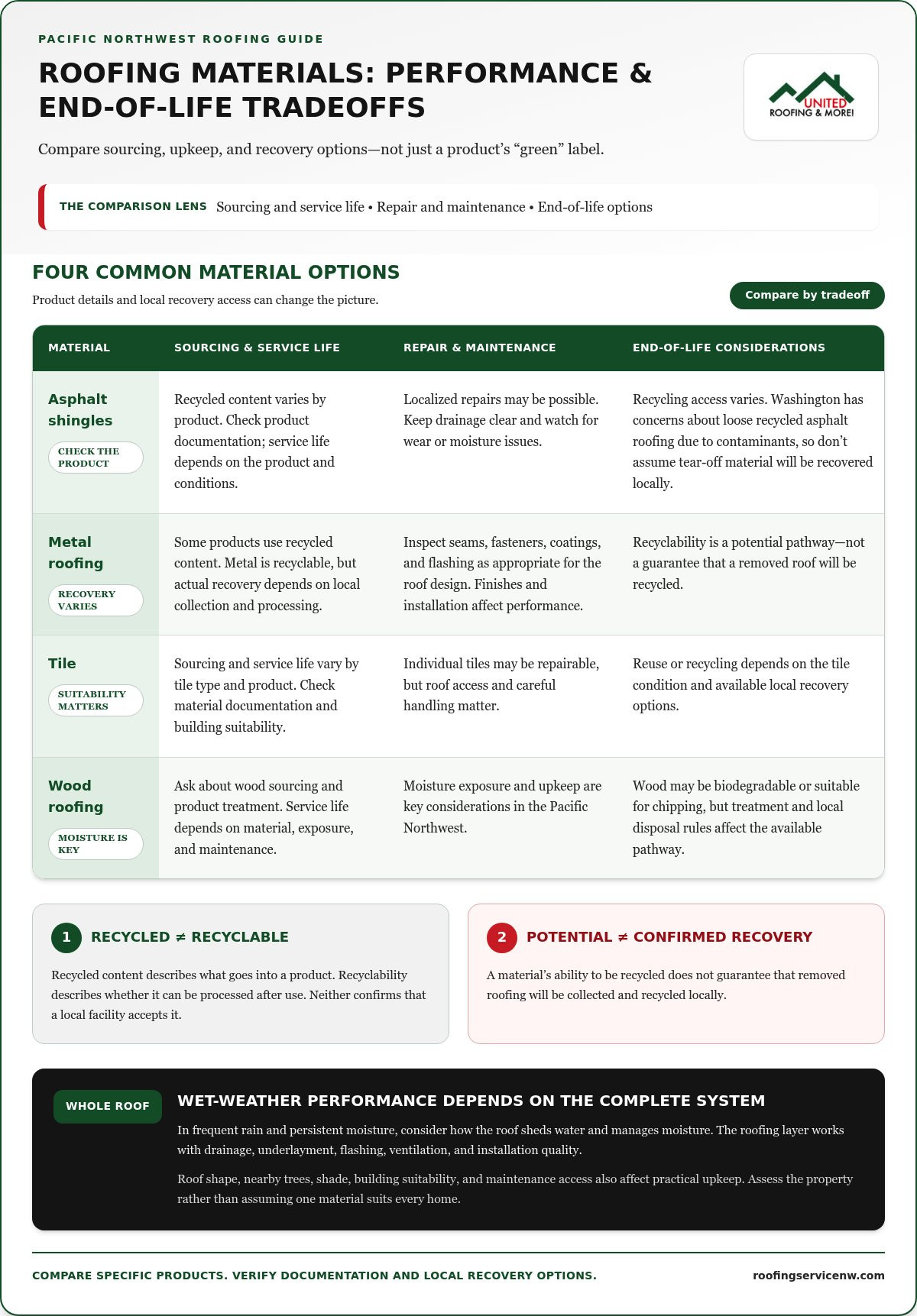
Compare environmentally friendly roofing materials by the full set of tradeoffs, not one label. Recycled content, service life, repair needs, and end-of-life recovery each matter, but product specifications and local recycling access can change the picture. Use the table as a starting point, then verify details for the specific material and roof assembly under consideration. In particular, distinguish a material’s potential to be recycled from a confirmed recovery route for the removed roofing.
| Material | Sourcing and service life | Repair and maintenance | End-of-life considerations |
|---|---|---|---|
| Asphalt shingles | Recycled content varies by product. Check product documentation; service life depends on the product and conditions. | Localized repairs may be possible. Keep drainage clear and watch for wear or moisture issues. | Recycling access varies. Washington has concerns about loose recycled asphalt roofing due to contaminants, so don’t assume tear-off material will be recovered locally. |
| Metal roofing | Some products use recycled content. Metal is recyclable, but actual recovery depends on local collection and processing. | Inspect seams, fasteners, coatings, and flashing as appropriate for the roof design. Finishes and installation affect performance. | Recyclability is a potential pathway, not a guarantee that a removed roof will be recycled. |
| Tile | Sourcing and service life vary by tile type and product. Check material documentation and building suitability. | Individual tiles may be repairable, but roof access and careful handling matter. | Reuse or recycling depends on the tile condition and available local recovery options. |
| Wood roofing | Ask about wood sourcing and product treatment. Service life depends on material, exposure, and maintenance. | Moisture exposure and upkeep are key considerations in the Pacific Northwest. | Wood may be biodegradable or suitable for chipping, but treatment and local disposal rules affect the available pathway. |
Recycled content, metal, and maintenance
Recycled content describes what goes into a product; recyclability describes whether it can be processed after use. Neither confirms that a local facility accepts it. For both shingles and metal, check product-specific sourcing information and local recovery options. Coatings, finishes, fasteners, and the complete assembly can also affect durability, repairs, and maintenance needs.
When reviewing a metal product, consider its finish and roof design as well as its recycled content. For shingles, compare the product documentation and repair guidance, then consider the disposal pathway for tear-off material. These questions help separate evidence about a product from assumptions based on the material name.
Tile, wood, and roof-system alternatives
Tile and wood bring different sourcing, weight, and maintenance questions. Their fit depends on the building and exposure, not simply whether a material is natural. A reflective finish may support a cool roof approach, but its value depends on climate and design. Vegetated roofs can support stormwater management, yet require suitable structural and drainage planning.
For a project-specific discussion of material tradeoffs and installation planning, explore roof replacement planning.
Do Green Roofing Claims Mean Better Long-Term Performance?
No. A recycled-content percentage or “natural” label describes one part of a roof’s story, not its total environmental performance. A material’s overall impact also depends on how it’s made, how long it remains useful, whether damaged areas can be repaired, and what happens to it after removal. For environmentally friendly roofing materials, the strongest comparison considers the complete roof system and the building it serves.
Upfront material impacts matter, but so does avoiding an early replacement. A product with appealing sourcing claims may require frequent repairs or prove difficult to recover at end of life. Another option might have different production impacts but suit the building well and remain serviceable with maintenance. Neither is automatically the better choice. Product details, roof design, installation quality, and ongoing care all influence real-world results.
Which sustainability claims deserve closer scrutiny?
Look for documentation tied to the specific product, not broad statements about a material category. Manufacturer information can describe sourcing or recycled content, while independent standards and verified environmental declarations can provide additional evidence. These documents have different scopes, so note what they cover and what they leave out. A claim about recyclability, for example, doesn’t establish that a local facility will accept the removed material.
Use this checklist to separate useful evidence from vague marketing language:
- Recycled content: Is the claim specific to this product, and does it explain the amount or type of recycled material?
- Sourcing: Is the source of renewable or other raw materials clearly described?
- Environmental documentation: Is there a product-specific declaration or independent verification, and what impacts does it assess?
- End-of-life pathway: Is there a practical reuse or recycling route for this material in the project’s location?
- Performance: Does the available product information address maintenance, repair, and suitability for the roof assembly?
Check certification names and environmental claims against current documentation before treating them as proof. Terms such as “green,” “eco-friendly,” or “sustainable” can sound reassuring without explaining the basis for the claim.
How durability and maintenance affect the comparison
Early replacement can add new material demand, construction activity, and disposal. That makes expected service and repair options important parts of a lifecycle comparison. Review product-specific guidance on maintenance and repairs rather than relying on a general ranking of materials or an unsupported lifespan claim.
Include installation details and upkeep in your evaluation. A well-matched product that can be maintained and repaired may serve the building more effectively than a material chosen for one environmental feature alone. Compare the evidence behind each claim with the roof’s design, exposure, and the care needed to keep the assembly performing.
How to Choose Sustainable Roofing for a Washington Property
The right roof starts with the building, not a broad “eco” label. Use this process to compare options for your Washington property and connect environmental priorities with practical installation needs.
- Assess roof condition and design. Identify whether the project involves repairs or replacement, then consider roof slope, shape, and structural capacity. These factors affect which materials and assemblies are suitable.
- Account for site exposure. Consider shade, nearby trees, and exposure to local weather. In the Seattle area, moisture management matters: assess drainage, ventilation, and how the roof assembly handles water. The roof drip edge guide explains how this edge detail helps direct water away from the roof and building.
- Compare documented product attributes. Make a simple comparison sheet for sourcing, recycled content, durability evidence, repair guidance, maintenance, and end-of-life options. Favor specific product information over broad environmental language, and distinguish manufacturer statements from independently verified documentation.
- Review the complete installation scope. The visible roofing material is only one part of the system. Include underlayment, flashing, ventilation, drainage details, and access for future maintenance in the project discussion. A material must work with the full assembly and the structure beneath it.
- Check applicable requirements and plan the budget. Washington codes and local permitting requirements can change, and local jurisdictions may have additional rules. Verify the current requirements for your project before work begins. For broader planning, review the complete roof replacement guide. If budgeting is part of your decision, the roof financing guide for Marysville and Greater Seattle offers another project-planning resource.
This process makes the choice of environmentally friendly roofing materials more specific to your building. It also keeps material selection separate from installation scope, so you can compare both clearly. United Roofing & More! provides roof replacement, installation, and repairs for residential and commercial properties. Discuss your roofing project as you plan a durable system suited to your property.
Plan an Environmentally Considered Roof Replacement with United Roofing & More!
Material comparisons are most useful when they’re tied to the roof in front of you. A project discussion can connect the roof’s current condition, your environmental priorities, and the work needed for a durable installation. United Roofing & More! is a locally owned and operated Pacific Northwest contractor providing roof replacement, installation, and repairs for residential and commercial properties.
Bring your priorities into the planning conversation. The goal isn’t to choose a material based on a broad “green” claim, but to consider how the proposed roof system fits the building, its exposure, and the maintenance you’re prepared to handle. That keeps decisions about environmentally friendly roofing materials grounded in the actual project.
What to prepare before a roof project discussion
You don’t need to arrive with every detail. A few notes can help make the conversation clear and productive:
- Roof history: Share the approximate roof age, past repairs, and any recurring concerns you’ve noticed.
- Visible issues: Note areas of concern, such as signs of moisture, drainage trouble, or wear. These observations help frame the discussion, though a professional assessment is needed to evaluate the roof’s condition.
- Your priorities: Identify what matters most, such as lower maintenance demands, repairability, responsible sourcing, or end-of-life recovery.
- Building details: Mention features that may affect planning, including roof shape, shade, and access for future maintenance.
Project recommendations depend on the property and the complete roof system. A material that looks promising on paper still needs to suit the structure, installation requirements, and local conditions. Clear communication helps connect your priorities with a practical replacement or installation plan.
Move from comparison to a clear next step
Before moving forward, summarize your preferred material criteria and the questions that remain. You might prioritize documented sourcing, clear maintenance guidance, repair options, or a realistic end-of-life pathway. Keep those criteria separate from installation scope. Supporting components and workmanship also contribute to how the finished roof performs.
United Roofing & More! provides professional roof replacement, installation, and repair. Roofing financing options are also available to help homeowners and businesses fund projects. Start with your roof’s condition and priorities, then build a plan suited to your property.
Explore roofing services with United Roofing & More!
Choose a Roof That Fits Your Property and Priorities
The strongest choice among environmentally friendly roofing materials isn’t based on a single recycled-content, natural-material, or efficiency claim. Look at sourcing, expected service, repair and maintenance needs, and end-of-life options together. Then weigh those details against your building’s design, local moisture exposure, drainage, and the complete roof assembly.
A clear project plan helps turn those comparisons into practical decisions. United Roofing & More! is a locally owned and operated Pacific Northwest roofing contractor providing residential and commercial roof replacement and installation, along with roof repairs and financing options. Project discussions focus on the roof’s condition, your priorities, and installation planning, with clear communication along the way.
Ready to talk through your roof and next steps? Explore roofing services with United Roofing & More! With the right information and a plan suited to your property, you can move forward with confidence.
Frequently Asked Questions
Is metal roofing environmentally friendly?
Metal roofing can offer durability and recyclability advantages, but the material name alone doesn’t establish its overall environmental impact. Consider the specific product’s sourcing, manufacturing information, installation requirements, maintenance guidance, and end-of-life options. Recycled content and recyclability are separate claims: a product may be recyclable without containing recycled material, and local recovery access affects whether it can actually be recycled. Compare documented details with your building’s needs and expected roof use.
What is the most environmentally friendly roofing material?
There’s no single best roofing material for every property. Compare product-specific sourcing information, durability evidence, repairability, maintenance needs, and end-of-life pathways. In the Pacific Northwest, roof design and moisture management matter too. A material that performs well on one building may not suit another’s slope, structure, or exposure. Look at the complete roof system, including supporting components, rather than choosing based only on the visible material or one sustainability label.
Are recycled asphalt shingles a sustainable roofing choice?
Recycled asphalt shingles may help reduce demand for some new materials, but recycled content alone doesn’t prove that a product is environmentally preferable overall. Review the manufacturer’s documentation, durability information, and guidance on repairs and maintenance. Also consider what happens after the roof is removed. Recycling access varies, and Washington has concerns about contaminants in loose recycled asphalt roofing. Compare available recovery pathways with other materials suited to your building.
Can a green roof work in the Pacific Northwest?
Yes, a vegetated roof can suit some Pacific Northwest buildings, but it needs appropriate design and building conditions. Planning should account for structural capacity, waterproofing, drainage, maintenance access, and the roof’s intended use. Rainfall makes the complete assembly especially important. A green roof isn’t a direct replacement for every conventional roof system, so assess the building and ongoing care needs before deciding whether this approach fits your property.
Do environmentally friendly roofing materials cost more?
Project costs vary with the material, product, roof design, and installation scope, so a general price range may not reflect your roof. Compare project estimates alongside product documentation, maintenance needs, repair considerations, and expected service. Financing may also be a planning option. United Roofing & More! offers roofing financing to help homeowners and businesses fund roofing projects. The clearest comparison looks beyond material price to the full replacement project and the care the roof may require over time.
How can I tell whether a roofing material is genuinely sustainable?
Look for product-level information on sourcing, recycled content, durability, maintenance, and end-of-life handling. Check what any environmental declaration or independent verification actually covers, and separate documented details from broad marketing terms such as “green” or “natural.” Then consider how the product fits the complete roof assembly and local conditions. No single certification, label, or material attribute describes every environmental impact.
Does a sustainable roof need special maintenance in Washington?
Maintenance depends on the roofing product, roof design, surroundings, and manufacturer guidance. In rainy areas such as Marysville, Seattle, Renton, Everett, Lynnwood, Kirkland, Mount Vernon, Bothell, Edmonds, Shoreline, Sammamish, Redmond, Bellevue, Tacoma, and Kent, drainage and moisture management deserve attention. Don’t assume an environmentally marketed roof is maintenance-free. Include inspection access, repair planning, and product-specific care instructions in your roof decision.


