What if the biggest threat to your home isn't a Pacific Northwest storm, but the decisions you make before the first shingle is even laid? It's a valid concern for homeowners in Seattle, Marysville, and across the Puget Sound in 2026. With labor shortages affecting 85% of contractors, the risk of a subpar installation is higher than ever. Understanding the common roofing mistakes to avoid is the first step toward protecting your property and your wallet.
We know that a roof replacement is a major investment. It's natural to feel anxious about hidden costs or choosing the wrong materials for our specific damp climate. You want a leak-free home and a contractor who values transparency as much as you do. This checklist will give you the clarity you need to navigate your project with confidence and peace of mind.
By reading this, you'll learn how to bypass the pitfalls that lead to structural damage and wasted money. We're covering everything from moisture control and attic ventilation to the latest 2026 building code requirements in Washington. Let's make sure your next roofing project is done right the first time.
Key Takeaways
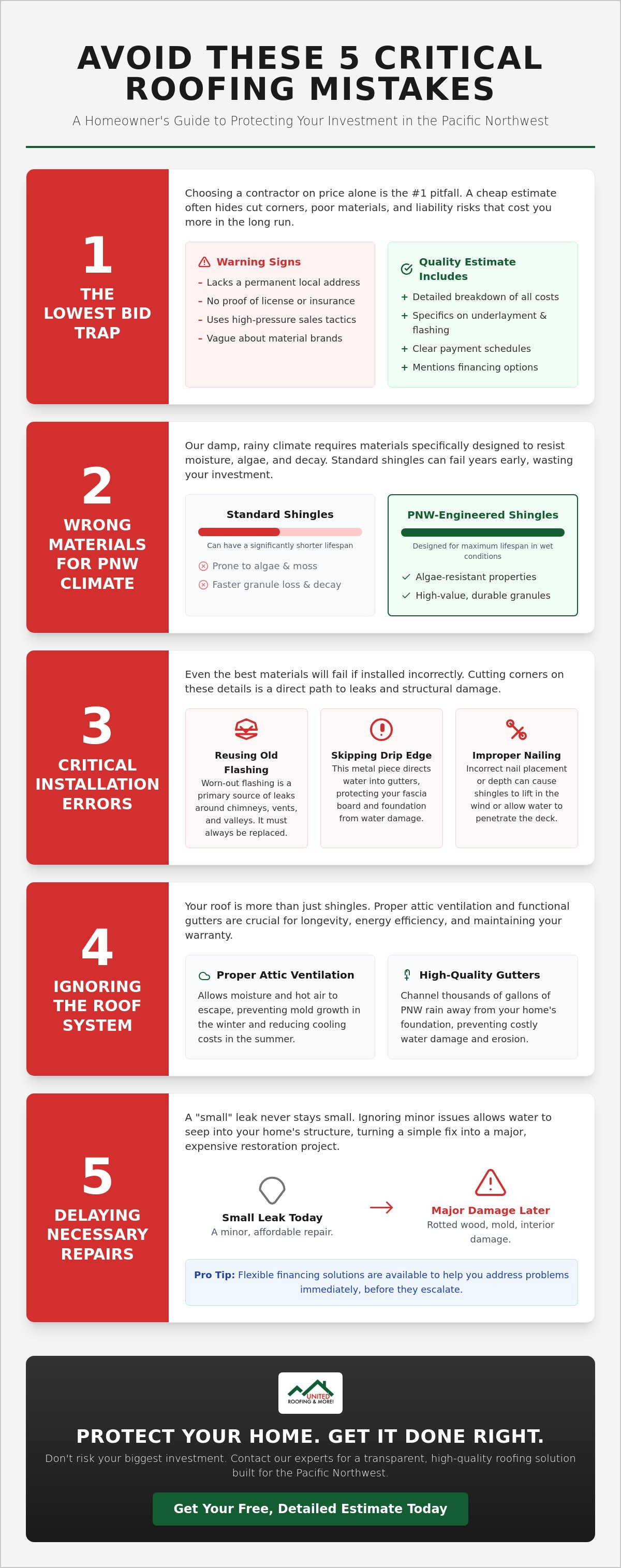
- Avoid the trap of the lowest bid by vetting contractors for proper licensing and insurance to ensure long-term reliability.
- Select materials specifically engineered for the Pacific Northwest climate to prevent premature shingle failure and moisture damage.
- Protect your structural investment by identifying common roofing mistakes to avoid, such as reusing old flashing or skipping critical ventilation steps.
- Treat your roof as a complete system by integrating high-quality gutters and attic airflow to maintain your manufacturer warranty.
- Explore flexible roofing financing solutions to address small leaks immediately before they turn into costly interior repairs.
Hiring a Roofing Contractor Based on the Lowest Bid
Choosing a contractor based solely on the lowest bid is a dangerous game. It's one of the most common roofing mistakes to avoid. While a cheap estimate looks good on paper, it often signals that the crew is cutting corners. You might save money today, but you'll pay for it in five years when the leaks start. Quality work requires skilled labor. In 2026, skilled labor is in high demand, and professionals who know their worth don't undercut the market.
Tailgate contractors are a major risk for homeowners. These workers often lack a permanent local address or proper insurance coverage. If an uninsured worker gets hurt on your roof, the financial burden could fall on you. A professional roof installation involves following strict state safety regulations and local building codes. Don't risk your home's equity or your personal liability on someone without a verified license and solid local reputation.
Cheap bids frequently skip essential parts of the roof system. Many unqualified crews omit the roof drip edge. This metal component is critical for directing water into your gutters and away from your home's fascia. When you look at the variety of commercially available roofing materials, understand that the accessories are just as important as the shingles. A master roofing specialist won't skip these details to lower their price.
We believe in transparency and honest dialogue. You deserve to know exactly where your money is going. Learning these common roofing mistakes to avoid helps you spot a low-quality bid before you sign. Always ask for a detailed breakdown of the work and the specific products being used. A high-quality roof is an investment in your family's safety and your home's future value.
The Red Flags of an Unqualified Contractor
Watch out for contractors who don't have a permanent local address. A regional phone number and a physical office show they'll be around if a problem arises later. Be wary of high-pressure sales tactics. If they push you to sign a contract before they've even climbed onto your roof, walk away. A true pro will also be specific about the material brands they use.
What a Quality Roofing Estimate Must Include
A professional estimate is transparent and detailed. It should list everything from tear-off costs to debris removal. Look for specific mentions of underlayment, flashing, and ventilation. Clarity is key for your peace of mind. A quality estimate should clearly define payment schedules and offer roofing financing options. This ensures you can afford a high-quality job without compromising on the safety of your home.
Choosing the Wrong Materials for the Pacific Northwest
Your roof isn't just a design choice. It's a shield against the relentless rain of the Puget Sound. Many homeowners prioritize aesthetics over moisture resistance. This is one of the most critical common roofing mistakes to avoid. In our damp climate, choosing a material that can't handle high humidity is a recipe for disaster. Standard asphalt shingles cover 75 to 80 percent of American homes, but not all shingles are created equal. If you pick a budget option without algae-resistant properties, your roof will look green and weathered within just a few years.
The damp air in Seattle and Marysville accelerates shingle decay. Since roofing material costs saw an increase of 6 to 10 percent recently, making the wrong choice now is more expensive than ever. A poor material choice significantly shortens your roof replacement timeline. You might think you're saving money, but you'll likely face another full project years before you should. It's about protecting your investment with shingles designed for our specific environment. Our team provides clear guidance on roofing financing to help you afford the high-quality materials your home needs.
Installation quality matters just as much as the shingles themselves. Even the best materials fail if the details are ignored. Many Common Roofing Errors stem from a lack of understanding of local weather patterns. For example, shingles must have high-value granules to reflect heat and resist organic growth. Without these, the persistent moisture in Washington will rot your decking from the outside in. We prioritize transparency and want you to understand exactly why certain materials work better in our community.
The Moss and Algae Trap
Shaded roofs in the North Sound are moss magnets. Porous, budget shingles invite organic growth that roots into the material. This lifts the shingles and allows water to seep underneath. Premium shingles use copper or zinc granules to kill algae on contact. Don't rely on temporary zinc strips. They aren't a substitute for shingles engineered with built-in protection. Investing in quality materials now prevents toxic mold and structural rot later.
Matching Material to Your Roof Pitch
You must calculate roof pitch before you buy any materials. Washington state building code requires a minimum slope of 2:12 for asphalt shingles. If your roof is too flat, water will "wick" or move upward under the shingles. This leads to hidden leaks and interior damage. Using shingles on a low-slope surface is a common error that voids manufacturer warranties. Always ensure your material choice matches the physical reality of your roof's shape.
Critical Installation Errors: Cutting Corners on the Details
Even the most expensive shingles will fail if the installation is sloppy. High-quality materials are only half the battle. The real protection comes from the thousands of small details handled during the labor process. Cutting corners on these details is one of the most common roofing mistakes to avoid. When a crew moves too fast, they overlook the invisible layers that keep your attic dry. You want a roof that lasts decades, not just until the next big storm. Quality installation is about precision and patience.
Reusing old flashing is a major error. It is the number one cause of leaks on otherwise "new" roofs. Flashing is the metal transition that directs water away from chimneys, walls, and valleys. While it might look okay from the ground, old metal often has pinholes or rusted edges. Replacing these components during a roof installation is mandatory for a professional result. If a contractor suggests "saving" money by keeping old flashing, they are setting you up for a future disaster. We prioritize clear dialogue and will always show you why new flashing is a non-negotiable part of your project.
Nailing patterns are another area where quality often slips. Every shingle manufacturer has a specific "nail line" that ensures the shingle stays put during high winds. If nails are placed too high, the shingle can easily pull away or "blow off" during a typical Pacific Northwest windstorm. Proper nail depth is also critical. Nails that are driven too deep can tear the shingle, while nails left too high will eventually poke through the layer above. Synthetic underlayment provides superior tear resistance and a more reliable moisture barrier than traditional felt paper.
Never ignore the condition of your roof deck. If your contractor installs new shingles over soft or rotting plywood, the nails won't hold. This leads to sagging and eventual structural failure. A transparent expert will always inspect the sheathing after the old materials are removed. If repairs are needed, we discuss the costs upfront so there are no surprises. Our goal is a roof that looks great and performs even better.
The Hidden Role of Underlayment and Drip Edges
Water often gets under shingles during wind-driven rain. Without a high-quality drip edge, moisture seeps into your fascia boards and rafter tails. This leads to wood rot that is expensive to fix. In the Pacific Northwest, ice and water shields are essential in valley areas. These self-adhering membranes provide an extra layer of protection where water flow is heaviest. Don't let a crew skip these critical barriers.
Flashing Failures Around Chimneys and Vents
Relying on "caulk-only" seals is a temporary fix that always fails. Proper step-flashing involves weaving metal pieces with each shingle layer along vertical walls. This creates a mechanical water shed that doesn't rely on chemicals. For wider chimneys, a "cricket" is necessary. This small peaked structure sits behind the chimney to divert water to the sides. Without it, water pools and eventually finds a way into your home.
Neglecting Attic Ventilation and Gutter Systems
Your roof is more than just shingles. It is a complex system. It relies on constant airflow and efficient drainage to survive. Neglecting attic ventilation is one of the top common roofing mistakes to avoid. If your attic can't breathe, your shingles will cook from the inside out. This is known as the "Cooked Shingle" effect. It causes shingles to become brittle and fail years ahead of schedule. Most importantly, poor ventilation often voids your manufacturer warranty. Don't lose your investment because of a few blocked vents.
Trapped moisture is a silent killer in Pacific Northwest homes. Our damp climate causes humidity to build up quickly inside the attic. Without proper airflow, this moisture settles on your rafters and decking. This leads to structural rot and toxic mold. Some contractors make the mistake of mixing different types of exhaust vents. Using a ridge vent alongside a power fan actually short-circuits the airflow. The fan pulls air from the ridge vent instead of the cool soffits. This leaves the rest of your attic stagnant and hot. We prioritize your peace of mind by ensuring your home has a balanced, functional system.
We believe in transparency and keeping you informed. If you suspect your roof isn't breathing correctly, it's time for a professional checkup. We offer flexible roofing financing to help you address these hidden issues before they cause structural failure. Our goal is to provide a quality job that protects your home for decades.
Intake vs. Exhaust: The Balanced System
A ridge vent is useless without proper soffit intake. Air must enter at the bottom and exit at the top. If your insulation is packed too tightly against the roof edge, it blocks this flow. Check your attic for "rusty" nails or dark stains on the wood. These are classic signs of poor ventilation. In winter, this heat buildup also causes ice dams. These dams force water under your shingles and into your walls, causing massive interior damage.
Gutter Neglect and Foundation Damage
Gutters are the final piece of your roofing system. When they clog, water has nowhere to go. It pools at the roof edge and seeps under the shingles. Many Pacific Northwest homes have undersized gutters that can't handle our heavy rainfall. Upgrading to larger gutters ensures water moves away from your foundation. The pitch of your gutters is just as important as the pitch of your roof. Even a slight sag can cause water to sit, inviting pests and wood rot.
Delaying Repairs and Ignoring Financing Options
Waiting for a "better time" to fix your roof is a gamble you won't win. It is one of the most common roofing mistakes to avoid. A small brown spot on your ceiling is rarely just a cosmetic issue. By the time you see water inside, the insulation is already soaked. The wood is already damp. Delaying a necessary project allows toxic mold to take root in your attic. This threatens your family's health and your home's structural integrity. You don't have to wait until you have the full amount saved in cash. Securing your home today with roof financing near me is the smartest move you can make.
Many homeowners believe they must pay 100 percent of the cost upfront. This misconception often leads to dangerous delays. In 2026, the cost of materials and labor continues to rise. Waiting six months could mean paying significantly more for the exact same service. We prioritize your peace of mind by offering clear dialogue about your payment options. Our goal is to make a high-quality roof accessible to every neighbor in our community. Don't let a temporary budget gap turn into a permanent structural disaster.
A failing roof also tanks your home's resale value. If you plan to sell, a certified inspection will catch every shortcut and leak. Buyers in the Pacific Northwest are wary of moisture issues. They will demand a massive price drop or walk away entirely. Smart homeowners treat their roof as a protected asset. By using professional services early, you maintain the equity you've worked hard to build. We are here to help you navigate these choices with transparency and expertise.
The Escalating Cost of Procrastination
Procrastination is expensive. A simple $500 repair can quickly balloon into a full replacement costing thousands. Water doesn't just stay on the surface. It rots rafter tails and destroys drywall. You should also know that insurance companies often deny claims if they see evidence of neglect. They cover sudden storm damage, but they won't pay for a leak you ignored for two years. Acting now protects your insurance eligibility and your wallet.
Smart Financing as a Roofing Strategy
Financing is a powerful tool for your home's future. Low-monthly-payment plans allow you to choose higher-quality, long-lasting materials like architectural shingles. As of June 2026, interest rates for home improvement loans typically range from 5.96 percent to 35.99 percent APR depending on your credit. At United Roofing & More!, we are committed to transparent and accessible payment solutions. We want you to have a safe, leak-free home without the financial stress. Reach out today to discuss how we can make your project a reality.
Secure Your Home and Investment Today
Your roof is your home's first line of defense. We've explored the critical common roofing mistakes to avoid, from choosing the wrong materials for our damp climate to ignoring the vital role of attic ventilation. Taking a proactive approach today ensures you aren't caught off guard by a structural emergency tomorrow. It's about protecting your equity and your family's safety with a system that actually works.
As a locally owned and operated business in the PNW, we understand the specific challenges our weather brings to your roof. We are specialists in leak detection and full replacements. We prioritize your peace of mind through clear dialogue and expert financing options. You don't have to navigate these complex decisions alone. Our team is ready to provide the transparency and quality you deserve for a safe, leak-free home.
Get a Professional Roof Inspection and Financing Quote Today!
Invest in your home with confidence. We look forward to helping you build a roof that lasts for decades.
Frequently Asked Questions
How do I know if my roofing contractor is actually qualified?
Verify that your contractor has a valid state license, active liability insurance, and a permanent local address in the Pacific Northwest. Qualified professionals provide specific material brand names and written manufacturer warranties. Avoid "tailgate" contractors who pressure you for immediate signatures or refuse to show proof of insurance. We believe in transparency and keeping you informed throughout the entire installation process.
Can I install a new roof over my old shingles to save money?
Installing a new roof over old shingles is generally a mistake that leads to premature failure. This practice traps heat and moisture between the layers, which "cooks" the new shingles from underneath. It also adds significant weight to your home's structure. Most importantly, an overlay prevents a full inspection of the roof deck for hidden rot or structural damage.
What are the most common signs of a poorly installed roof?
Look for uneven shingle lines, missing drip edges, or visible nails through the shingle surfaces. These are classic common roofing mistakes to avoid during a professional project. You might also notice shingles that blow off easily during a typical windstorm. If you see reused, rusty flashing around your chimney or vents, the job was likely rushed and remains at high risk for leaks.
How much does a typical roof replacement cost in the Seattle area?
Roof replacement costs vary significantly based on the square footage of your home and the materials you choose. Factors like roof pitch and the complexity of your attic ventilation system also impact the final estimate. We recommend getting a detailed breakdown of all costs, including tear-off and debris removal. We offer flexible roofing financing to help make your project accessible and stress-free.
Is it a mistake to repair my roof myself?
Yes, DIY roofing is dangerous and often voids manufacturer warranties. Professionals use specialized safety equipment required by state regulations for any work done at height. A small mistake in nailing patterns or flashing placement can lead to thousands of dollars in interior damage. It is always better to trust a local expert who understands the unique moisture challenges of our region.
What happens if my roof ventilation is inadequate?
Inadequate ventilation causes heat and moisture to build up in your attic space. This leads to brittle shingles and structural rot in your rafters. In the winter, poor airflow creates ice dams that force water under your shingles and into your walls. Identifying these common roofing mistakes to avoid early can prevent toxic mold and expensive interior repairs.
Why is my new roof leaking around the chimney?
Leaks around a chimney usually happen because the contractor reused old flashing or relied on caulk instead of metal seals. Caulk is a temporary fix that dries out and cracks in our wet weather. A quality job requires new step-flashing and often a chimney cricket to divert water. We prioritize these mechanical details to ensure your home stays dry through every season.
Does a new roof include new gutters and flashing?
A professional roof installation should always include new flashing, but gutters are often treated as a separate service category. You should always verify the specific scope of work in your written estimate. Since the roof and gutters work together as a system, it is often smart to upgrade both at once. We offer clear dialogue regarding all service options to help you plan a complete project.


