
A manufacturer's badge on a contractor's truck doesn't guarantee your home will stay dry during a Marysville atmospheric river. Many homeowners assume a shiny logo equals expertise, but in the Pacific Northwest, the difference between a dry attic and a costly mistake often comes down to what happens before the first shingle is even nailed. You've likely felt that familiar worry when the rain starts pounding, wondering if your roof can actually handle the relentless moisture or if a future warranty claim will be denied because of an installation technicality.
We understand that finding a reliable partner is stressful. That's why we've compiled the essential questions to ask a roofing contractor to help you secure a roof that truly lasts. You deserve a professional who knows the 2021 International Residential Code inside and out and understands the specific bond and insurance requirements mandated by Washington State. This guide previews 15 critical questions that will help you identify a transparent local expert, verify their registration through the Department of Labor & Industries, and ensure your home is protected by a transferable, long-term warranty. Let's get you the peace of mind you need before the next heavy rain season arrives.
Key Takeaways
- Understand why "licensed and insured" is just the starting point and how to verify professional manufacturer certifications.
- Learn how a contractor’s tier status with manufacturers determines your eligibility for long-term, transferable warranty coverage.
- Master the specific questions to ask a roofing contractor about moisture management techniques that protect homes in the high-rainfall Marysville and Seattle areas.
- Follow a simple 5-step checklist to verify any roofer’s registration, bond, and insurance through the Washington State Department of Labor & Industries.
- Discover how to balance quality with affordability by using local expertise and flexible roofing financing options.
Essential Questions to Ask a Roofing Contractor About Their Credentials
Many homeowners stop after hearing a contractor is "licensed and insured." That is a dangerous mistake. In Washington, the state doesn't actually "license" roofing contractors; it registers them. This registration is the legal floor, not the ceiling of quality. When you are building your list of questions to ask a roofing contractor, you must look for proof that they exceed these basic state requirements. Start by asking for their physical office address in the Marysville or Seattle area. A local office proves they are a stable part of the Puget Sound community. It ensures they won't disappear when the first major storm hits your neighborhood.
License vs. Certification: What You Need to Know
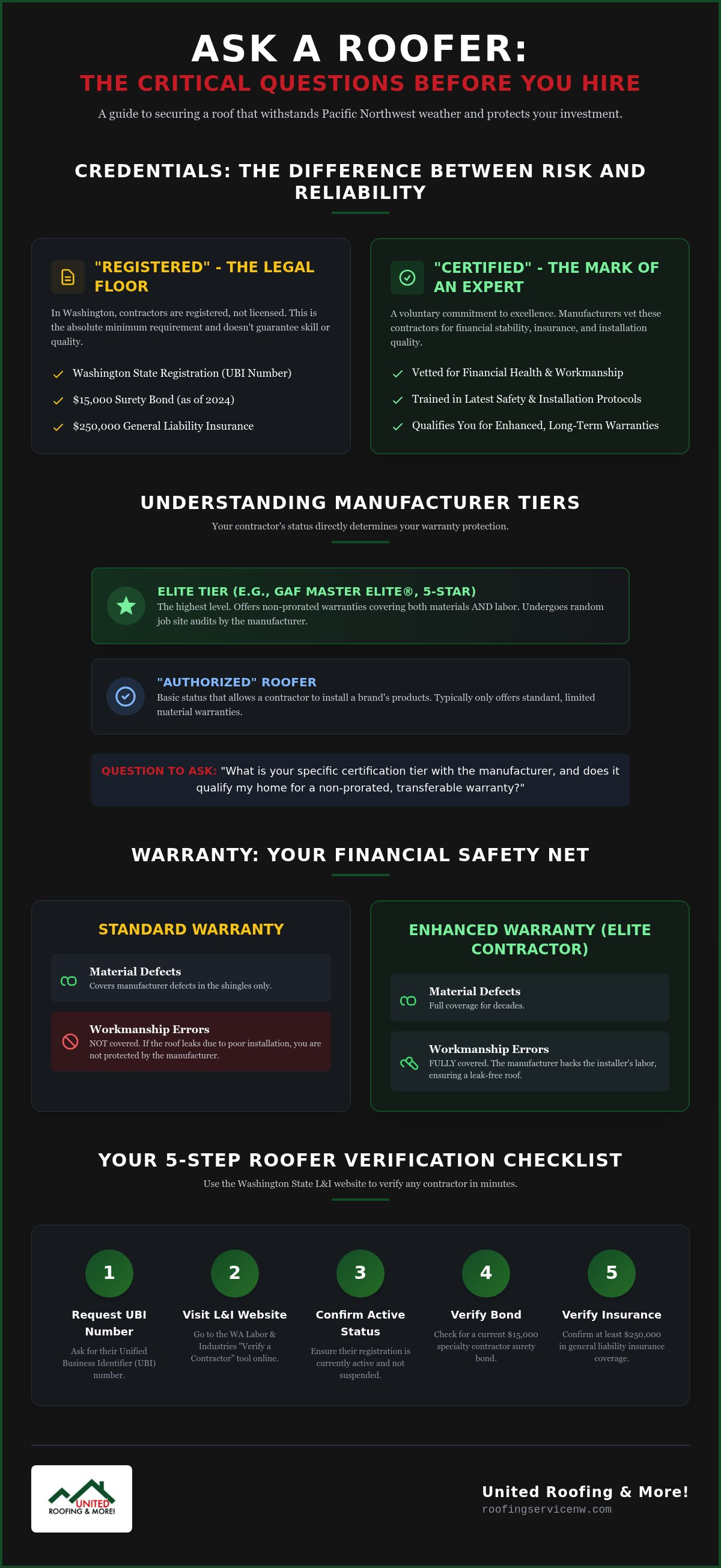
Washington requires every contractor to have a Unified Business Identifier (UBI) number and a surety bond. As of 2024, specialty roofing contractors must hold a $15,000 bond. They also need general liability insurance with at least $250,000 in coverage. These are mandatory legal steps, but they don't test a roofer's actual skill. Certification is a voluntary commitment to excellence. It means a manufacturer has vetted the company's workmanship and financial health. This elite status is necessary for a comprehensive roof replacement guide outcome. It protects you from liability because certified crews are trained in the latest safety protocols and installation techniques.
Why Industry Credentials Matter for Your Home's Value
Credentials do more than just prevent leaks; they protect your biggest financial investment. If you decide to sell your home, a roof installed by a certified professional adds significant resale value. Buyers want to see a transferable warranty that stays with the property. These professional badges also simplify the process if you ever need to file an insurance claim after a windstorm. A certified roofer is an elite contractor who has met rigorous manufacturer standards for training and financial stability. They have mastered the use of commercially available roofing materials to ensure your home stays dry. Use your questions to ask a roofing contractor to separate the basic laborers from the true industry experts. You want a partner who invests in their own training so they can better protect your family.
Checking these credentials early saves you from massive headaches later. Don't be afraid to ask for documentation. A transparent contractor will be proud to show you their L&I registration and their manufacturer badges. It's the first step toward a stress-free project.
Questions Regarding Manufacturer Tiers and Warranty Protection
A contractor's status with a manufacturer isn't just a marketing badge. It directly dictates the level of protection your home receives. When you are building your list of questions to ask a roofing contractor, you must ask which specific tier they hold with brands like GAF or CertainTeed. Most roofers are simply "authorized," which provides standard material coverage. Only a small percentage reach the elite "Master Elite" or "5-Star" status. These top tiers are the only ones capable of offering non-prorated, long-term warranties that cover both materials and labor for decades.
Understanding the Tier System (GAF, CertainTeed, etc.)
Reaching the top level requires more than just a fee. Manufacturers demand rigorous credit checks, multiple years in business, and verified insurance. These master roofing standards are designed to protect you from "fly-by-night" operations that might close their doors before your roof develops a leak. To maintain these credentials, manufacturers often perform random audits on active job sites. This ensures the installation team follows every specific detail of the manufacturer’s manual, rather than cutting corners to save time. Asking about these audits helps you confirm the contractor is held to a higher standard of accountability.
The Financial Safety Net of Enhanced Warranties
The biggest risk with a standard roof installation is the gap between material and workmanship warranties. A standard material warranty only covers shingle defects. If a non-certified roofer makes an installation error, the manufacturer will likely deny your claim. Enhanced warranties bridge this gap by including labor coverage backed by the manufacturer itself. This means if the contractor makes a mistake or even goes out of business, the manufacturer still honors the protection.
In the competitive Seattle real estate market, these warranties are a major selling point. A transferable, high-tier warranty makes your home much easier to sell because it offers the next owner total peace of mind. Labor coverage is often the most important part of an enhanced warranty. It prevents you from paying thousands in out-of-pocket costs to fix a simple installation error. If you want to ensure your investment is fully protected, you can request a professional diagnostic to see which warranty tier fits your home best.
Always verify the contractor's status on the manufacturer's official website. This simple step ensures the "Master" badge on their truck is currently active and valid. It is the only way to guarantee you receive the long-term coverage you are paying for.
Climate-Specific Questions: Protecting Your Roof in the PNW
Western Washington weather is famously brutal on standard building materials. Between the constant drizzle in Seattle and the high-wind storm cycles in Marysville, your roof faces unique pressure every single day. One of the most vital questions to ask a roofing contractor is how they specifically adapt their installation for the local climate. Standard methods used in drier states simply won't work here. You need a system designed for high-humidity environments where moisture is the primary enemy.
Moss is a silent roof killer in the PNW. It acts like a sponge, holding moisture against your shingles and accelerating the breakdown of the asphalt. Ask your contractor about integrated moss prevention techniques, such as shingles with copper-infused granules. Ventilation is the other half of the battle. In our humid climate, poor attic airflow creates a breeding ground for mold. This trapped condensation can ruin your insulation and rot your structural beams before you even notice a leak.
Every quality installation must include a roof drip edge to ensure water flows into the gutters instead of behind them. This small metal strip is the essential guard that prevents fascia rot and keeps wind-driven rain from entering your attic space.
Combating Moisture and Wind-Driven Rain
Dig deep into their underlayment strategy. A professional should prioritize high-quality synthetic underlayment over traditional felt paper. You should also ask about the placement of ice and water shields. These waterproof barriers are critical in valleys and around chimneys where water tends to pool. Certified roofers excel at identifying early signs of structural decay during the tear-off process. They don't just cover up problems; they fix the underlying issues to ensure your new roof lasts.
Local Building Codes and Compliance in Western Washington
Building codes are not uniform across the Puget Sound. A contractor working in Sammamish, Bellevue, or Redmond must navigate specific municipal rules regarding wind speed ratings and snow loads. PNW roofers must be experts in moisture management to prevent long-term attic rot. Local experts who hold manufacturer certifications are far more likely to pass municipal inspections on the first attempt. This efficiency keeps your project on schedule and avoids the stress of failed code compliance.
A 5-Step Checklist for Verifying a Roofer's Credentials
Verifying a contractor's claims is the only way to protect your home from subpar work. You shouldn't take a salesperson's word at face value. Use this 5-step checklist to ensure you are hiring a true professional. This process is one of the most important questions to ask a roofing contractor before you sign a contract or pay a deposit. Follow these steps to separate the local experts from the high-pressure sales teams.
- Step 1: Use the Washington Department of Labor & Industries (L&I) Verify tool to check their registration.
- Step 2: Cross-reference manufacturer portals to confirm their active certification status.
- Step 3: Review the Better Business Bureau (BBB) specifically for how they resolve past complaints.
- Step 4: Request a current Certificate of Insurance (COI) sent directly from their insurance agent.
- Step 5: Ask for local references in cities like Renton, Kirkland, or Edmonds to prove their community presence.
Using the Washington L&I Lookup Tool
The L&I "Verify a Contractor" tool is your first line of defense. Every legitimate roofer in Washington must have a Unified Business Identifier (UBI) number. As of July 2024, specialty roofing contractors are required to hold a $15,000 surety bond. You must check that their bond and workers' compensation coverage are both active. A lapsed policy is a massive red flag. If a worker is injured on your property and the contractor doesn't have active coverage, you could be held liable for the medical costs. A clean L&I record is the foundation of a trustworthy roofer.
Manufacturer Verification Portals
Manufacturer badges are often displayed on trucks and websites, but they can expire. Major brands like GAF and CertainTeed maintain online contractor locators. Enter the company's name to verify that the badge they are showing you is actually valid. You should also ask for their unique "Manufacturer ID" number. This allows you to confirm their specific tier level and training history directly with the manufacturer. This step ensures you are eligible for the enhanced warranties discussed earlier in this guide. If you want to see how an elite team handles your specific home, you can schedule a professional roof inspection today.
Transparency is the hallmark of a professional. A reliable contractor will have these documents ready to share. They understand that your peace of mind depends on their proven track record and financial stability. Don't settle for anything less than a fully verified expert.
Why United Roofing & More! is the Answer to Your Roofing Questions
Choosing the right partner for your home shouldn't feel like a gamble. You've gathered the right questions to ask a roofing contractor, and now you need a team that provides clear, honest answers. United Roofing & More! brings elite standards to every project in Marysville, Seattle, and the surrounding Puget Sound. We lead with our professional credentials and a "no-nonsense" approach to service. Being locally owned means we live in the same communities we serve. We care about our reputation because our neighbors are our clients. We don't use high-pressure tactics; we use proven expertise to keep your home dry. Our goal is to make professional roofing accessible for every family in our region.
High-Quality Solutions for Every Budget
A common worry for homeowners is the initial cost of a certified roof installation. It's tempting to choose a "budget" laborer for a quick patch, but that often leads to future warranty denials and structural rot. We overcome this barrier by offering accessible roofing financing options. These plans allow you to invest in a high-tier, certified system without draining your savings. You get the long-term savings of a roof that survives the PNW climate for decades. Our team takes the time to walk you through every financial option. We want you to feel confident in your investment. A certified roof isn't just a purchase; it's a financial safety net for your home's future value. We make quality work affordable with flexible payment solutions for every project.
Serving the Entire Puget Sound Region
Our commitment to quality extends from Tacoma all the way north to Mount Vernon. We aren't a national franchise that uses a "one-size-fits-all" installation manual. Every member of our team is trained specifically for the unique moisture cycles of Western Washington. We understand the importance of proper ventilation and drip edge installation in high-humidity areas like Everett and Kirkland. We stay informed on the latest local building codes to ensure your project is compliant and safe. Our goal is to make the process as easy as possible for you. We keep you informed at every step, from the initial diagnostic to the final cleanup. Contact United Roofing & More! today for your free certified inspection and financing consultation. We are ready to help you secure your home with expert care and accessible financing.
Ready to Secure Your Pacific Northwest Home?
Your home is likely your biggest investment. Protecting it from the relentless Western Washington rain requires more than just a standard roof; it requires a climate-proof system installed by verified experts. By using the right questions to ask a roofing contractor, you've learned how to verify credentials through the Washington L&I tool and distinguish between basic laborers and certified professionals. You now understand that high-tier manufacturer warranties and moisture management techniques are the keys to long-term durability.
At United Roofing & More!, we combine expert PNW craftsmanship with the transparency you deserve. We're locally owned and operated, serving our community from Marysville to Tacoma with pride. Don't let the fear of upfront costs prevent you from getting the quality your home needs. We have flexible financing available to make elite roofing accessible for every budget. Our team is ready to provide the no-nonsense service and professional results your property requires.
Secure Your Home with Certified Experts—Get a Free Estimate Today!
Take the first step toward total peace of mind before the next storm cycle begins. We look forward to helping you protect your family and your investment for years to come.
Frequently Asked Questions
Is a certified roofer more expensive than a non-certified one?
Certified roofers may have higher initial estimates because they invest in ongoing training and premium materials. However, United Roofing & More! provides flexible roofing financing options to help make these elite standards accessible for every budget. A certified installation prevents the costly repairs and early failures often seen with uncertified laborers. You are paying for a roof that survives the Puget Sound climate without the need for constant, expensive maintenance.
Can I verify a roofer's certification through the manufacturer?
You can verify a contractor's status through manufacturer portals like GAF or CertainTeed. Most major brands have a contractor locator tool where you can search by company name or zip code. This is one of the most vital steps when finalizing your questions to ask a roofing contractor. Verifying their status online ensures the badges on their truck are current and that you are eligible for the highest levels of warranty protection.
Does hiring a certified roofer affect my homeowners insurance?
Hiring a certified professional can positively impact your homeowners insurance in several ways. Many insurance providers offer premium discounts for roofs installed by certified experts because they are less likely to leak or fail. A certified installation also ensures that your roof meets the latest 2021 International Residential Code standards. This makes the claims process much faster if your home suffers damage during a typical Seattle storm season because the quality is already documented.
What happens if a certified roofer goes out of business?
If you have an enhanced manufacturer warranty, you are protected even if the original installer goes out of business. These high-tier warranties are backed by the manufacturer itself, not just the local contractor. If your roofer closes their doors, the manufacturer will assign another certified professional to handle any covered repairs. This provides an essential safety net for homeowners in Marysville and the Puget Sound who want to ensure their investment is always secure.
How long does a manufacturer-certified roof replacement usually take?
A typical roof replacement for a standard residential home in the Seattle area usually takes between 1 and 3 days. This timeline can vary based on the complexity of your roof and the current weather conditions. Certified teams follow a strict, multi-step process to ensure every layer meets manufacturer standards. While they won't rush the installation, their organized approach ensures your home is dried in quickly to protect it from unexpected rain during the project.
Are all roofers in Washington State required to be certified?
No, Washington State only requires roofing contractors to be registered with the Department of Labor & Industries, which involves a bond and insurance. Certification is a voluntary step that demonstrates a commitment to higher standards. We choose to maintain these certifications to ensure our Marysville and Seattle clients receive the best possible results. A registered roofer can legally work, but only a certified roofer can provide the manufacturer-backed labor warranties that protect your home.
What is the difference between a workmanship warranty and a material warranty?
A material warranty covers defects in the shingles themselves. A workmanship warranty covers errors made by the crew during the installation. When you use a certified contractor, you can often combine these into an enhanced warranty backed by the manufacturer. This means both materials and labor are covered under one policy. It is one of the top questions to ask a roofing contractor during your initial consultation to ensure you have total protection.
Can a certified roofer help with storm damage insurance claims?
Certified contractors are highly effective at assisting with storm damage claims because they know exactly what adjusters look for. Our team provides the detailed photo documentation and structural assessments required to prove the extent of the damage. We understand the specific building codes in cities like Everett and Kirkland. This expertise ensures your insurance company has the information they need to approve a full, code-compliant repair or replacement after a major PNW windstorm.


